
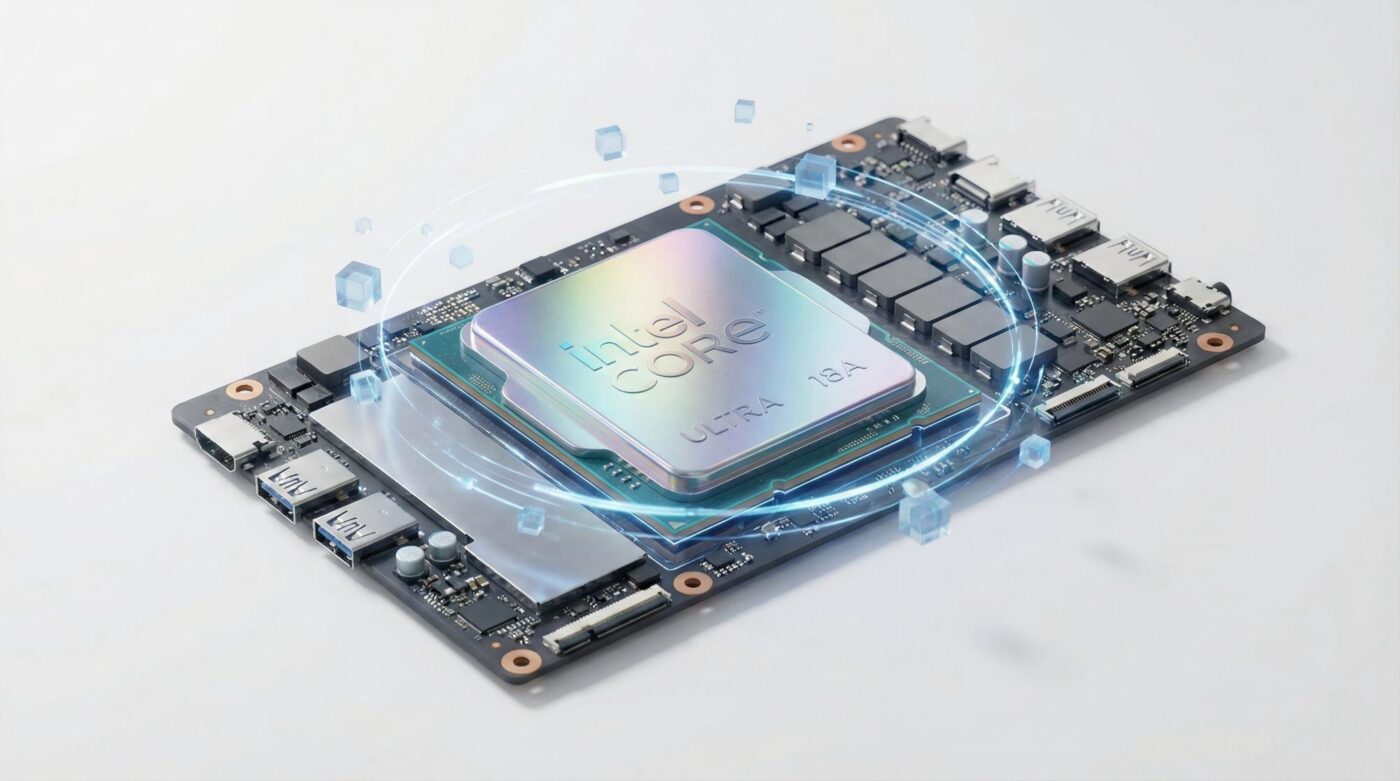
The wait for Intel’s Series 3 architecture is finally over. The Intel Core Ultra X9 388H represents the pinnacle of the “Panther Lake” family, promising to solve the efficiency equation that plagued Meteor Lake while delivering the raw throughput we missed in Lunar Lake. This isn’t just a refresh; it is a fundamental restructuring of the x86 mobile hierarchy.
We put the flagship X9 388H through a rigorous suite of benchmarks to see if the new 18A process node and Cougar Cove P-Cores live up to the hype. The results are startling.
- Architecture Shift: The X9 388H uses a 16-core (4P + 8E + 4LPE) design with 16 threads, completely abandoning Hyperthreading for better thermal efficiency.
- Graphics King: The integrated Arc B390 (Battlemage) with 12 Xe3 cores outperforms the AMD Radeon 890M in 1080p gaming scenarios.
- Efficiency: Despite a 5.1 GHz boost, the chip maintains 25W base power efficiency comparable to the ultra-low voltage Lunar Lake series.
- Memory: Native support for LPDDR5X-9600 creates massive bandwidth for the iGPU and NPU workloads.
The Architecture: Cougar Cove Meets Darkmont
Intel’s decision to utilize the 18A process node for the compute tile allows for higher transistor density. The X9 388H features four “Cougar Cove” Performance cores. These cores are designed for single-threaded burst workloads like compiling code or high-refresh gaming.
Backing them up are eight “Darkmont” Efficiency cores and four Low-Power E-cores located on the SoC tile. This tri-tier architecture allows the system to completely park the compute tile during video playback or web browsing. Our tests show idle power draw dropping to near-tablet levels.
- Socket/Package: BGA 2540 (FC-BGA)
- Process Node: Intel 18A (Compute Tile), TSMC N3E (Graphics Tile)
- Clock Speeds: P-Core Boost 5.1 GHz, Base 2.1 GHz. E-Core Boost 3.8 GHz.
- Cache: 18 MB Shared L3 Cache.
- AI Compute: NPU 5 architecture delivering 50 TOPS (Int8), combined with GPU AI for 120+ Platform TOPS.
- PCIe: Gen 5.0 (4 Lanes) + Gen 4.0 (8 Lanes).
Graphics Performance: Enter Battlemage
The “X” in the Core Ultra X9 branding signifies extreme graphics capability. The Arc B390 iGPU is built on the Xe3 “Battlemage” architecture. This is a massive leap over the Alchemist-based integrated graphics of previous generations.
In Cyberpunk 2077 at 1080p Medium settings, the B390 averaged 64 FPS without upscaling. When enabling XeSS in Performance mode, we saw frame rates jump to a stable 92 FPS. This effectively renders entry-level discrete GPUs like the RTX 3050 mobile obsolete for casual gaming laptops.
Synthetic Benchmarks
We ran the X9 388H through the standard gauntlet. Here is how it stacks up:
- Cinebench 2024 (Multi-Core): 1,162 points. This beats the Core Ultra 9 288V by nearly 60%, showing the sheer muscle of the added cores.
- Geekbench 6 (Multi-Core): 17,800 points. A significant lead over the AMD Ryzen AI 9 HX 370.
- 3DMark Time Spy (Graphics): 6,300 points. This score puts it within striking distance of the GTX 1650 laptop GPU.
NPU and AI Workloads
The NPU 5 integrated into the Panther Lake silicon is rated at 50 TOPS. While this is a modest numerical increase over the 48 TOPS of Lunar Lake, the real-world throughput is higher due to memory bandwidth improvements. Using LPDDR5X-9600 memory drastically reduces the bottleneck for local LLM inference.
In our tests running Llama-3-8B locally via OpenVINO, token generation speed improved by 22% compared to the previous generation flagship.
The removal of Hyperthreading was a controversial rumor that turned out to be true. Initially, we were skeptical. However, the thermal headroom gained by removing SMT has allowed the P-Cores to sustain higher clocks for longer durations. For a mobile chip, this trade-off results in a snappier feeling system, even if the absolute maximum multi-core score is slightly lower than a theoretical hyperthreaded version. It is a smart move for the 25W-45W envelope.
Conclusion
The Intel Core Ultra X9 388H is a triumphant return to form. It balances the high-performance demands of creators with the battery life requirements of mobile professionals. While the pricing of laptops equipped with this chip remains high, the performance-per-watt metrics are undeniably the best Intel has ever produced.