
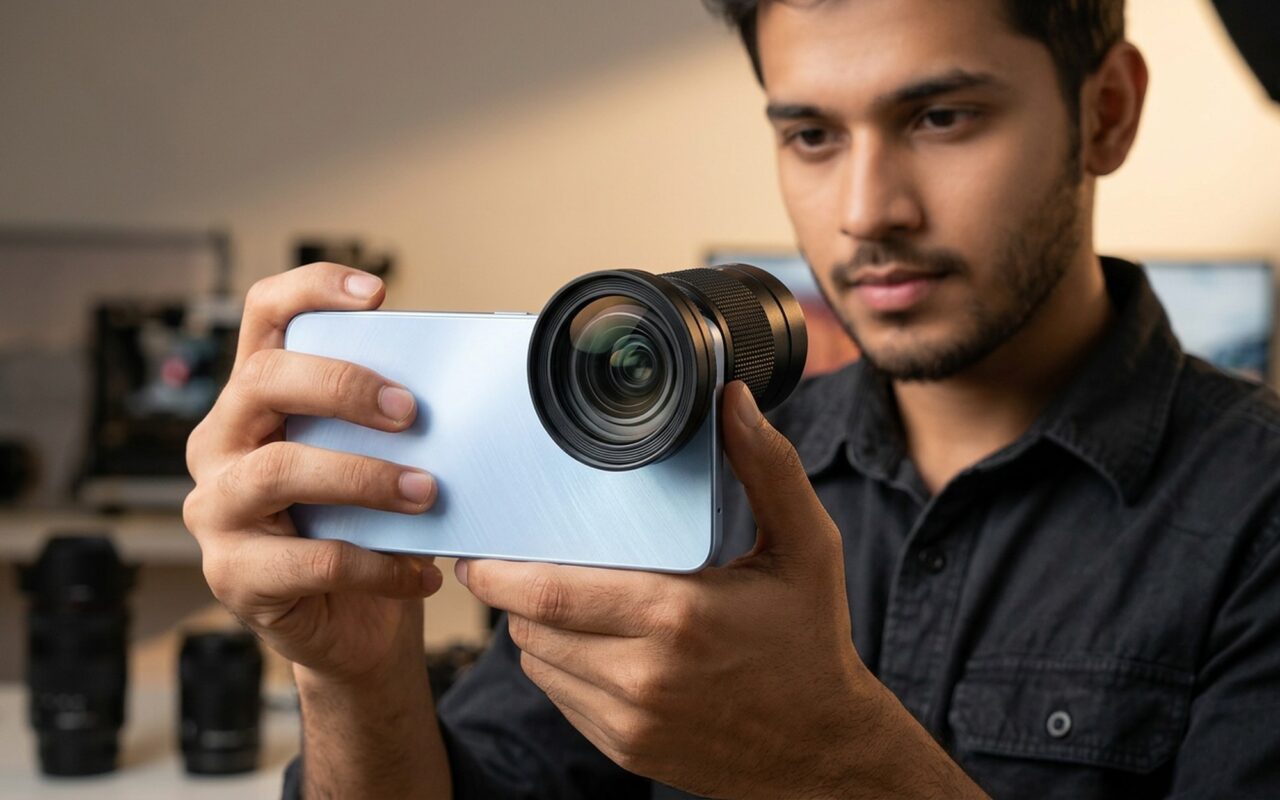
The vivo X300 Ultra is not a conventional flagship with a better zoom button. It is a modular camera phone built around a 35mm main camera, an 85mm periscope, and optional 200mm and 400mm ZEISS telephoto extenders. That hardware makes it unusually capable, but it also creates a marketing problem: vivo and reviewers use terms such as optical, lossless-resolution, in-sensor crop, hybrid zoom, and digital crop for different points on the same zoom ladder.
This is a source-led analysis, not a hands-on review. Reviewstown did not physically test the X300 Ultra. We cross-checked vivo’s current specifications and launch material against independent reviews, camera samples, and owner reports. The original page’s unsupported MWC experience claims and its confident description of a “usable 800mm focal length” have been removed.
The short answer: who should buy the vivo X300 Ultra?
The X300 Ultra makes the most sense for a serious mobile photographer or video creator who likes a 35mm default view, expects to use manual controls, and is willing to carry the Photography Kit when long reach matters. Its 200MP main and telephoto sensors, large ultrawide sensor, 4K 120fps 10-bit Log recording, and extender support form one of the broadest mobile imaging systems available.
It is harder to recommend as an ordinary premium phone. The body weighs 232g or 237g depending on color, the camera island is large, European pricing has reached about EUR 1,999, and the optional kit adds cost and bulk. Buyers outside an official sales market also need to solve network, warranty, repair, and return questions before judging the import price.
Most importantly, do not buy it because a headline says 800mm. Buy it if the native 35mm and 85mm cameras already fit how you shoot, then treat the 200mm and 400mm extenders as optional tools rather than proof that the phone replaces a dedicated camera.
What 800mm actually means on the X300 Ultra
vivo’s global product page presents a camera system that starts with built-in 14mm, 35mm, and 85mm equivalent views and expands through optional 200mm and 400mm extenders. vivo’s footnotes explicitly describe the 200mm and 400mm figures as optical focal lengths. Its March MWC announcement, distributed through PR Newswire, describes 1600mm as a digital crop.
The 800mm number is less clear. vivo’s India page uses it as a section heading, but does not give it the same optical definition as 200mm and 400mm. Android Authority’s launch coverage called it “lossless-resolution” zoom. In contrast, Digital Camera World reports that reach beyond about 170mm uses in-sensor cropping and then generative AI, with increasingly smoothed texture at longer settings. These descriptions are not equivalent.
Separate optics from cropping before judging the result
Equivalent focal length describes field of view. It does not, by itself, reveal whether the image came from native optics, an attached lens, a sensor crop, or generated detail.
The native periscope view from the 200MP telephoto camera.
An optional 2.35x ZEISS attachment that vivo defines as optical.
An optional 4.7x ZEISS attachment, also defined by vivo as optical.
Cropping and computational processing extend reach. vivo does not consistently define 800mm as optical.
This distinction does not mean every long-range image is bad. Digital Camera World found the 400mm attachment strong and described 800mm results from the extender as impressive, although sharpening became visible in fine textures. PetaPixel’s field review also found the 200mm and 400mm extenders creatively useful, while calling 1600mm hybrid zoom extreme rather than a substitute for professional wildlife glass.
The practical rule is simple. Judge 85mm, 200mm, and 400mm from full-resolution samples. Treat 800mm and 1600mm as convenience modes whose quality depends heavily on light, subject detail, movement, and processing. Text, fur, foliage, railings, and distant faces are good stress tests because invented texture becomes easier to see.
The 35mm main camera is the real buying decision
Most flagship phones use a main camera around 23mm or 24mm equivalent. The X300 Ultra starts at 35mm. That is not a small stylistic difference. It changes what fits in the frame every time the camera opens.
A 35mm view is useful for street scenes, environmental portraits, food, products, and subjects that benefit from less wide-angle exaggeration. Faces near the edge of the frame can look more natural, backgrounds appear closer, and the composition often feels deliberate without immediately switching to a telephoto camera. The 200MP 1/1.12-inch Sony LYT-901 sensor also gives vivo substantial resolution for 50mm and 70mm crops.
The cost is space. A 35mm main camera can be awkward in a small room, across a restaurant table, when filming a child at arm’s length, or when using the rear camera for a self-recorded clip. The X300 Ultra answers with a 14mm ultrawide built around a relatively large 50MP 1/1.28-inch sensor, but moving between 14mm and 35mm is still a large perspective jump. Cropping the ultrawide toward a more familiar view may work in good light, but it is not the same as having a native 23mm main camera.
Tech Advisor’s review reaches the same practical split. It praises 35mm for street photography, candid images, and portraits, while noting that it is less suitable for point-of-view video and rear-camera selfies. This is more important than whether the X300 Ultra wins a generic camera ranking. A buyer who dislikes 35mm as the default will fight the phone every day.
Camera hardware and the evidence behind it
The official global specification page lists a 200MP main camera at f/1.85, a 50MP ultrawide at f/2.0, a 200MP periscope at f/2.67, and a 50MP front camera. The built-in telephoto has an 85mm equivalent view and uses a large 1/1.4-inch sensor. All three rear cameras support optical stabilization according to vivo’s product material.
Independent reviews are broadly positive but expose real constraints. Digital Camera World found the 35mm main camera detailed, the ultrawide unusually clean, and the 85mm telephoto the strongest stills camera of the set. Android Authority praised the natural color profile but found the default vivid profile too saturated. Tech Advisor notes that the telephoto aperture is narrower than its predecessor’s, a design choice that may help extender compatibility but gives the native lens less light.
PetaPixel reports that two firmware updates changed its early camera experience. That is useful context for any launch-period comparison. It means old samples may not represent current processing, but it does not justify assuming every remaining problem has been fixed. When comparing reviews, check the publication date, firmware build, color profile, and whether the extender was attached.
Why the Photography Kit is valuable and inconvenient
The Photography Kit is more than a decorative grip. Independent reviewers describe a case, control grip, lens adapter, filter ring, straps, tripod mounting, and the optional 200mm and 400mm ZEISS extenders. PetaPixel says the grip includes physical shutter, zoom, record, and function controls plus a 2300mAh battery. Digital Camera World also notes support for 67mm filters, which matters to video creators who need an ND filter to control shutter speed in bright light.
The strongest part of vivo’s approach is software integration. Tech Advisor and PetaPixel report that the extenders work across a wide range of camera modes, including RAW capture and professional video workflows. In practice, that is more useful than an accessory that works only in a special zoom mode.
The limitations are equally concrete. The 400mm lens is large enough to change how the system is carried. Framing a moving subject at 400mm is difficult, and Tech Advisor found the live preview shakier than the processed result. Digital Camera World liked the lens bodies but found parts of the case less premium than expected. The phone and kit together also approach dedicated-camera pricing in Europe.
The correct comparison is therefore not “phone versus cinema camera.” It is “phone alone versus phone plus a specialized accessory system.” The kit is attractive for concerts, daylight sports, travel details, and occasional wildlife. A dedicated camera remains stronger when a job depends on predictable autofocus, large-sensor low-light quality, long recording sessions, interchangeable lenses, and repeatable detail without generative reconstruction.
Video tools are a stronger claim than cinema replacement
vivo’s official page lists 4K 120fps 10-bit Log recording across the rear cameras, alongside professional controls and stabilization modes. Digital Camera World found the X300 Ultra the strongest Android video phone it had used, citing manual tools, waveforms, histograms, LUT monitoring, a teleprompter, and smooth stabilization. It also notes an important workflow detail: LUTs are for preview and still need to be applied in post-production.
That feature set can reduce the equipment needed for travel video, social production, behind-the-scenes capture, and location scouting. It does not remove phone-camera limits. Fixed apertures complicate motion blur in daylight without an ND filter. Small sensors still have less natural depth separation than larger cameras. Sustained 4K or 8K capture increases heat and battery drain, and audio quality still depends on microphone placement or external equipment.
The better conclusion is that the X300 Ultra is an unusually complete mobile video tool. Calling it a cinema-camera replacement turns a defensible strength into an unsupported promise.
Performance, battery, and software caveats
The official vivo specification page lists the Snapdragon 8 Elite Gen 5, 16GB and 512GB or 1TB configurations, a 6.82-inch 3168 by 1440 display with a 1Hz to 144Hz refresh range, OriginOS 6 based on Android 16, IP68 and IP69 protection, USB 3.2, Bluetooth 6.0, and 100W wired plus 40W wireless charging. It lists a typical 6600mAh battery, while some European reviews report a 6400mAh regional version and others report 6600mAh in Europe. Buyers should check the exact local SKU rather than copy one capacity across every market.
Battery experience also varies by workload. Tech Advisor generally reached the end of a day and often the following morning. Android Authority reported much longer typical endurance. Camera use, high-resolution processing, mobile signal quality, display settings, and extended video recording can easily explain part of that spread. Neither result guarantees the same outcome for a creator shooting an event.
OriginOS 6 ships on both Chinese and global variants according to vivo’s specification page and current independent reviews. The global model is the safer choice when available because network certification, Google integration, regional services, warranty handling, and resale are easier to verify. A cheaper Chinese import can still be rational for an experienced buyer, but a retailer installing Google services is not equivalent to an officially supported regional model.
Owners report issues worth testing during the return window, including notification behavior, software limitations, heat during intensive use, and camera processing changes after firmware updates. A month-long ownership discussion focuses on OriginOS frustrations, while a video-focused owner report documents specific workflow complaints from a filmmaker. These Reddit reports are anecdotal rather than proof of a universal defect. However, their value is as a checklist: test your banking apps, Android Auto, wearables, notifications, eSIM, carrier features, hotspot, camera modes, and preferred cloud workflow before the return period closes.
Global availability, network bands, and warranty risk
The X300 Ultra is vivo’s first Ultra model with a broad international release, but “global” does not mean every country. It remains unavailable through normal official channels in the United States and United Kingdom, while selected European and Asian markets have official sales. Price, storage, battery capacity, included charger, eSIM combinations, and warranty terms can vary by market.
The global parameter page lists broad LTE and 5G support, including B71 and n71, but that table should not be assumed to cover a Chinese import. A retailer band list may describe a different model number. Even when radio bands overlap, carrier whitelisting, voice over LTE, Wi-Fi calling, visual voicemail, emergency calling, and eSIM activation can fail independently.
Before importing, ask the seller for the exact model number and obtain its band list in writing. Confirm who pays return shipping, where warranty repairs occur, whether an opened device can be returned, and whether local taxes are included. Compare that total with an officially sold alternative such as the Samsung Galaxy S26 Ultra, not only with the X300 Ultra’s Chinese retail price.
A practical buyer decision framework
Choose the camera workflow before choosing the phone
The X300 Ultra is strongest when its unusual focal lengths and modular accessories match a real shooting habit.
Best for people who want 35mm street and portrait framing plus a strong native 85mm telephoto.
A more portable option for concerts, travel details, and compressed landscapes.
Useful when reach matters enough to justify a larger lens, steadier technique, and extra carrying space.
Better if you need a familiar 23mm main view, official local support, a smaller body, or simpler automatic photography.
Final assessment
The vivo X300 Ultra is one of the most ambitious camera-phone systems available in 2026. Its strongest advantages are not an undefined 800mm label. They are the native 35mm perspective, the large 85mm telephoto sensor, the unusually capable ultrawide, professional video controls, and the option to add real 200mm or 400mm optics.
Those advantages come with a narrow fit. The 35mm default can be restrictive indoors, the phone is heavy, the complete kit is expensive, and importing creates support risk. Processing at very long focal lengths also needs careful scrutiny because official and independent descriptions do not agree on where cropping ends and generated detail begins.
For a creator who understands those compromises, the X300 Ultra can replace several casual travel and mobile-production tools. For everyone else, it is better understood as a specialized camera phone than a universal flagship, and certainly not as a guaranteed replacement for a dedicated camera system.
- Distinctive 35mm main camera with a large 200MP sensor
- Strong native 85mm periscope and unusually capable ultrawide camera
- Optional 200mm and 400mm ZEISS optical extenders
- Advanced 4K 120fps 10-bit Log video tools across the rear cameras
- Photography Kit supports physical controls, filters, RAW capture, and professional video modes
- 800mm marketing is not consistently defined as optical by vivo
- The 35mm default view can be restrictive indoors and for self-recording
- Large camera island and 232g to 237g body reduce everyday comfort
- European pricing and optional accessories make the complete system expensive
- Import buyers face model-specific network, warranty, repair, and return risks
Frequently Asked Questions
Does the vivo X300 Ultra have 800mm optical zoom?
vivo explicitly defines the optional 200mm and 400mm extender settings as optical focal lengths, but it does not consistently give 800mm the same definition. Independent reviews describe longer settings as involving sensor cropping and computational processing.
What is unusual about the vivo X300 Ultra main camera?
Its main camera uses a 35mm equivalent view instead of the roughly 23mm or 24mm view common on flagship phones. That can improve street, portrait, food, and product framing, but it fits less into the frame indoors or at arm’s length.
What is included in the vivo X300 Ultra Photography Kit?
Contents vary by package and market, but reviewed kits combine a phone case, control grip, mounting hardware, filter support, straps, and compatibility with optional 200mm and 400mm ZEISS extenders. Verify the retailer’s exact bundle before ordering.
Is the vivo X300 Ultra available in the United States or United Kingdom?
It is not normally sold through official channels in either market. Importing is possible, but buyers must verify the exact model’s network bands, carrier activation, eSIM behavior, warranty location, tax treatment, and return terms.
Can the vivo X300 Ultra replace a dedicated camera?
It can replace several casual travel and mobile-production tools for the right creator, especially with an extender. A dedicated camera remains more predictable for large-sensor image quality, long recording sessions, interchangeable lenses, autofocus, and detail without computational reconstruction.