
The “Weird” Earbud Era
We are living through a strange time for headphones. You have likely seen them in the wild: people walking around with what look like large plastic earrings clamped to the side of their heads. These are “clip-on” open-ear buds, and until now, they have mostly been the domain of niche brands or budget knock-offs.
Then Sony entered the chat.
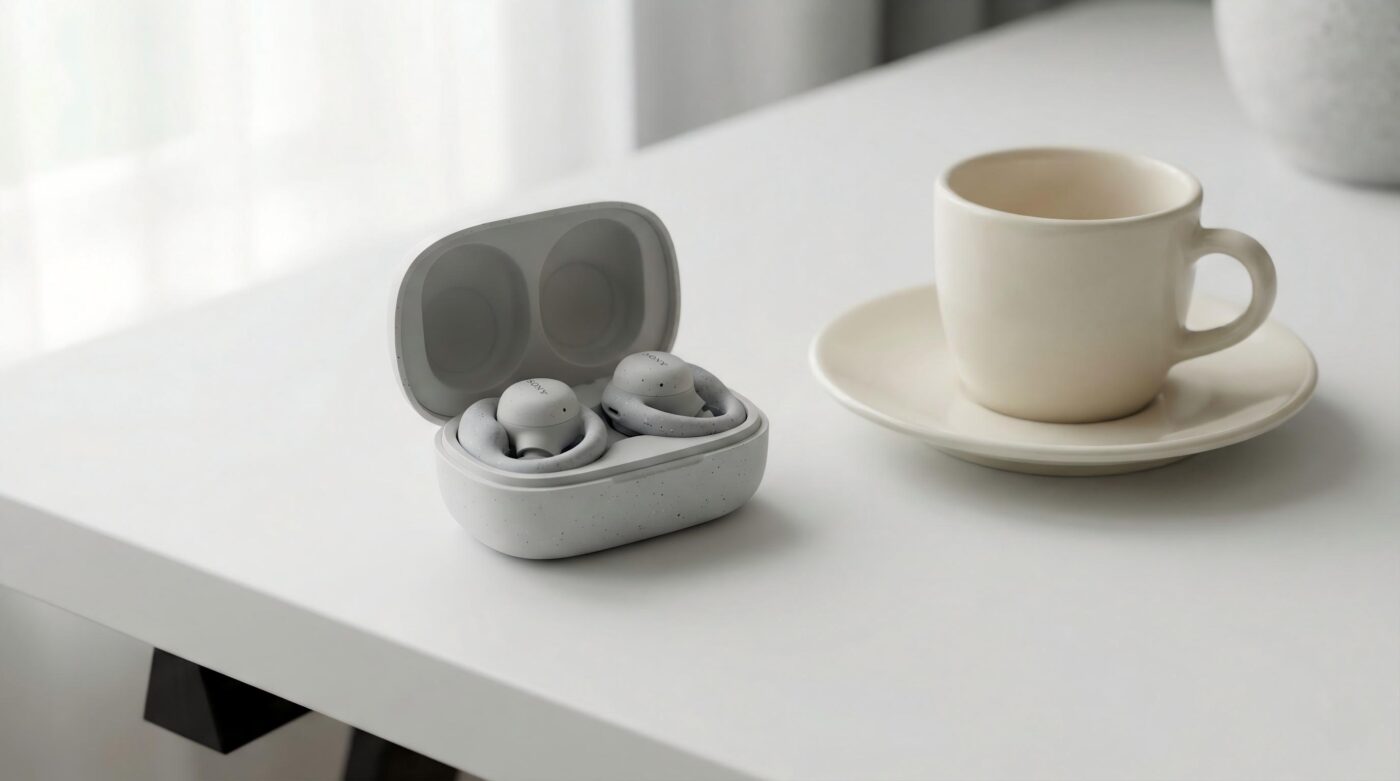
The LinkBuds Clip is Sony’s attempt to legitimize this form factor. It is not just another plastic clamp; it is a calculated, over-engineered answer to the Bose Ultra Open and the Huawei FreeClip. I spent the last week wearing them to see if Sony solved the two problems that plague this entire category: they usually hurt, and they usually sound like tin cans.
The Goldilocks Fit (and the “Spirit Pillow”)
Clip-on earbuds rely on a simple friction mechanism. A flexible bridge connects the battery (situated behind your ear) to the speaker (positioned in front). The challenge is balance: if the bridge is too tight, it causes pain. If it is too loose, you risk losing them on the subway.
Sony’s solution is the “C-bridge.” It is less floppy than the Bose version but softer than the ambie clamps, sitting right in the middle of the comfort spectrum.
Solving the “One Size” Problem
Here is the clever part: Sony knows ears are not one-size-fits-all. They included a silicone adapter they call the “Spirit Pillow” (a rough translation, but let’s go with it). It is a small cushion you can attach to the bridge to narrow the gap.
If you have thin ears, standard clips usually wobble. With the cushion, these stay locked in without digging into cartilage. I tested this on a friend with thinner ears who hates clip-ons. She actually forgot she was wearing them after ten minutes. That is a win.
Sound Quality: Fighting Physics
Let’s be real: You cannot cheat physics. These are 10mm drivers hovering outside your ear canal. You will not get sub-bass that rattles your skull.
Out of the box, the sound profile is distinctively bright. Sony tuned these for clarity rather than impact. Vocals and strings are sharp, perhaps almost too sharp at times. If you listen to podcasts or acoustic tracks, they shine because the detail is there.
However, if you throw a bass-heavy hip-hop track at them, the energy evaporates. It is better than the cheap alternatives, but it lacks the warmth you get from the Bose Ultra Open.
- Driver Size: 10mm (Open-ring driver unit)
- Bluetooth: Version 5.3
- Software Tricks: “Leak Suppression” mode. This aggressively cuts mid-high frequencies to stop your coworker from hearing your music. It works, but it destroys the audio quality. Use it only when necessary.
The Secret Weapon: Call Quality
Here is where the LinkBuds Clip earns its price tag. The call quality is absurdly good for an open-ear device.
Most open earbuds pick up everything around you. Sony used a bone conduction sensor combined with their microphone array to isolate your voice.
I took a call on a windy street corner to test the limits. The person on the other end had no idea I was outside. If you spend your day in Zoom meetings or taking calls while walking the dog, this feature alone might be worth the entry price.
The “Sony” Frustrations
For $229.99, there are some glaring omissions that are hard to ignore.
- No Wear Detection: If you take them off, the music keeps playing. In 2026, on a premium product, that is inexcusable.
- Limited Codec Support: Support is limited to SBC and AAC. There is no LDAC and no LC3. For a company that prides itself on “High-Res Audio,” this feels lazy. You are paying a premium for the form factor and the brand, not the bitrate.
- Charging Speed: The speeds are slow unless you use the 3-minute quick charge feature.
Battery Life Performance
Battery life is decent. I got just under 8 hours of continuous playback, which lines up closely with Sony’s 9-hour claim (without advanced features running). The case gives you another 28 hours. It is enough for a week of commuting.
Verdict
The LinkBuds Clip is a specific tool for a specific person. If you want immersive sound, buy the WF-1000XM5. If you want bass in an open format, buy the Bose.
But if you need a headset you can wear for eight hours straight, take clear calls on, and forget is even there? This is the one. The “Spirit Pillow” fit system makes it the most adaptable clip-on market, and the microphone performance is in a league of its own. Just don’t expect it to rock your world when the beat drops.
Score: 7/10
The Good:
- Best-in-class fit for different ear shapes (thanks to the adapter).
- Incredible microphone performance (Bone conduction helps).
- Solid connection stability (Bluetooth 5.3).
- Unique “Leak Suppression” mode for offices.
The Bad:
- No auto-pause/wear detection.
- Sound is thin on bass.
- Expensive ($230) for the feature set.
- No High-Res codecs (SBC/AAC only).

- Redmi Buds 8 Pro Review 2026: Good ANC, Poor Battery - March 2, 2026
- Sony LinkBuds Clip Review: Finally, a Clip-On Earbud That Actually Fits? - February 21, 2026
- Samsung Galaxy Z TriFold Review: A 10-Inch Canvas With a Heavy Flaw - February 12, 2026