
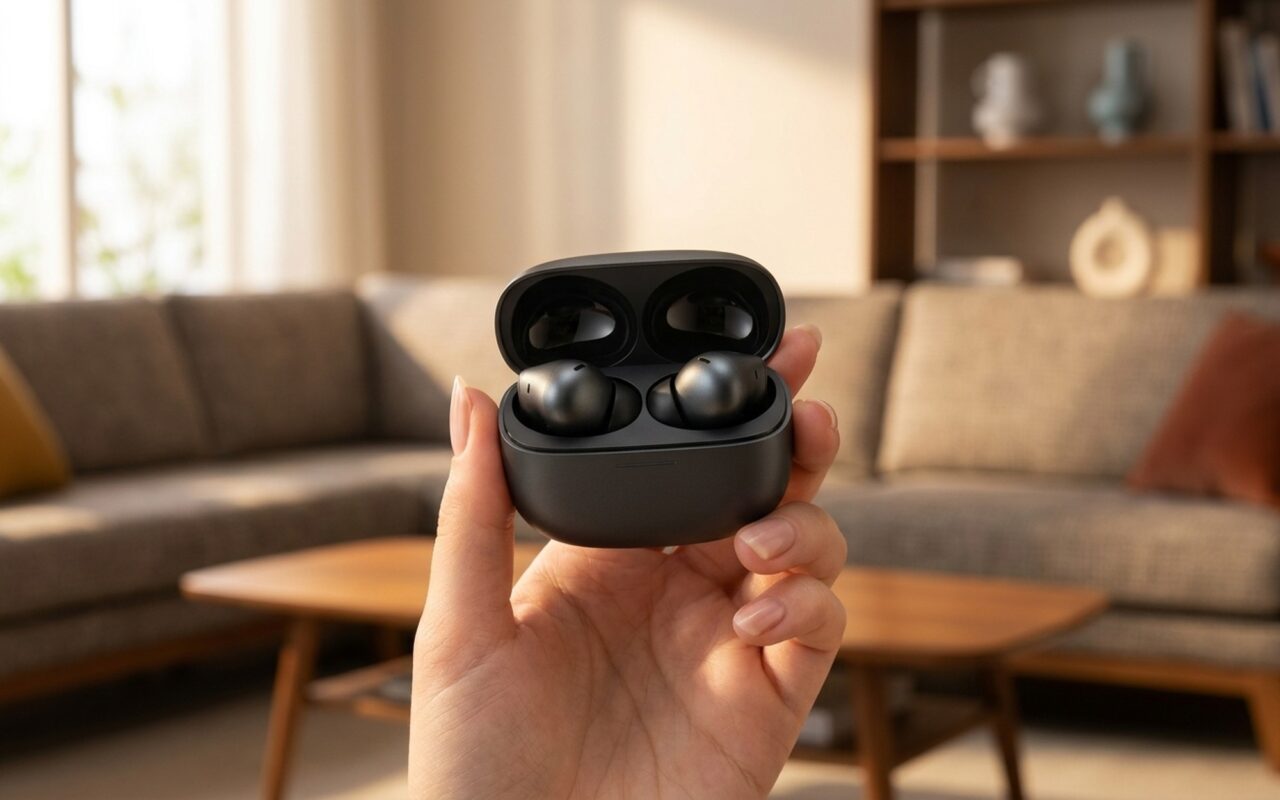
The Redmi Buds 8 Pro launched globally in early 2026 as Xiaomi’s answer to a clear market gap: ANC earbuds that genuinely work, priced for people who refuse to spend $250 on AirPods. At roughly $69-79 USD, they deliver noise cancellation that independent tests score identical to the AirPods Pro 3. The battery story is not as clean.
This review covers everything: ANC performance data, sound quality and EQ recommendations, real-world battery figures, and a direct comparison against the EarFun Air Pro 4+ and OnePlus Buds 4 so you can decide whether these belong in your ears in 2026.

Design and Comfort
The Redmi Buds 8 Pro use a stem-style design available in three colorways: Glacier Blue, Obsidian Black, and Cloud White. The earbuds weigh in at a lighter side of the category, and the three included ear tip sets cover most ear canal sizes. Most users with average ear anatomy report solid passive isolation and a secure fit during commutes.
The case is compact and rectangular with a USB-C port at the bottom. One omission that stands out in 2026: there is no wireless charging. Given that earbuds at this price from EarFun and Nothing now include Qi charging, this feels like a cost cut that Xiaomi should reconsider for the next generation.
Durability is IP54 certified for the earbuds themselves, meaning they handle sweat and light rain without complaint. The case has no water resistance rating, so keep it out of your gym bag’s wet pocket.
Full Specs at a Glance
| Specification | Detail |
|---|---|
| Drivers | 11mm titanium dynamic + dual 6.7mm PZT tweeters |
| Bluetooth | 5.4 |
| Codecs | LDAC, AAC |
| ANC | Up to 55dB, 20Hz-5kHz bandwidth |
| Battery (ANC on) | 4.5h per charge / 16h total |
| Battery (ANC off) | 8h per charge / 33h total |
| Fast Charge | 5 min = 2h playback |
| Water Resistance | IP54 (earbuds) |
| Multipoint | Yes (2 devices) |
| App | Xiaomi Earbuds (Android / iOS) |
One spec correction from earlier versions of this article: the global model uses LDAC, not LHDC-V. LHDC-V is found on Chinese domestic hardware. If you purchased from an international retailer, you are running LDAC.
ANC Performance: The Headline Feature
The 55dB ANC depth covers frequencies from 20Hz to 5kHz, a noticeably wider range than the Redmi Buds 6 Pro, which topped out at 4kHz. That extra 1kHz of coverage makes a practical difference in handling the higher-pitched drone of office HVAC systems and bus engines.
In structured tests published by Scarbir, the Buds 8 Pro scored 18 out of 20 points across five noise categories: static hum, traffic, shopping mall chatter, and even snoring. That 18/20 score matches the $250 AirPods Pro 3 in the same testing framework.
Wind noise handling is a genuine standout. The algorithm detects wind within approximately three seconds and automatically dampens the external microphones, without requiring the user to switch modes manually. Competing earbuds at this price typically demand a manual toggle.
For daily commuters on metros, trains, or buses, the noise cancellation performs above expectations at every turn. Office and café ambient noise is handled cleanly at ANC levels 12-15 out of 20. Maximum level 20 is available for aircraft, but adds noticeable ear pressure during longer sessions.
Sound Quality: Warm, Deep, and Worth EQ Attention
The coaxial triple-driver setup (one 11mm titanium dynamic driver handling bass and mids, dual 6.7mm PZT ceramic tweeters covering highs) creates a warm, dark tuning profile with boosted sub-bass and restrained upper treble.
The sub-bass performance is a genuine surprise at this price. Low-frequency content in electronic music, hip-hop, and cinematic scores has real texture and depth, not just volume. The 11mm titanium diaphragm reaches lower and with more physical impact than most single-driver competitors under $100.
The weakness shows in the lower midrange. The boosted bass energy bleeds upward into the 200-400Hz range, where male vocals and lower guitar body sit. Voices can sound slightly thick in back-to-back comparison with more neutrally tuned competitors like the Nothing Ear (a). For music-first listeners, the Xiaomi Earbuds app’s custom EQ (reducing 63Hz and 125Hz by 2-3dB) brings vocal clarity forward without losing the impressive bass floor.
Spatial audio through Dolby Audio with dynamic head-tracking adds width, though the effect leans toward a closed, enveloping character rather than an open, airy stage. If soundstage is your priority, it helps to understand how headphone soundstage actually works before setting expectations for in-ear monitors at any price.
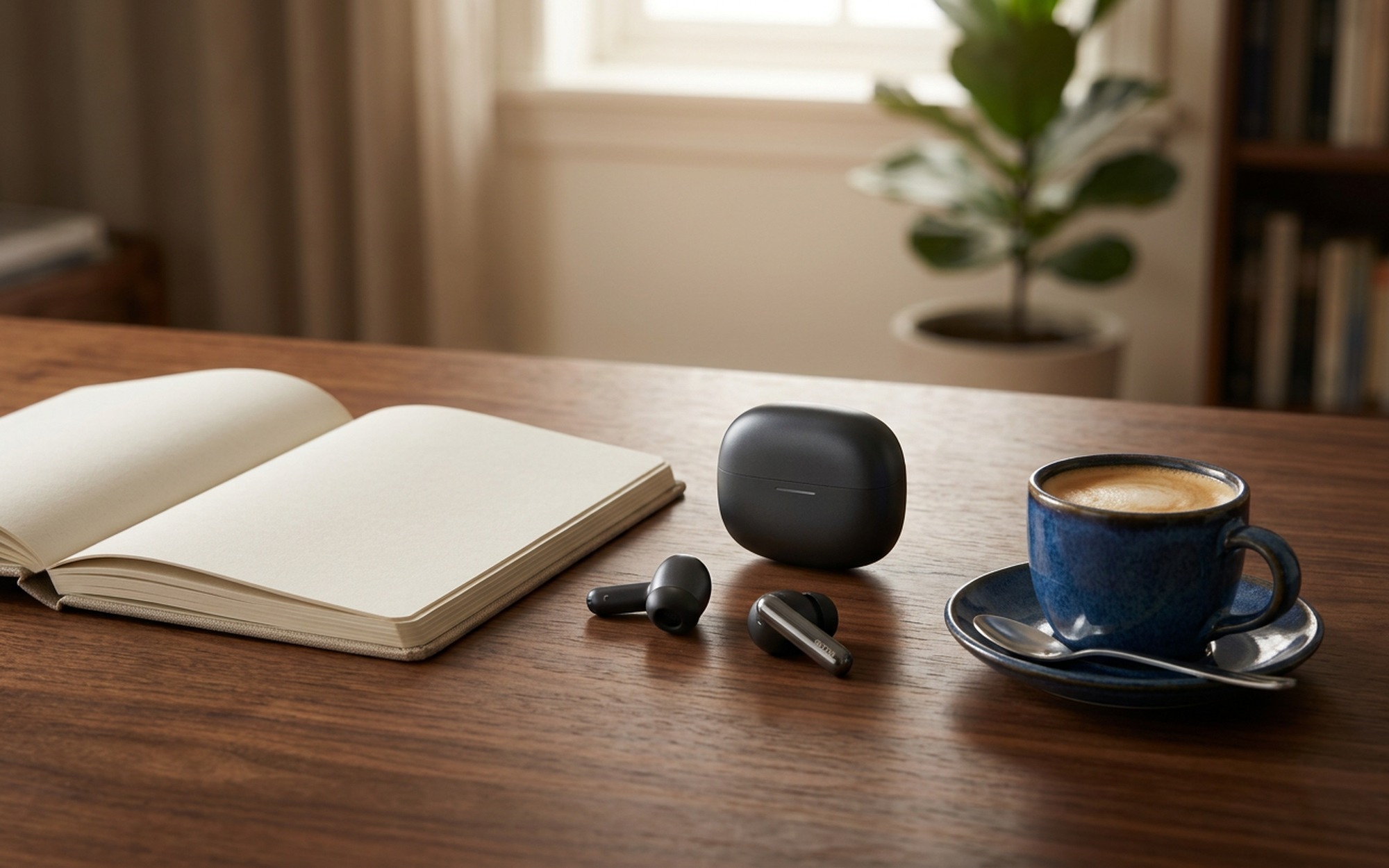
Battery Life: The Real-World Picture
This is where the Redmi Buds 8 Pro falls short, and the gap is meaningful in 2026.
With ANC enabled: 4.5 hours per charge, roughly 16 hours total with the case. With ANC off: 8 hours per charge, up to 33 hours total. These are not the worst numbers ever seen in earbuds, but rivals at a similar price have moved significantly ahead:
- EarFun Air Pro 4+: 9 hours ANC on, 45+ hours total
- OnePlus Buds 4: 7 hours ANC on, 35 hours total
- Nothing Ear (a): 6 hours ANC on, 30 hours total
For most commuters who use earbuds 2-3 hours per day and charge the case nightly, 4.5 hours per charge is workable. For long-haul travelers, remote workers, or anyone who regularly forgets to charge, the short battery is a genuine problem that no amount of ANC performance compensates for.
The fast-charge feature partially softens this: five minutes of charging in the USB-C case delivers two hours of playback. That is a legitimate lifeline when you realize at 7am that the case is empty.
App and Customization
The Xiaomi Earbuds app (available for Android and iOS) provides one of the more capable customization suites in the budget segment:
- ANC strength slider with 20 discrete levels
- Transparency mode strength control
- Three ambient sound options (rain, wind chimes, birds) to layer under ANC
- Fully remappable touch controls per earbud
- Four built-in EQ presets plus custom five-band EQ
- Dolby Audio toggle (though LDAC mode on Android forces Dolby on)
The Dolby Audio limitation is worth flagging for Android users: if your phone connects via LDAC, the app locks Dolby spatial processing on. This affects the soundstage character described above. iOS users and Android users connecting via AAC do not face this restriction.
Google Fast Pair is supported for Android, making initial setup a single tap. Dual-device multipoint works reliably for switching between a phone and laptop, with audio resuming on the active source within two seconds.
Redmi Buds 8 Pro vs Competitors
| Earbuds | Price | ANC Battery | ANC Score | Notable Edge |
|---|---|---|---|---|
| Redmi Buds 8 Pro | ~$70 | 4.5h | 18/20 | Strongest ANC depth |
| EarFun Air Pro 4+ | ~$89 | 9h | Lower | Nearly 2x battery |
| OnePlus Buds 4 | ~$100 | 7h | Moderate | 10-min case recharge |
| Nothing Ear (a) | ~$109 | 6h | Good | Cleaner mids, open fit |
| AirPods Pro 3 | $249 | 6h | 18/20 | Full Apple ecosystem |
The Samsung Galaxy Buds 4 Pro is another benchmark in this space: rated at 84% average attenuation and purpose-built for Samsung ecosystem features. At $249 it sits above the Redmi’s price bracket, but if you are on Samsung hardware and the budget can stretch, it outperforms on ecosystem integration. For Android users not locked into Samsung or Apple, the Redmi Buds 8 Pro represents the strongest pure ANC argument under $80.
Who Should Buy the Redmi Buds 8 Pro?
Buy them if:
– You commute daily on public transport and noise cancellation is your top priority
– Your listening sessions run under four hours before you return to a charger
– You want LDAC Hi-Res audio and Dolby spatial audio at a budget price
– You are already in the Xiaomi ecosystem
Skip them if:
– You need 6+ hours of ANC battery without touching the case
– You prefer a neutral, vocal-forward sound signature
– Wireless case charging is non-negotiable for your workflow
If the Redmi Buds 8 Pro pairing with Xiaomi hardware appeals to you, the Xiaomi Book Pro 14 (2026) is worth a look as a companion device. The LDAC connection between the two stays stable and the latency in multipoint mode is noticeably lower than on third-party hardware.
Verdict
The Redmi Buds 8 Pro is the best budget ANC earbuds you can buy in 2026, as long as battery life is not your dealbreaker. The 55dB noise cancellation is a genuine engineering achievement at $70, the bass texture punches well above the price, and the fast-charge feature keeps the short battery from being a daily disaster.
The 4.5-hour ANC runtime is the product’s honest limitation. Xiaomi did not hide it: they built excellent noise cancellation and trimmed the battery budget to hit the price. Whether that tradeoff works depends entirely on how you use earbuds day to day. For most urban commuters, the answer is yes. For everyone else, the EarFun Air Pro 4+ offers better balance.
For full specifications and current pricing, see the official Redmi Buds 8 Pro product page.
- 55dB ANC matches AirPods Pro 3 in independent testing (18/20 score)
- Exceptional sub-bass depth and texture for the price
- LDAC Hi-Res Audio Wireless and Dolby Audio support
- 5-minute fast charge delivers 2 hours of playback
- IP54 dust and water resistance
- 20-level ANC slider plus wind noise auto-detection
- Dual-device multipoint connection
- Only 4.5 hours battery with ANC on (lowest in class at this price)
- No wireless charging for the case
- Warm, bass-heavy tuning bleeds into lower vocal frequencies
- Android LDAC users cannot disable Dolby Audio spatial processing
Frequently Asked Questions
Is the Redmi Buds 8 Pro worth buying in 2026?
Yes, for one specific type of buyer: someone who commutes daily and needs strong ANC on a tight budget. The 55dB noise cancellation is genuinely class-leading at this price, matching the $250 AirPods Pro 3 in independent ANC tests. If you spend more than four hours per day away from a charging case, the 4.5-hour ANC battery makes it a difficult choice against rivals like the EarFun Air Pro 4+, which lasts nearly twice as long per charge.
What is the real-world battery life of Redmi Buds 8 Pro with ANC on?
With ANC active, expect around 4.5 hours per charge and approximately 16 hours total including the charging case. With ANC off, official figures reach 8 hours per charge and up to 33 hours total. Fast charging helps: five minutes in the case gives two hours of listening. The battery weakness is real but manageable if you charge the case nightly.
How does Redmi Buds 8 Pro ANC compare to AirPods Pro 3?
Independently tested by Scarbir, the Redmi Buds 8 Pro scores 18 out of 20 on ANC performance, identical to the Apple AirPods Pro 3 which costs $250. The Redmi earbuds cover 20Hz to 5kHz of noise reduction bandwidth and automatically detect wind within three seconds, then suppress microphone pickup. The AirPods Pro 3 outperform in ecosystem features and battery life, but the core noise cancellation depth is genuinely comparable.
What are the best EQ settings for Redmi Buds 8 Pro sound quality?
In the Xiaomi Earbuds app, the default Balanced preset delivers the most accurate midrange but can feel overwhelming in bass-heavy genres. The Enhance Bass preset maintains depth without pushing the low end further. For vocal clarity in podcasts or spoken audio, reduce the 63Hz and 125Hz bands by 3dB in the custom EQ. Android users on LDAC should note that Dolby Audio spatial processing cannot be turned off in this mode, which adds a slight cave-like reverb to the soundstage.
How does Redmi Buds 8 Pro compare to EarFun Air Pro 4+?
Both sit in the $60-100 budget ANC bracket, but they prioritize different strengths. The Redmi Buds 8 Pro wins on ANC depth (18/20 vs lower for EarFun) and sub-bass texture. The EarFun Air Pro 4+ wins on battery life (9 hours with ANC vs 4.5 hours), making it better for full-day use. Choose Redmi if commute noise is your main concern; choose EarFun if you need all-day battery without worrying about case recharges.