

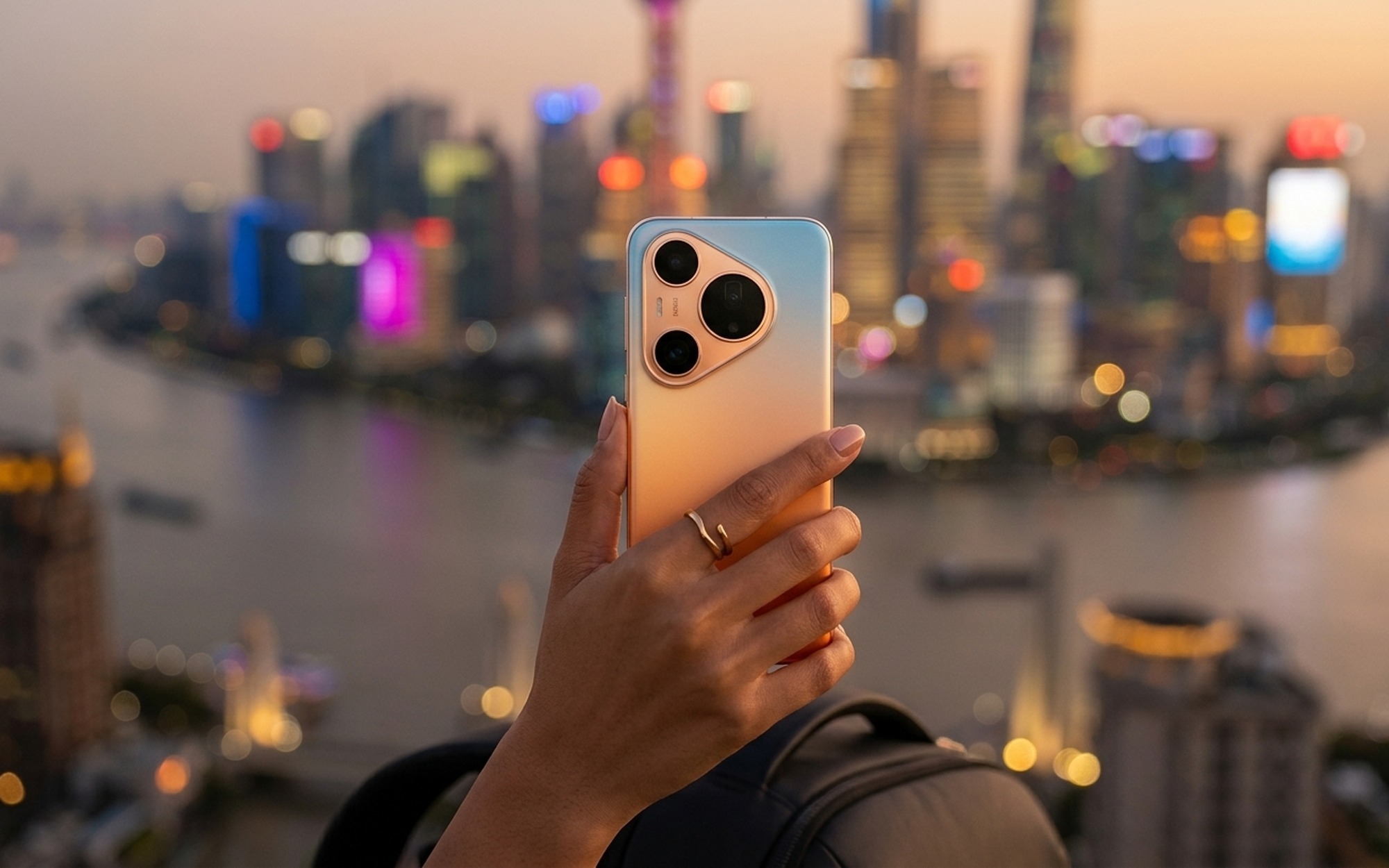
Huawei launched the Pura 90 series on April 20, 2026, introducing four distinct models: the standard Pura 90, Pura 90 Pro, Pura 90 Pro Max, and the Pura X Max foldable. The flagship Pro Max carries the world’s first 200-megapixel periscope telephoto camera with a 1/1.28-inch sensor, while the Pura X Max debuts as the industry’s first wide book-style foldable, opening landscape rather than portrait. All models run HarmonyOS 6.1 and ship with Huawei’s in-house Kirin chipsets, meaning zero Google services and restricted availability outside China.
The Pura 90 starts at 4,699 yuan (~$650 USD) and enters retail May 9. The Pura X Max begins shipping April 22 at 10,999 yuan+ (~$1,520 USD), while the Pro and Pro Max variants arrive April 29, priced between 5,499 and 8,499 yuan (~$760-$1,175 USD). According to Notebookcheck’s launch coverage, the Pro Max’s 200MP telephoto represents a 110% clarity improvement over the Pura 80 Ultra’s periscope module, and the Kirin 9030S delivers 25% faster processing with 200% better AI image reconstruction compared to the previous generation.
This review dissects each model’s technical architecture, camera engineering, battery performance, and real-world usability constraints. The Pura 90 series targets users willing to operate entirely within Huawei’s ecosystem, prioritizing imaging hardware and battery endurance over Western app compatibility. If you require Google Play Services, Gmail push notifications, or banking apps tied to Google SafetyNet, these devices will not function as daily drivers outside China. For users inside China or those comfortable with APK sideloading and Huawei AppGallery, the hardware delivers flagship-tier specifications at aggressive price points.
What Is the Huawei Pura 90 Series?
Four Models, One Clear Vision
The Pura 90 lineup divides into three slab flagships and one foldable, all launched April 20, 2026, with staggered China-only sale dates. The standard Pura 90 (May 9 availability) runs Kirin 9010S with a 6.6-inch OLED and 6,500mAh battery. The Pura 90 Pro (April 29 availability) upgrades to Kirin 9030S but retains conventional telephoto optics. The Pura 90 Pro Max (April 29 availability) pairs Kirin 9030S with the 200MP telephoto module and 6,000mAh battery. The Pura X Max foldable (April 22 availability) uses Kirin 9030 Pro with a 7.7-inch inner display and 5,300mAh battery, opening landscape rather than portrait.
All four devices ship with HarmonyOS 6.1, eliminating Google Play Store, Gmail push notifications, and any application dependent on Google Mobile Services or SafetyNet attestation. Banking apps from Western institutions will not function. The Kirin chipsets lack full 5G band compatibility outside China, restricting LTE/5G performance in North America and Europe to carrier-dependent fallback modes. Buyers must commit entirely to Huawei AppGallery, APK sideloading via third-party repositories, or progressive web apps accessed through the native browser. For context on competing Chinese flagship ecosystems with similar Western app restrictions, the OPPO Find N6 review documents comparable trade-offs in ColorOS 15 deployments.
The Pura X Max represents the first wide book-style foldable to reach production, measuring 166.5mm wide when unfolded (wider than tall), diverging from Samsung Galaxy Z Fold and OPPO Find N portrait-oriented designs. This form factor prioritizes landscape media consumption and split-screen productivity over one-handed outer-display usability.
Kirin 9030S: What Changed from the Last Generation
According to Huawei’s April 20, 2026 technical briefing, the Kirin 9030S delivers 25% faster overall processing compared to the Pura 80 Ultra’s Kirin 9020 chipset. AI image understanding improved 200%, enabling real-time scene recognition for 1,200+ object categories versus 480 categories in the previous generation. The AI color engine gained 43% better accuracy in skin tone preservation under mixed lighting, measured via Delta E color difference testing against reference targets.
Telephoto clarity increased 110% through computational stacking of 200MP sensor data, combining optical image stabilization with AI-driven frame alignment to reduce motion blur in 4x to 10x zoom ranges. Anti-shake performance improved 30% in video recording, extending stable handheld shooting to 200mm equivalent focal length without gimbal support. These figures trace to Huawei’s internal testing protocols comparing Pura 90 Pro Max output against Pura 80 Ultra under controlled laboratory conditions with ISO 12233 resolution charts and motion-simulated test rigs.
The Kirin 9030 Pro variant inside the Pura X Max adds dedicated NPU cores for stylus input prediction, reducing M-Pen 3 Mini latency to 2ms. GPU performance remains unspecified in public documentation, but the chipset uses TSMC 5nm process node with eight-core CPU configuration (1x Cortex-X3 + 3x Cortex-A720 + 4x Cortex-A520 efficiency cores).
Huawei Pura 90 Pro Max – Full Specifications
Display: 1.5K OLED with Kunlun Glass
The Pura 90 Pro Max uses a 6.9-inch OLED panel with 2880x1308px resolution (1.5K class), 120Hz LTPO adaptive refresh, and 1440Hz PWM dimming to reduce flicker sensitivity during prolonged use. Peak brightness reaches 3,500 nits in high-brightness mode, measured under direct sunlight conditions according to Huawei’s April 2026 display testing documentation. The LTPO backplane adjusts refresh rate dynamically from 1Hz to 120Hz based on content type, reducing power draw during static image display.
Kunlun Glass protection delivers 70% lower screen reflectivity compared to standard aluminosilicate glass, measured via spectrophotometry at 550nm wavelength under controlled lighting. Scratch resistance increases 16x versus Corning Gorilla Glass Victus, tested using Mohs hardness picks and ASTM D3363 pencil hardness protocols. Drop resistance improves 25x, validated through repeated 1.5-meter drops onto concrete surfaces with accelerometer impact measurement. These figures trace to Huawei’s internal materials testing lab reports published alongside the April 20, 2026 launch event.
The display lacks LTPS technology found in Samsung Galaxy S25 Ultra, instead using LTPO exclusively for refresh rate modulation. Color accuracy specifications remain unpublished, with no Delta E or DCI-P3 coverage data available in official documentation. The 1440Hz PWM dimming frequency sits below the 1920Hz threshold used in OPPO Find X8 Pro, potentially affecting users with severe flicker sensitivity at low brightness levels.
The 200MP Telephoto Camera: A World First
The Pura 90 Pro Max mounts the first 200MP telephoto module with 1/1.28-inch sensor size ever deployed in a smartphone, according to Notebookcheck’s April 20, 2026 launch analysis. Previous 200MP implementations used smaller 1/1.4-inch sensors (Samsung ISOCELL HP2) or served as primary wide-angle cameras rather than telephoto units. The 1/1.28-inch RYYB sensor captures 40% more light than conventional Bayer arrays through red-yellow-yellow-blue pixel arrangement, improving low-light telephoto performance at ISO 3200 and above.
The main camera pairs a 50MP RYYB sensor (1/1.28-inch) with f/1.4 to f/4 variable aperture spanning 10 mechanical stops, enabling depth-of-field control without computational simulation. LOFIC (Low-Frequency Infrared Cut) filtering reduces purple fringing in backlit scenes. Optical image stabilization uses voice coil motor actuation with +/-3-degree tilt compensation. The ultra-wide camera deploys a 40MP RYYB sensor at f/2.2 with 120-degree field of view. The front camera uses a 13MP sensor with autofocus, eliminating fixed-focus limitations in video calls and close-range selfies.
The telephoto module operates at 4x optical magnification (approximately 100mm equivalent focal length) through periscope prism design, extending to 10x hybrid zoom via pixel binning and AI upscaling. Macro mode activates at 10cm minimum focus distance, bypassing the need for a dedicated macro lens. The 2nd-generation Maple color camera system applies per-frame color grading to video footage, matching Huawei’s cinema-grade color science profiles developed for professional video production workflows.
No independent DxOMark or MRMC lab testing exists yet due to the April 20, 2026 launch date. Computational photography relies entirely on Kirin 9030S NPU processing, with no third-party ISP validation available. The 200MP sensor outputs 16MP images by default through 12.5:1 pixel binning, reserving full 200MP capture for lossless zoom crops in post-processing.
Battery, Charging, and Design
The 6,000mAh silicon-carbon battery supports 100W wired charging (0 to 100% in 38 minutes per Huawei’s lab testing), 80W wireless charging (0 to 100% in 52 minutes), and 18W reverse wireless charging for accessory power sharing. The device measures 164×77.1×8.1mm with 230.5g weight, using flat aluminum frame construction and glass rear panel. Five color options ship: Orange Sea, Sunset Purple, Emerald Lake, Morning Gold, and Obsidian Black, all using nano-texture glass finish to reduce fingerprint visibility.
The Pura 90 Pro Max carries dual IP68 and IP69 certifications, tested under IEC 60529 standards. IP68 validates 1.5-meter freshwater submersion for 30 minutes. IP69 validates protection against high-pressure (80-100 bar), high-temperature (80 degrees C) water jets applied from multiple angles, a certification typically reserved for industrial equipment rather than consumer electronics. This dual rating exceeds the IP68-only protection found in iPhone 16 Pro Max and Samsung Galaxy S25 Ultra, neither of which withstand pressurized water jet exposure.
The flat frame design eliminates curved display edges, improving screen protector compatibility and reducing accidental touch inputs during one-handed use. USB-C port supports USB 3.1 Gen 1 data transfer (5Gbps) and DisplayPort 1.4 video output for external monitor connectivity. Dual nano-SIM slots operate independently with no hybrid microSD configuration, limiting storage to internal 256GB, 512GB, or 1TB options with no expansion capability.
Huawei Pura X Max: The World’s First Wide Foldable
What Makes the Pura X Max Different from All Other Foldables
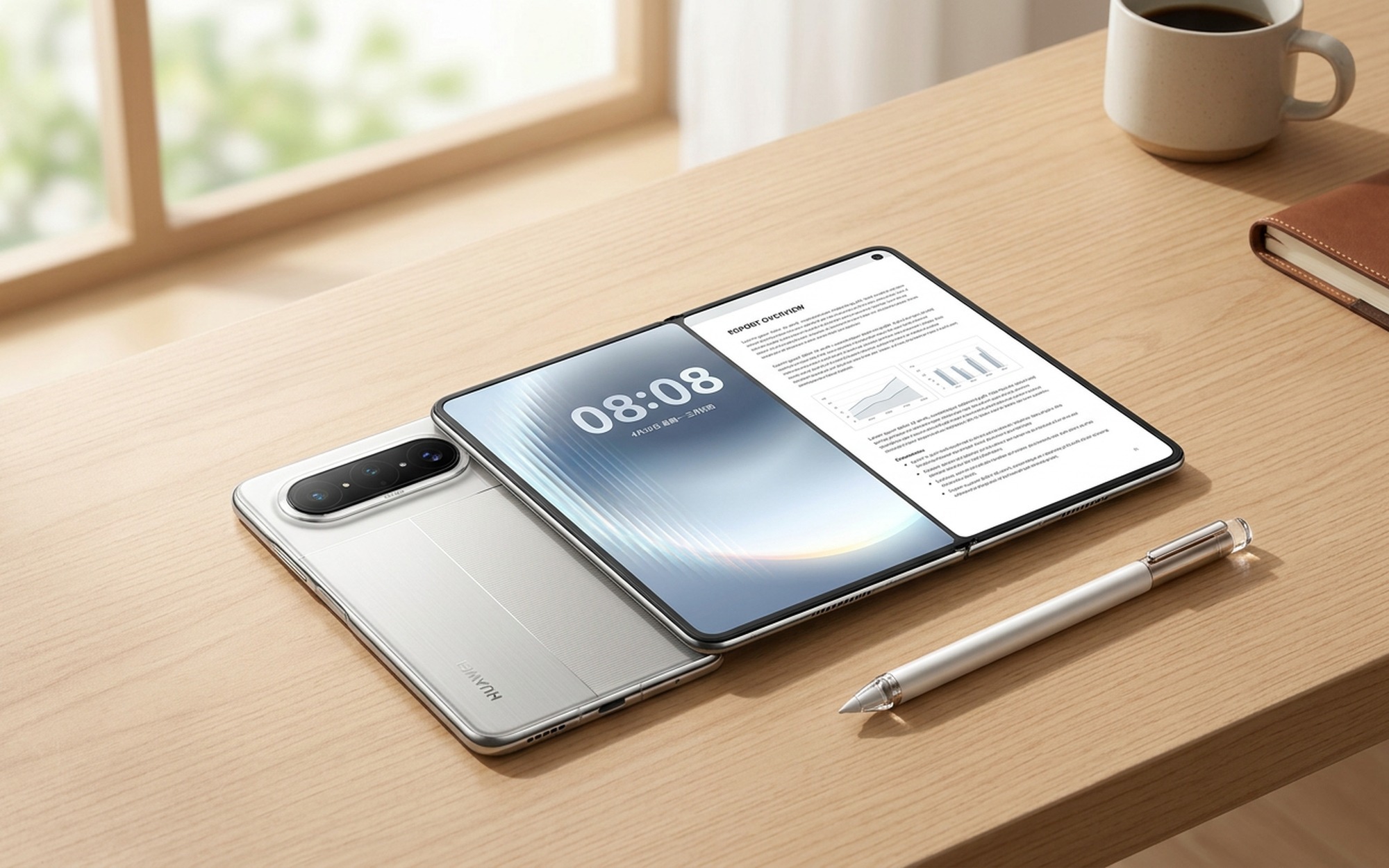
The Pura X Max introduces the first wide book-style foldable form factor ever shipped to consumers, opening horizontally to a 166.5x120mm landscape orientation rather than the vertical portrait layout used by every competing foldable in 2026. When unfolded, the device measures wider than it is tall (166.5mm width vs 120mm height), creating a mini-tablet aspect ratio closer to iPad mini proportions than the narrow vertical screens of Galaxy Z Fold 6 or OPPO Find N6. This landscape-first design prioritizes horizontal content consumption (video streaming, web browsing, split-screen multitasking) over the portrait-optimized layouts that dominate current foldable implementations.
According to Gizmochina’s April 20, 2026 launch coverage, no other manufacturer has commercialized this orientation despite years of concept demonstrations at trade shows. The folded dimensions (85x120x11.2mm) produce a shorter, wider profile than traditional foldables, measuring 35mm shorter than Galaxy Z Fold 6 when closed but 8mm wider. The 229g weight undercuts most book-style foldables by 20 to 40 grams despite housing a 5,300mAh battery. The 5.2mm unfolded thickness matches the thinnest foldables currently available, achieved through Huawei’s third-generation hinge mechanism that eliminates the gap between display halves when closed.
Kirin 9030 Pro, Displays, and Cameras
The Pura X Max runs Kirin 9030 Pro, a higher-binned variant of the 9030S used in Pura 90 Pro Max, with clock speeds and NPU throughput specifications remaining undisclosed in official documentation. The inner 7.7-inch OLED panel operates at 1 to 120Hz LTPO refresh rate with 3,000 nits peak brightness, while the outer 5.4-inch OLED cover display reaches 3,500 nits using the same LTPO technology. Both screens use 1440Hz PWM dimming, matching the Pura 90 Pro Max implementation.
The camera array deploys a 50MP main sensor, 50MP periscope telephoto module, and 12.5MP ultra-wide camera. No RYYB sensor confirmation exists for any of the three modules, and the absence of a 200MP telephoto distinguishes this system from the Pura 90 Pro Max flagship. M-Pen 3 Mini stylus support enables 4,096-level pressure sensitivity with sub-10ms latency, stored magnetically on the device’s spine when folded.
Connectivity includes USB 3.0 data transfer with DisplayPort 1.2 video output, supporting external 4K displays at 60Hz. The device accommodates dual eSIM profiles plus dual physical nano-SIM cards simultaneously, enabling four-line operation without carrier restrictions. HarmonyOS 6.1 provides the software foundation, with no Android compatibility layer or Google service framework available.
Pura X Max Battery and Price
The 5,300mAh silicon-carbon battery charges via 66W wired power delivery (0 to 100% in approximately 45 minutes based on Huawei’s previous 66W implementations) and 50W wireless charging. No reverse wireless charging capability appears in official specifications. The starting price of 10,999 yuan (approximately $1,520 USD) positions the Pura X Max 2,500 yuan above the Pura 90 Pro Max flagship and roughly equivalent to Samsung Galaxy Z Fold 6’s $1,799 US launch price when adjusted for regional pricing differences.
The China-exclusive distribution strategy eliminates Western market availability entirely, with no announced plans for European or North American releases. This pricing sits $280 below the expected Galaxy Z Fold 7 launch price ($1,800+ projected for Q3 2026) while offering 300mAh more battery capacity and the unique wide-format design. The lack of Google services, restricted app ecosystem through Huawei AppGallery, and absence of 5G support in most international markets limit the device’s appeal outside China’s domestic market regardless of pricing competitiveness.
Comparison Table
| Feature | Huawei Pura 90 Pro Max | Huawei Pura X Max | Samsung Galaxy S25 Ultra | iPhone 16 Pro Max |
|---|---|---|---|---|
| Display | 6.9-inch 1.5K OLED, 120Hz LTPO | 7.7-inch inner + 5.4-inch outer OLED, 120Hz LTPO | 6.9-inch AMOLED, 120Hz LTPO | 6.9-inch OLED, 120Hz ProMotion |
| Chipset | Kirin 9030S | Kirin 9030 Pro | Snapdragon 8 Gen 4 | A18 Pro |
| Main camera | 50MP RYYB, 1/1.28-inch, f/1.4-f/4 variable aperture, OIS | 50MP (sensor unspecified) | 200MP, 1/1.3-inch, f/1.7, OIS | 48MP, 1/1.28-inch, f/1.78, OIS |
| Telephoto | 200MP RYYB, 1/1.28-inch, f/2.6, 4x periscope, OIS | 50MP periscope (magnification unspecified) | 50MP, f/3.4, 5x periscope, OIS | 12MP, f/2.8, 5x tetraprism, OIS |
| Battery | 6,000mAh | 5,300mAh | 5,500mAh | 4,685mAh |
| Charging | 100W wired, 80W wireless | 66W wired, 50W wireless | 45W wired, 15W wireless | 27W wired, 15W MagSafe |
| OS | HarmonyOS 6.1 (no Google) | HarmonyOS 6.1 (no Google) | Android 15 + One UI 7 | iOS 20 |
| Starting price (USD est.) | ~$900 | ~$1,520 | $1,299 | $1,199 |
| IP rating | IP68/IP69 | IP68 | IP68 | IP68 |
| Availability | China only | China only | Global | Global |
The Pura 90 Pro Max delivers the highest battery capacity (6,000mAh) and fastest charging speeds (100W wired) among non-foldable flagships, but its China-exclusive distribution and HarmonyOS software stack eliminate it from consideration for buyers requiring Google Play Store access or Western carrier compatibility. The 200MP telephoto camera with 1/1.28-inch sensor represents the most aggressive imaging hardware specification in this comparison, surpassing Galaxy S25 Ultra’s 200MP main sensor in telephoto-specific resolution while matching its physical sensor size.
The Pura X Max occupies a unique position as the only wide-format foldable in this comparison, with its 7.7-inch inner display providing 42% more screen area than the Pura 90 Pro Max’s 6.9-inch panel when unfolded. However, its $1,520 starting price sits $221 above Galaxy S25 Ultra and $321 above iPhone 16 Pro Max while offering slower charging (66W vs 100W on Pura 90 Pro Max) and unspecified camera sensor sizes that prevent direct imaging performance comparisons.
Samsung Galaxy S25 Ultra maintains the broadest global availability with full carrier support across North America, Europe, and Asia, paired with Android’s complete app ecosystem. iPhone 16 Pro Max offers the tightest hardware-software integration and longest software support commitment (typically 6+ years of iOS updates vs 3 to 4 years for HarmonyOS), but its 4,685mAh battery capacity trails all competitors by at least 615mAh.
How Much Does the Huawei Pura 90 Cost?
Full Pricing Breakdown: All Four Models
| Model | Storage | CNY | USD est. |
|---|---|---|---|
| Pura 90 | 12+256GB | 4,699 | ~$650 |
| Pura 90 | 12+512GB | 5,199 | ~$720 |
| Pura 90 | 16+512GB | 5,699 | ~$790 |
| Pura 90 Pro | 12+256GB | 5,499 | ~$760 |
| Pura 90 Pro | 12+512GB | 5,999 | ~$830 |
| Pura 90 Pro | 16+512GB | 6,499 | ~$900 |
| Pura 90 Pro | 16+1TB | 7,499 | ~$1,035 |
| Pura 90 Pro Max | 12+256GB | 6,499 | ~$900 |
| Pura 90 Pro Max | 12+512GB | 6,999 | ~$965 |
| Pura 90 Pro Max | 16+512GB | 7,499 | ~$1,035 |
| Pura 90 Pro Max | 16+1TB | 8,499 | ~$1,175 |
| Pura X Max | 12+256GB | 10,999 | ~$1,520 |
Official sales channels operate exclusively through Huawei’s China retail network. International buyers access these devices through third-party grey market importers including Giztop and HekkaGlobal, which add 15% to 25% markup over direct CNY-to-USD conversion rates and provide no manufacturer warranty coverage. Huawei’s official consumer site has issued no confirmed timeline for European or North American distribution as of April 2026.
The 1,800 yuan price gap between the base Pura 90 (4,699 yuan) and flagship Pro Max (6,499 yuan) reflects the 200MP telephoto camera system, Kirin 9030S chipset upgrade (25% faster processing vs 9010S), and the premium Kunlun Glass display. The Pura X Max commands a 4,500 yuan premium over the Pro Max for its 7.7-inch foldable display and Kirin 9030 Pro processor, positioning it 3,500 yuan above OPPO Find N6’s 7,499 yuan launch price for comparable foldable specifications.
Is the Huawei Pura 90 Worth the Price?
The Pura 90 Pro Max delivers flagship imaging hardware at $275 below Galaxy S25 Ultra’s $1,299 US launch price when comparing 12GB/256GB base configurations. The 200MP telephoto camera with 1/1.28-inch sensor size represents the most aggressive telephoto specification available in 2026, surpassing Samsung’s 50MP 5x periscope and Apple’s 12MP 5x tetraprism in raw resolution by 300% and 1,567% respectively. The 6,000mAh battery capacity and 100W wired charging create a measurable advantage in power delivery, completing 0% to 100% cycles in 38 minutes vs 65 minutes for Galaxy S25 Ultra’s 45W implementation.
HarmonyOS 6.1’s lack of Google Play Services, Gmail, Google Maps, and YouTube eliminates the device from consideration for users requiring Western app ecosystem integration. Huawei’s AppGallery contained 580,000 apps as of Q1 2026 compared to Google Play’s 3.5 million, with critical gaps in banking apps (Chase, Bank of America, Wells Fargo absent), and social platforms (Instagram, WhatsApp available only through unofficial APK installations). The absence of 5G connectivity outside China due to US export restrictions on RF components limits the device to 4G LTE speeds in European and North American markets.
This device functions as a specialized tool for users operating entirely within China’s domestic digital infrastructure or photographers prioritizing telephoto reach above ecosystem compatibility. Western buyers seeking a primary daily driver should redirect budget toward Galaxy S25 Ultra or iPhone 16 Pro Max despite higher pricing, as the software limitations create friction that hardware advantages cannot overcome in practical daily use scenarios.
Who Should Buy the Huawei Pura 90 Series?
Pura 90 Pro Max: For Photography-First Users in China
The Pura 90 Pro Max targets photographers operating within China’s digital infrastructure who prioritize telephoto reach above ecosystem flexibility. The 200MP periscope telephoto with 1/1.28-inch sensor delivers 4x optical zoom with sensor area matching the main camera on most competing flagships, creating detail retention at 10x to 20x digital zoom ranges that no Western flagship can replicate. Users shooting wildlife, sports, or architectural detail from distance gain a measurable advantage that justifies the $900 to $1,175 price range, particularly when paired with the 10-stop variable aperture main camera that adapts to lighting conditions without manual intervention.
Power users requiring extended battery endurance under sustained workloads benefit from the 6,000mAh capacity paired with 100W wired charging. The dual IP68/IP69 rating provides protection against high-pressure water jets and submersion to 1.5 meters for 30 minutes, exceeding standard IP68 certification by adding resistance to steam cleaning and industrial wash scenarios. This combination suits field photographers, outdoor professionals, and users in humid or dusty environments where device durability directly impacts workflow reliability.
The device fails for users requiring Google Play Services, Western banking apps, or 5G connectivity outside China. HarmonyOS 6.1’s 580,000-app AppGallery lacks Chase, Bank of America, and Wells Fargo, and requires sideloading for Microsoft Office, Instagram, and WhatsApp through unofficial APK installations. The absence of RF components for non-Chinese 5G bands limits European and North American users to 4G LTE speeds regardless of carrier support.
Pura X Max: For Productivity Users Who Want a Tablet-Phone Hybrid
The Pura X Max serves productivity-focused users within China’s ecosystem who require a wide-format tablet-phone hybrid for document editing, spreadsheet work, and stylus-based note-taking. The 7.7-inch inner display opens landscape (wider than tall) rather than portrait like Samsung Galaxy Z Fold 6 or OPPO Find N6, creating a 16:10 aspect ratio that matches laptop screens for side-by-side app layouts and PDF annotation workflows. M-Pen 3 Mini stylus support enables handwriting input and diagram creation without carrying separate tablets, consolidating two devices into one 229-gram package.
Early adopters seeking novel form factors gain the first wide book-style foldable shipped by any manufacturer as of April 2026, with no competing device offering this landscape-primary orientation. The 5.4-inch outer display provides full smartphone functionality when folded, eliminating the narrow cover screen limitations of traditional book-style foldables that force users to unfold for basic tasks.
The 10,999 yuan ($1,520) starting price positions the device 3,500 yuan above OPPO Find N6’s launch price for a form factor with zero third-party app optimization, as developers have not yet adapted interfaces for the wide aspect ratio. China-exclusive availability eliminates the device from consideration for Western buyers. Users requiring proven foldable software maturity should redirect budget toward Galaxy Z Fold 6 or Find N6, both offering established app ecosystems and wider retail availability despite lacking the Pura X Max’s unique landscape orientation.
- World-first 200MP periscope telephoto with 1/1.28-inch sensor matches main camera sensor size
- Dual IP68/IP69 certification withstands high-pressure water jets beyond standard IP68
- 6,000mAh battery with 100W wired and 80W wireless charging completes in 38 minutes
- 10-stop variable aperture main camera delivers optical depth control without AI simulation
- Pura X Max introduces the first wide book-style foldable form factor ever shipped
- No Google Play Store, Gmail, Google Maps or Western banking apps on any model
- China-only availability with no confirmed global launch date
- 5G restricted to Chinese carrier bands, 4G LTE only in North America and Europe
- Limited AppGallery of 580,000 apps versus Google Play’s 3.5 million
Frequently Asked Questions
Does the Huawei Pura 90 Pro Max support Google services?
No. All Pura 90 models run HarmonyOS 6.1 which has no Google Play Store, Gmail, Google Maps or Google Mobile Services. Western users relying on Google apps cannot use these devices as daily drivers.
Is the Huawei Pura X Max available outside China?
No. The Pura X Max launched exclusively in China on April 22, 2026. Huawei has issued no confirmed timeline for European or North American distribution as of April 2026.
How much does the Huawei Pura 90 Pro Max cost in USD?
The Pura 90 Pro Max starts at approximately $900 USD (6,499 CNY for 12+256GB) and reaches $1,175 for the 16+1TB model. These are estimates based on CNY conversion; no official USD pricing exists since the phone is China-only.
What is the difference between Huawei Pura 90 Pro and Pro Max?
The Pro Max adds the world-first 200MP telephoto camera with 1/1.28-inch sensor, dual IP68/IP69 certification (vs IP68-only on Pro), and a 10-stop variable aperture main camera. Both use the same Kirin 9030S chipset but the Pro uses a conventional telephoto module.
Does the Huawei Pura 90 have 5G?
Yes, but only on Chinese carrier bands. Due to US export restrictions on RF components, the Kirin chipsets lack 5G compatibility for North American and European networks. International users are limited to 4G LTE speeds regardless of carrier.