
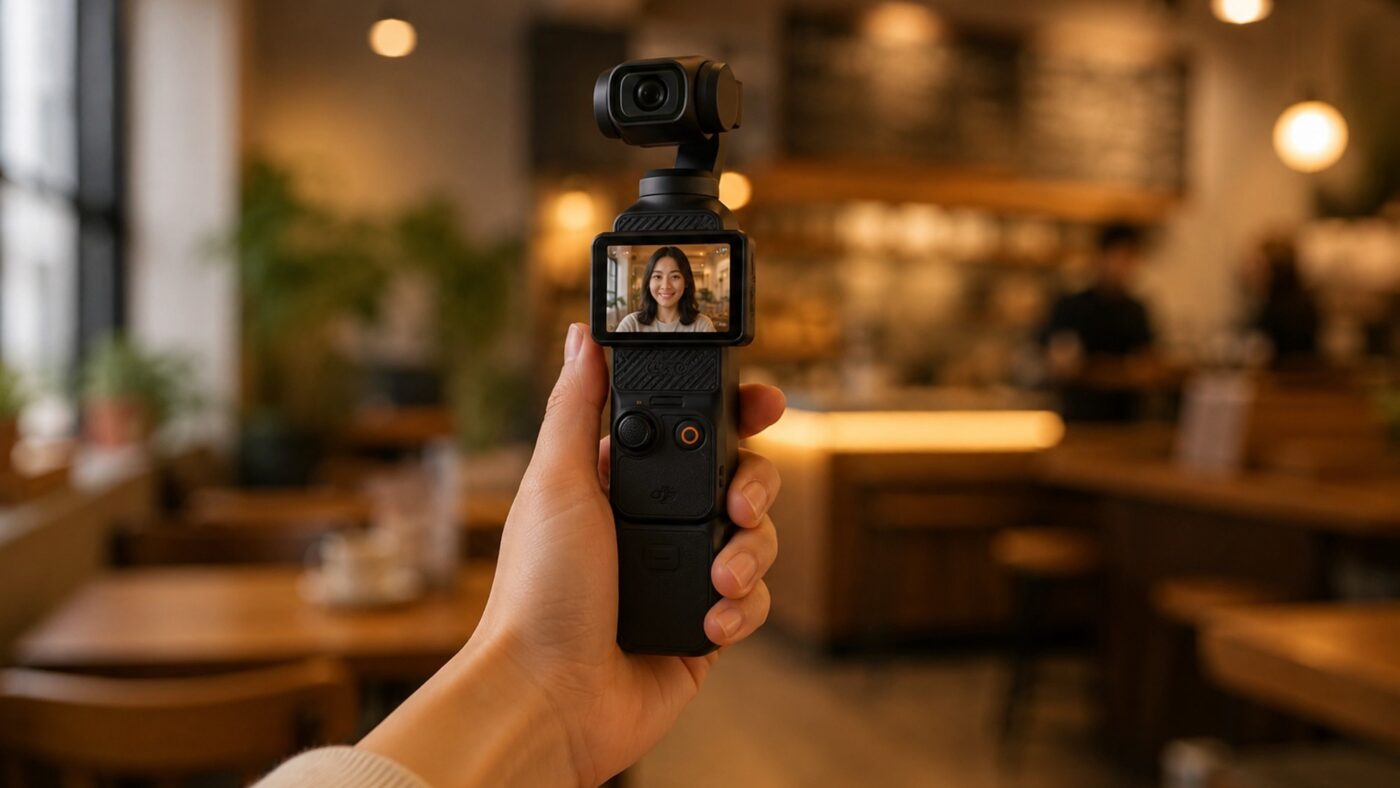
When AirPods launched, true wireless earbuds went from a niche gadget to a category every phone maker now ships. The handheld gimbal camera is having the same moment. According to DJI, its Osmo Pocket 3 has now passed 10 million lifetime units, a figure DJI founder Frank Wang confirmed in a 2026 interview, and the company reportedly once expected to sell just 300,000 to 400,000 units. That is the signal that a quiet category just went mainstream, and in 2026 it gets its first real arms race as the Insta360 Luna Ultra arrives to challenge DJI head on.
This guide cuts through the hype. We explain what a gimbal camera actually is, how the 3-axis stabilization inside it works, how the DJI Osmo Pocket and Insta360 Luna Ultra stack up for vlogging, and the honest question almost no buyer asks out loud: do you still need one if you already own a good phone?
What a Gimbal Camera Is, and Why Vloggers Keep Buying Them
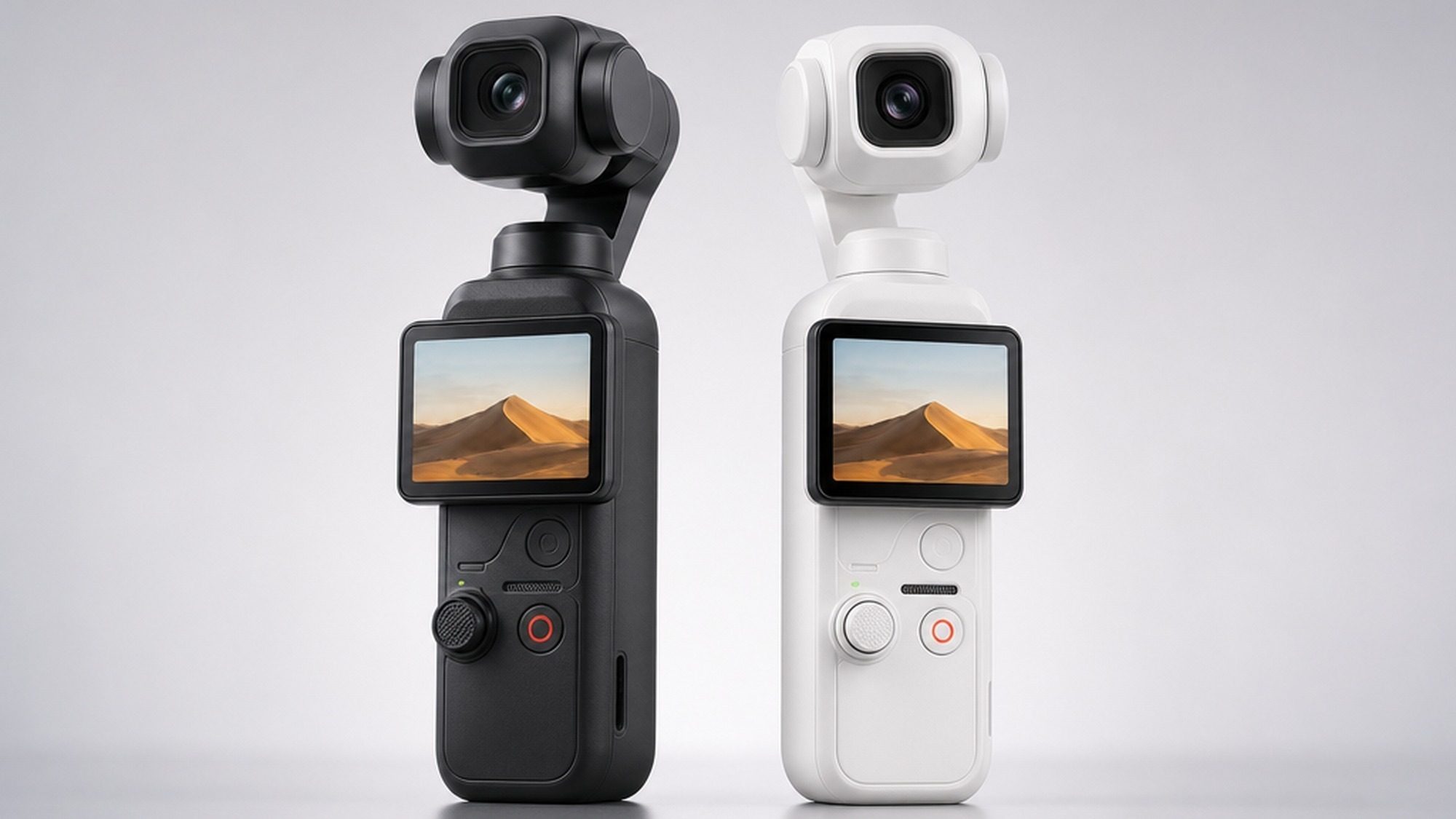
Strip away the marketing and a gimbal camera is three things fused into one body: a camera sensor, a lens, and a small set of motors that hold that lens steady while you move. That last part is the whole point. A normal camera shakes with your hand. A gimbal camera floats, so footage shot while walking looks like it came off a smooth dolly track.
The category matters for vlogging specifically because it removes friction. There is no phone to clamp in, no separate stabilizer to balance, no rig to assemble at the trailhead. You pull it out of a jacket pocket, twist the screen toward your face, and start talking. For a creator filming three videos a week, that speed is the actual feature.
What is a gimbal camera, and why do you need one?
A gimbal camera is a pocket-sized video camera with a built-in 3-axis motorized stabilizer that keeps the lens level while you move.
Sensor, lens, screen, and gimbal together, with no phone clamp or rig to assemble.
Motors counter pitch, roll, and yaw in real time so footage looks tripod-smooth on the move.
Rotating front screens and face tracking are made for talking to camera while walking.
From the 116g original Osmo Pocket onward, the point is that it disappears into a pocket.
How a 3-Axis Gimbal Stabilizer Actually Works
The phrase 3-axis sounds like jargon, but it describes exactly what the motors do. Three small brushless motors each control one axis of rotation, and together they cancel out the shake your hand introduces from every direction. An onboard sensor measures motion hundreds of times per second, and the motors respond instantly to keep the lens pointed where you aimed it.
This is the hardware difference that software cannot fully match. Your phone stabilizes video by cropping into the frame and shifting pixels after the fact, which costs resolution and falls apart in low light. A gimbal physically holds the lens still before the light ever hits the sensor, so there is nothing to crop and nothing to guess.
The three axes, and the brain that drives them
Each motor owns one direction of unwanted motion, and a motion sensor tells all three how to react in real time.
Cancels the up and down nodding as you walk, the motion that ruins most handheld clips.
Keeps the horizon level even when your wrist tilts, so the frame never leans.
Smooths side to side swing, turning a jerky pan into a slow cinematic sweep.
Brushless motors take orders from an inertial sensor that reads movement hundreds of times a second.
DJI Osmo Pocket vs Insta360 Luna Ultra
For years DJI had this category almost to itself. The 2026 story is that Insta360, the company behind the dominant 360 cameras and the Flow phone stabilizers, has spent five years studying how people film and is now aiming the Luna Ultra straight at the Osmo Pocket. The two brands also reveal two philosophies. DJI builds a refined creative tool and trusts you to point it. Insta360 chases an autonomous camera that tracks, frames, and follows you on its own.
Here is how the headline specs compare. DJI publishes the Osmo Pocket 3 figures as shipping manufacturer specs, while Insta360 claims the Luna Ultra column as announced pre-launch numbers, so treat that side as unverified until reviewers test retail units.
| Spec | DJI Osmo Pocket 3 | Insta360 Luna Ultra |
|---|---|---|
| Main sensor | 1-inch CMOS | 1-inch CMOS |
| Second camera | None, single lens | 1/1.3-inch telephoto |
| Zoom | Digital only | 3.9x optical, up to 6x lossless |
| Max frame rate | 4K at 120fps | 4K at 240fps |
| Screen | 2-inch rotating OLED | Rotating touchscreen |
| Gimbal design | Fixed to body | Twist, detachable head |
| Optics tuning | DJI | Leica co-engineered |
| Weight | About 179g | Under 150g, announced |
| Price | Around 519 dollars | Around 780 dollars, announced |
The pattern is clear. DJI offers the proven, lighter, cheaper, simpler camera with the deepest accessory ecosystem and a mature app. The Luna Ultra answers with a second telephoto camera, real optical zoom, Leica optics, and a gimbal head that twists off the handle for mounting flexibility. However, it is worth noting that more cameras and higher frame rates also mean more weight, more cost, and more to go wrong. In our view the second lens is a more interesting bet than the spec-sheet frame rates, because reach is the one thing a single-lens pocket camera genuinely cannot fake. Compared to the Osmo Pocket 3, the Luna Ultra is the riskier, more capable buy.
Gimbal Camera vs Action Camera vs Your iPhone
Three devices fight for the same vlogging dollar, and they are not interchangeable. An action camera such as a GoPro is built for abuse: waterproof, mountable on a helmet or chest, and stabilized electronically for point-of-view sport. It is the right tool when the camera is going to get wet, dropped, or strapped to something moving fast.
A gimbal camera is the opposite priority. It trades ruggedness for a larger sensor and physical stabilization, which in practice means cleaner low-light footage and a more cinematic look for travel, street, and talking-head vlogs. Compared to an action camera, it looks noticeably better than electronic stabilization once the light drops. If your videos are mostly you, a place, and a story rather than a downhill run, the gimbal is the better fit.
Then there is the phone in your pocket. A current iPhone shoots excellent video and, for many casual creators, is genuinely enough. The gap shows up at the edges: software stabilization crops your frame and gets noisy in dim light, and you cannot twist a phone into selfie framing one-handed while walking. If you film daily or shoot in tricky light, those edges are exactly where a gimbal camera earns its place. For a sense of how far phone cameras have closed the gap, our Oppo Find X9 Ultra camera review shows what a 2026 flagship sensor can and cannot do.
Why the Rotating Screen Is the Real Killer Feature
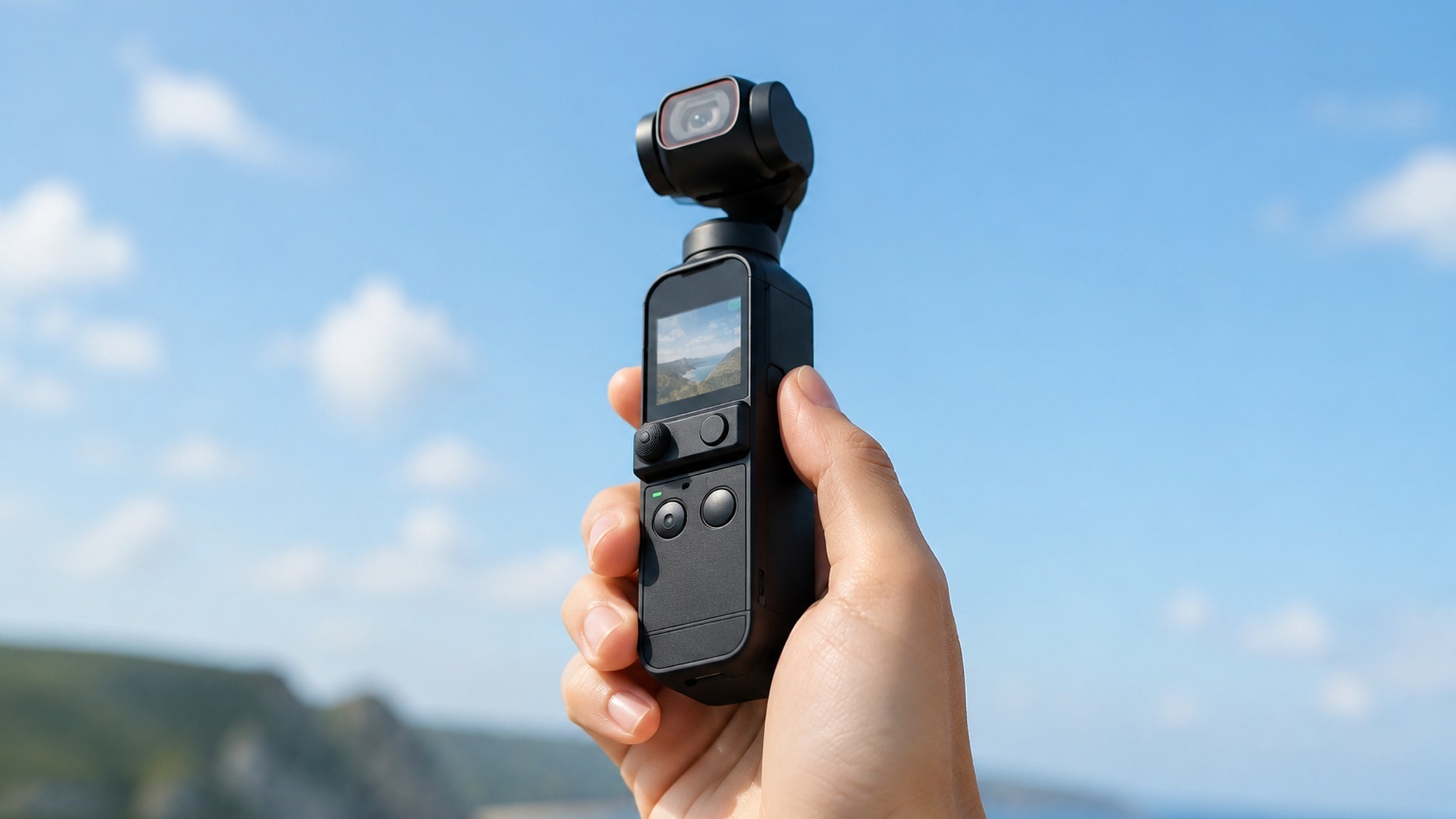
Ask a Pocket 3 owner what sold them and the answer is rarely the sensor. It is the screen that flips and rotates. The simple act of grip, then twist, turns the camera from forward-facing to selfie mode in under a second, and the camera powers into video as the screen rotates. That one gesture is the thing a phone cannot copy in one hand, and it is why the design keeps spreading.
The idea is older than DJI. Sony built a rotating, auto-on screen into a digital camera back in 2004, and camcorders used rotate-to-record hinges years before pocket gimbals existed. DJI did not invent the rotating screen, it executed it better than anyone for this specific use case. That is the recurring lesson of consumer tech: the company that wins is rarely first, it is the one that makes a scattered idea feel obvious.
From Niche to 10 Million: How DJI Built the Market
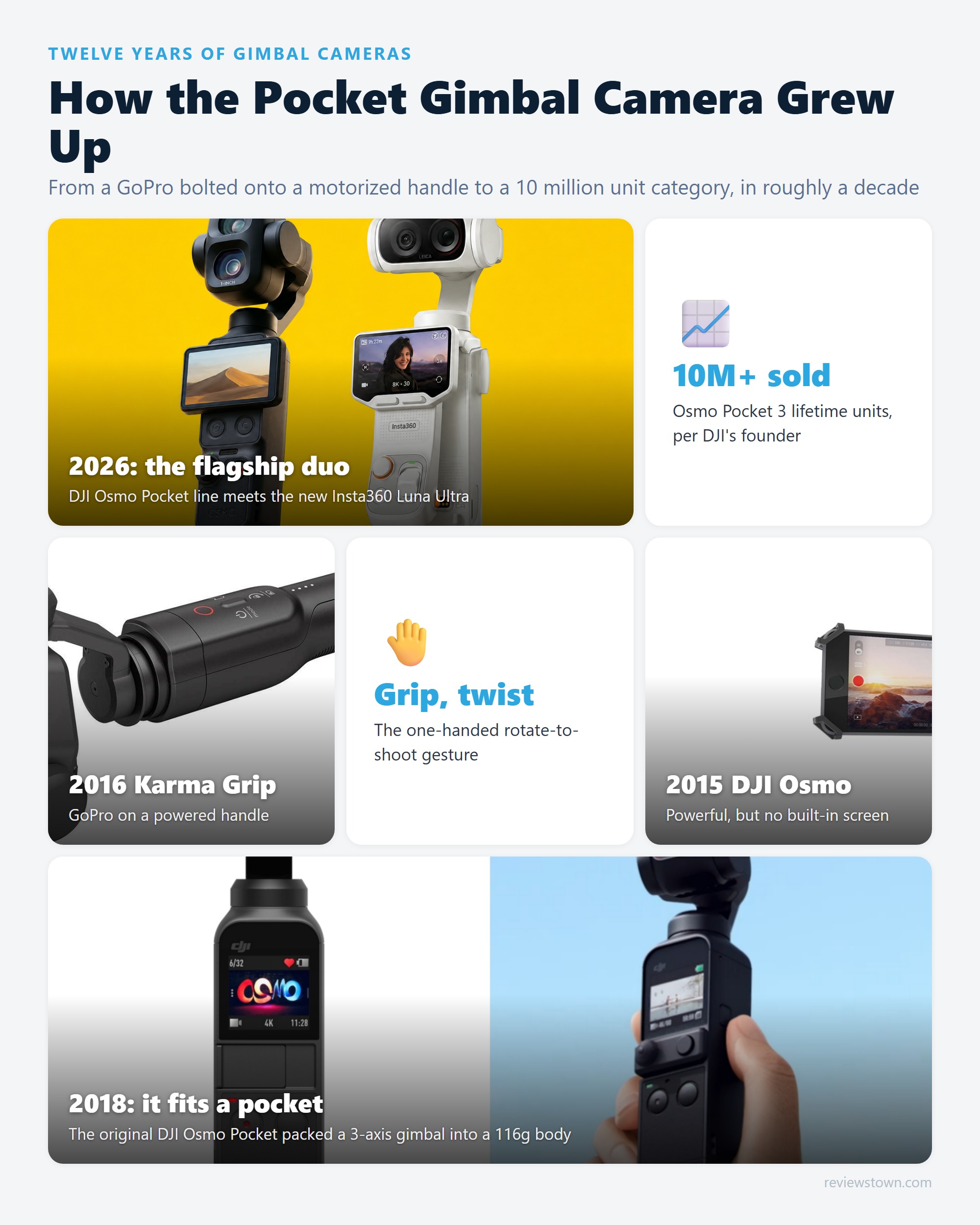
The 10 million figure is worth sitting with. DJI reportedly modeled the first Osmo Pocket for a few hundred thousand buyers, then revised expectations upward to a million after launch reception, and the Pocket 3 blew past both. According to Digital Camera World, the Pocket 3 spent close to a year as the best selling video camera in Japan and was so popular it kept selling out, which is the kind of demand that pulls competitors into a market.
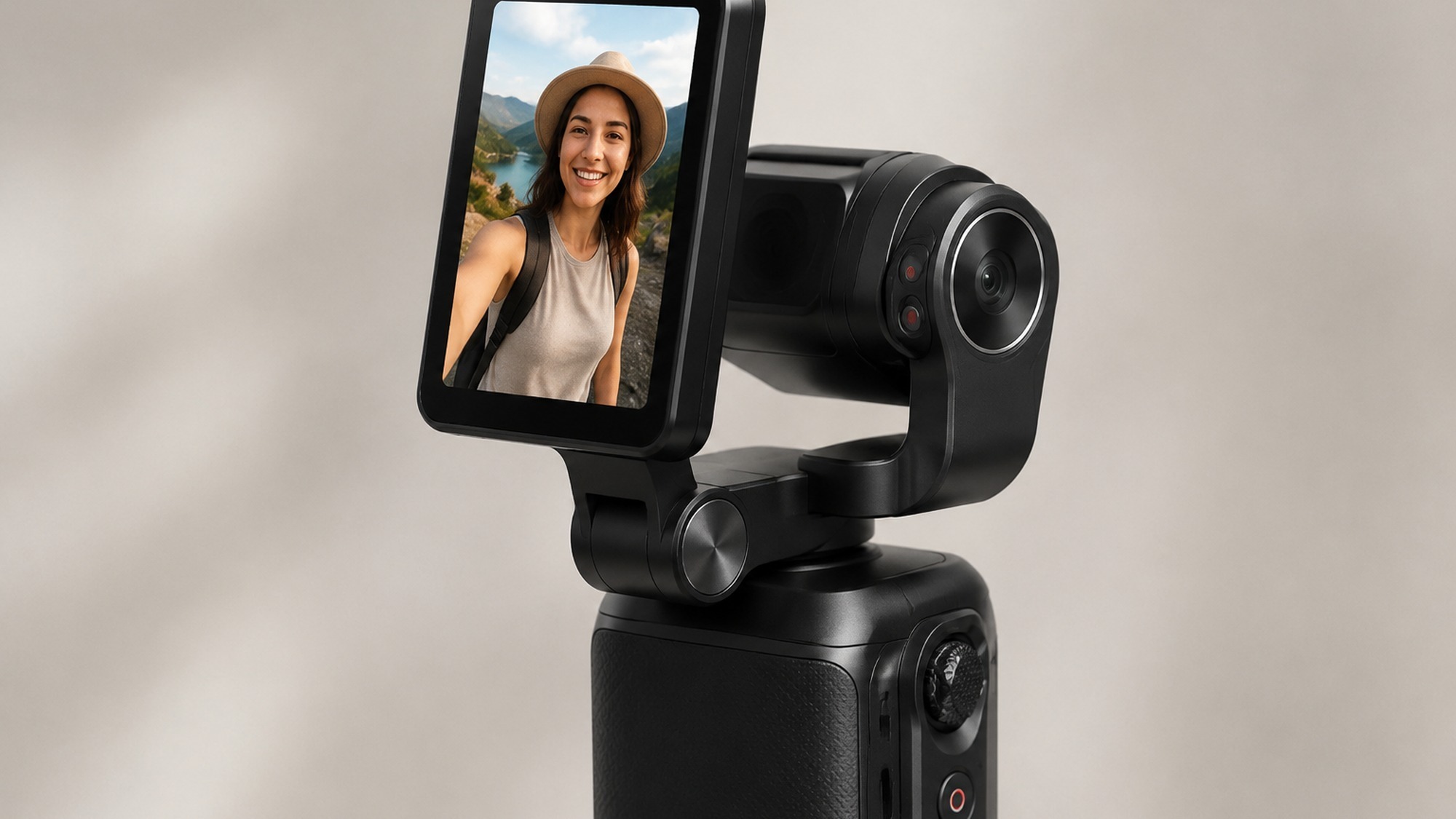
That is why 2026 looks like an inflection point rather than a single product launch. With the Pocket line now a confirmed bestseller heading toward a dual-camera future, the obvious next move is smartphone brands entering the space the way they all eventually shipped earbuds. Honor has already teased camera-forward concepts, and it would surprise no one to see Xiaomi, OPPO, or Vivo target the budget tier. New camera form factors are arriving from every direction, including wearables like the Guangfan AI camera earbuds, and the gimbal camera is simply the most mature of them. If you want to shop the wider field beyond pocket models, Digital Camera World keeps a running list of the best gimbals for 2026.
What Owners and Vloggers Report
The enthusiasm online is real, but so is the confusion. A recurring comment under gimbal camera comparison videos is some version of “I can’t tell which is best, they all look like the same thing,” which is exactly the buyer paralysis a crowded category creates. On Reddit, the more substantive debate on r/videography is whether a dedicated gimbal is still worth it now that phones have improved. In practice, owners report a clear tradeoff with smartphone gimbals like the DJI OM5: very small and easy to deploy, but not as powerful as they hoped, and many users praise the portability while wishing for stronger motors.
The most concrete recurring complaint sits on the hardware side. Across DJI owner threads, owners report gimbal calibration and motor errors, including a “gimbal control poor, calibrate gimbal” warning that recalibration does not always clear. It is not widespread enough to avoid the category, but it is a real reminder that these are precision mechanical devices, not sealed solid-state gadgets, and the moving parts occasionally need babysitting.
The Bottom Line
The gimbal camera has crossed from niche to mainstream, and 2026 is the year it gets genuine competition. For most vloggers the DJI Osmo Pocket 3 remains the safe, refined, well-supported pick, while the Insta360 Luna Ultra is the more ambitious camera for creators who want optical zoom and a second lens. If you already own a strong phone and only film occasionally, you can wait. But if you film often, walk while you talk, or shoot in low light, a 3-axis gimbal camera still does something your phone cannot, and it does it from your pocket.
- True 3-axis hardware stabilization beats phone software stabilization in low light and on rough ground
- Rotating screen and face tracking make one-handed, talk-to-camera vlogging genuinely effortless
- Pocketable bodies from 116g upward replace a camera plus a separate gimbal rig
- DJI Osmo Pocket 3 and Insta360 Luna Ultra both pair a 1-inch sensor with built-in stabilization
- Fixed lens and small body limit creative control versus a mirrorless camera on a full gimbal
- A modern flagship phone already covers casual clips, so the upgrade is not automatic for everyone
- Battery life and overheating can cut long takes short, a recurring owner complaint
- The newest dual-camera models push well past 700 dollars, no longer an impulse buy
Frequently Asked Questions
What is a gimbal camera and why do you need one?
A gimbal camera is a self-contained video camera with a built-in 3-axis motorized stabilizer that keeps the lens level as you walk, run, or pan. You need one when you want cinematic, jitter-free footage on the move without carrying a separate camera and gimbal rig. For most vloggers it replaces a whole bag of gear with a single pocketable device.
Is a gimbal camera worth buying for beginner vloggers?
For a beginner who films while walking or talking to camera, yes. The stabilization, face tracking, and front-facing screen remove most of the technical friction that makes early vlogs look amateurish. If you only post the occasional clip from a static spot, a recent phone will usually do the job for less money.
What is the difference between a gimbal camera and a smartphone stabilizer?
A smartphone stabilizer such as the DJI Osmo Mobile is just a powered handle that you clamp your phone into, so image quality depends on the phone. A gimbal camera has its own sensor, lens, and gimbal in one sealed body. The all-in-one design is smaller, faster to deploy, and tuned so the stabilization and the optics are matched.
What is the difference between a gimbal camera and an action camera?
An action camera like a GoPro relies on electronic image stabilization and a tough waterproof body built for helmets and chests during sport. A gimbal camera uses physical motors and a larger sensor for cleaner low-light video and a more cinematic look. Action cameras win for rugged point-of-view footage, gimbal cameras win for everyday vlogging and travel.
Do you still need a gimbal camera if you have an iPhone?
It depends on how much you film. A modern iPhone handles casual clips well, but its software stabilization still crops the frame and struggles in low light compared with a true 3-axis gimbal. Creators who film daily, walk while talking, or shoot in dim rooms still see a clear quality jump from a dedicated gimbal camera.
DJI Osmo Pocket vs Insta360 Luna Ultra, which is better for vlogging?
The DJI Osmo Pocket 3 is the proven, lighter, simpler choice with a mature app and the largest accessory ecosystem. The Insta360 Luna Ultra adds a second telephoto camera, optical zoom, and a detachable gimbal head for creators who want reach and flexibility. Pick DJI for refinement and value, Luna Ultra for versatility, if its launch units match the announced specs.