
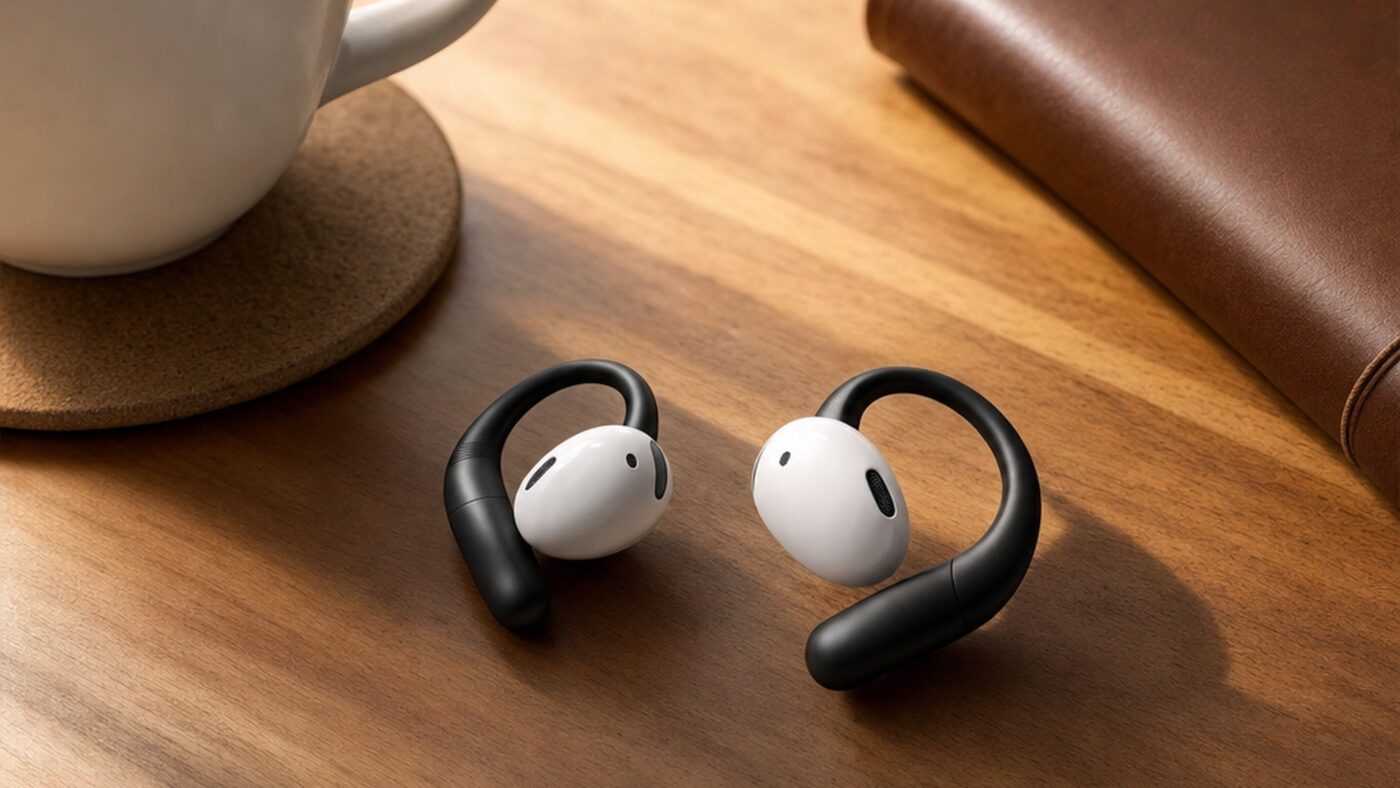
Two years into the assistant-on-your-wrist era, the category that actually changed how people use AI in public turned out to be smart glasses. Ray-Ban Meta hit a million units, and Bloomberg has Apple pushing AirPods toward a camera of their own. The earbud holdouts argued the form factor was too small to carry a useful camera. On May 15, 2026, Guangfan Technology shipped Lightwear and ended that argument. Two 2MP cameras, an eSIM-equipped case, a self-developed Lightware OS, and a single-bud weight of 11 grams, about half of a Ray-Ban Meta arm. This review examines what works, what does not, and whether the consumer AI hardware companion category finally has a real earbud entry.
What Guangfan Lightwear Is, in Plain Terms
Lightwear is an open-ear earbud with a curved camera lens sitting just below the speaker grille. Each side carries one 2-megapixel sensor, angled outward to approximate human peripheral vision. The charging case is the bigger story: it embeds an eSIM 4G radio and a GPS chip, so the earbuds can answer queries, fetch maps and stream messages without a paired phone. Inside both buds runs Lightware OS, an AI-native operating system that handles voice wake, vision capture, and the small-model edge inference Guangfan uses to keep latency under a second on most prompts.
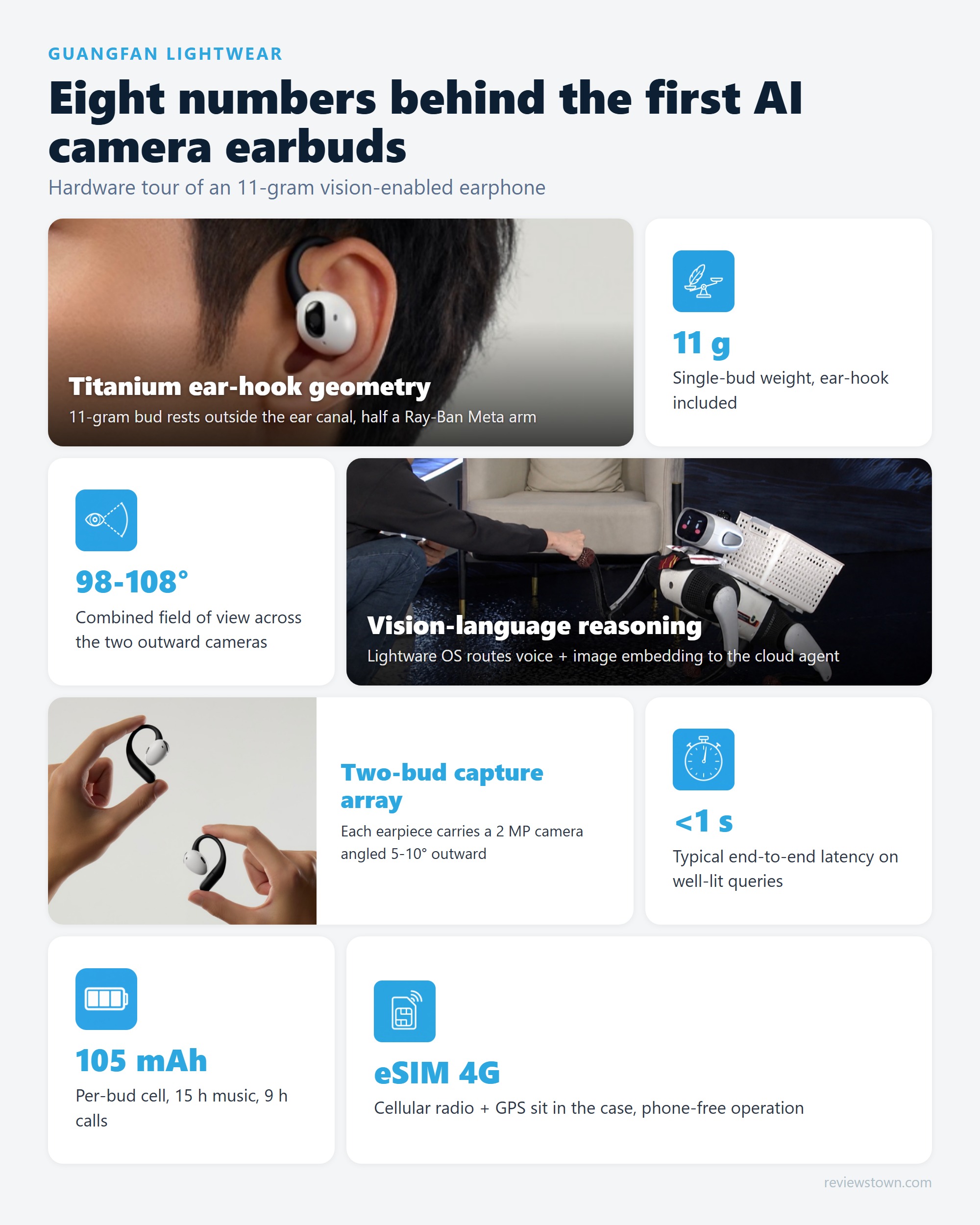
The headline number is 11 grams per bud. For comparison, AirPods Pro 2 weigh 5.3g, but they carry no camera and no cellular radio. Ray-Ban Meta weigh 49g per pair. Guangfan’s titanium ear-hook holds the weight outside your ear canal, which is why the spec is liveable in practice rather than uncomfortable.
What Are AI Camera Earbuds, and How Do They Work?
An AI camera earbud is built around three components: an outward-facing image sensor, a microphone array, and a connection to a vision-language model. On a voice trigger, Guangfan uses “Hi Lightwear” plus a question, the bud captures a still frame, encodes it locally into a compact vector, and forwards both that vector and your transcribed speech to the AI agent. The agent reasons over both modalities and responds through the bud’s speaker.
This is the same architecture Ray-Ban Meta uses, and it is the same architecture the University of Washington’s VueBuds research prototype published in April 2026. The UW team angled each camera 5 to 10 degrees outward to give a combined 98 to 108 degree field of view, ran a 74-participant comparison against Ray-Ban Meta, and reported 83 to 84 percent accuracy on translation and object identification and 93 percent on book author and title recognition. That academic baseline is the closest thing the industry has to a third-party benchmark for what these earbuds can do.
Guangfan claims parity with Ray-Ban Meta on its own internal tests but has not released independent data for Lightwear specifically. In practice that means: expect glasses-grade visual recognition for clear, well-lit subjects, and expect the buds to struggle with small text or low light just like the glasses do.
What are AI camera earbuds?
Wireless earphones with a built-in 2 MP camera, on-device vision-language model, and cellular connection, letting a voice agent reason about your surroundings without lifting a phone.
Each bud carries one outward-facing camera angled 5 to 10° for a 98 to 108° combined field of view, replicating the geometry the University of Washington’s VueBuds team validated.
Lightware OS encodes photos into compact embeddings locally; a vision-language model in the cloud reasons across vision, voice and GPS context.
The charging case carries the cellular radio and GPS, so the buds work as a standalone agent, no smartphone tether required.
A blue LED and shutter sound fire on every capture; the raw image is discarded the moment its embedding is produced.
AI Earbuds with Cameras vs. Traditional AI Earbuds
The most useful way to think about Lightwear is not as a better AirPods, it is as a different category. Traditional AI earbuds are blind. They can hear you and reach a language model, but they cannot see what you are seeing. That ceiling means a translation bud can convert words you read aloud, but it cannot look at a Japanese ramen menu and recommend a dish.
Camera earbuds change the question being asked. Instead of “how do you say X in Japanese?” the prompt becomes “what would you order here?”, and the bud answers because it can see the menu. In practice this is a smaller upgrade than the spec sheet suggests for sit-down moments where pulling out a phone is faster, and a much larger upgrade than the spec sheet suggests for moving contexts: cycling, cooking, carrying a child, navigating a foreign city.
The trade-off worth flagging: Lightwear is half-duplex at launch. You cannot interrupt the agent mid-reply, which feels archaic compared to OpenAI’s full-duplex Advanced Voice mode. Guangfan’s founder told Chinese press that full-duplex is in development but offered no timeline.
Hardware, Battery and What 11 Grams Actually Buys You
Each earbud carries a 105 mAh cell. Guangfan rates that at 15 hours of continuous music playback or 9 hours of voice calls, comfortably above AirPods Pro 2’s 6 hours and Pixel Buds Pro 2’s 8 hours. With the 2,000+ mAh charging case the total stretches to about 90 hours of mixed use.
The asterisk is vision queries. Each photo-plus-inference cycle pulls roughly the same draw as a 30-second voice call, so a vision-heavy day, say, a tourist taking 60 to 80 queries during sightseeing, will compress the per-bud number to 5 to 7 hours. That is still better than smart glasses (Ray-Ban Meta’s 4 hours of mixed use), but it is not the 15-hour figure on the box.
Other hardware notes: open-ear design rather than in-ear silicone tips, four ear-hook sizes in the box, IPX4 sweat resistance (not full waterproof), and Bluetooth 5.4 plus the eSIM-equipped case for phone-free operation.
No English-language review has shipped yet. Lightwear launched in China first. The clearest hands-on demonstration so far comes from a Mandarin-language unboxing posted the day after launch, which is worth watching for the camera placement and the LED capture indicator even if you do not speak the language (auto-translated captions handle the spoken content adequately).
What Lightwear Can Actually Do, Daily Use Cases
Guangfan’s launch demo covered six scenarios. From early hands-on reports across Chinese tech media, three of them hold up under real use and three are still rough:
Works well today: pointing at a storefront and asking for ratings or operating hours, identifying products on a shelf and pulling online prices, and location-triggered reminders that fire when you walk past a pharmacy, dry cleaner, or other errand site you logged earlier.
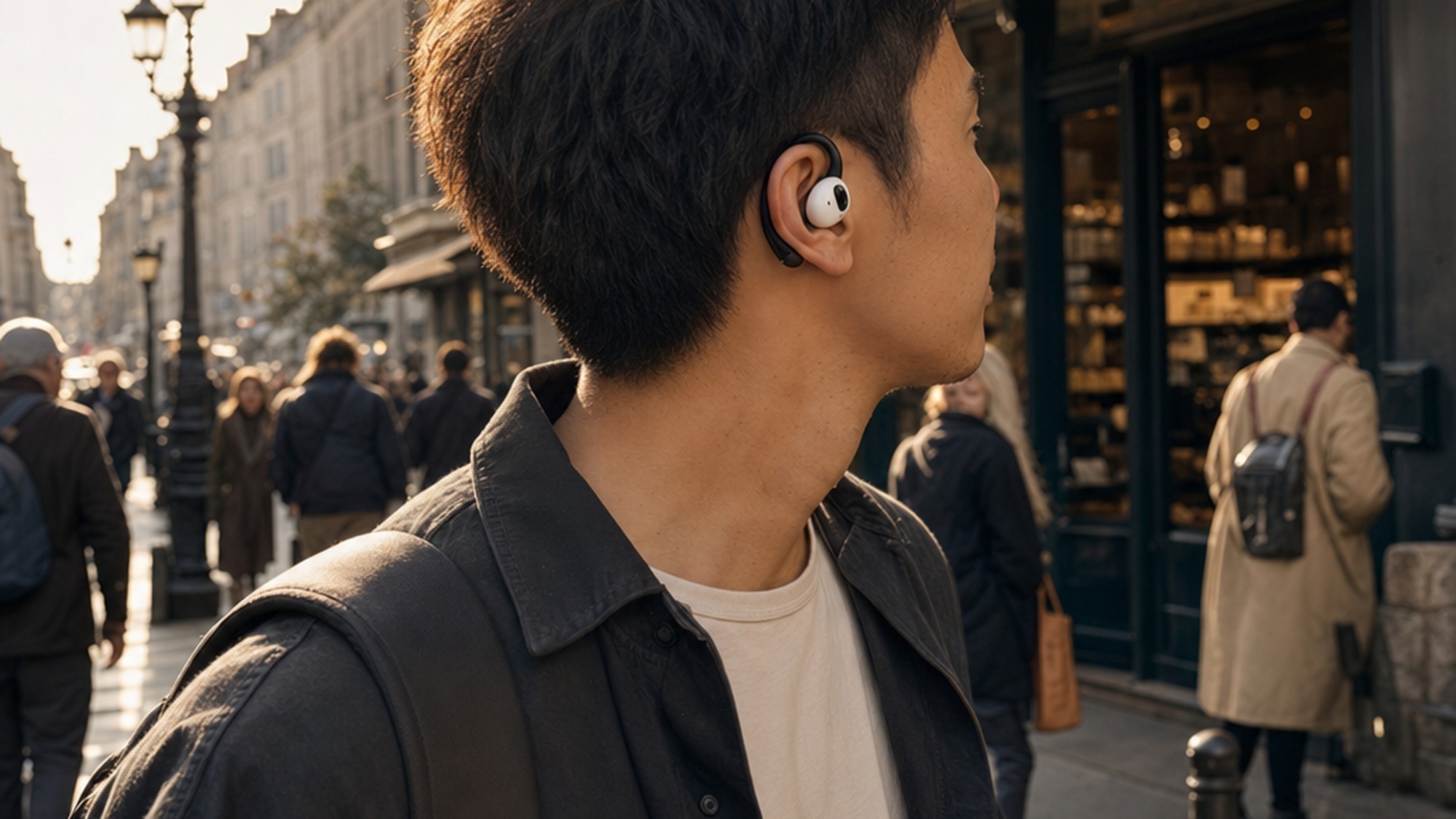
Works inconsistently: real-time translation of conversational speech (latency spikes when the cloud model is busy), reading dense text like medication labels (the 2MP sensor cannot resolve small print reliably), and automatic calendar coordination with transit suggestions (works when the calendar entry is in Guangfan’s supported apps, fails otherwise).
The accessibility implication is bigger than the gadget reviews suggest. For visually impaired users, a hands-free described-vision system that does not require lifting a phone or wearing prescription-incompatible glasses is genuinely new. Guangfan has not positioned Lightwear as an accessibility device, but the form factor lands closer to that audience than most reviewers have noticed.
Privacy, the LED, and the Bystander Problem
Lightwear ships three privacy mitigations. A blue LED ring lights around the lens during capture. An audible shutter clicks each time a photo is taken. And raw images are discarded immediately after vector embedding, nothing viewable is stored on the device or in the cloud, only the abstract embedding used for that one query.
These mirror the norms Ray-Ban Meta established for smart glasses, but the bystander problem is harder for earbuds. A pair of glasses telegraphs the presence of cameras; an earbud is small enough that someone across a table may not notice the LED. EU regulators have already flagged smart-glass camera disclosure as an unresolved issue under GDPR, and Lightwear’s smaller visual footprint will draw the same scrutiny.
The vector-embedding approach is technically defensible, you cannot reconstruct a viewable image from the embedding Guangfan stores. Whether that satisfies a regulator who wants users to see what was captured before it leaves the device is a different question.
What Users Actually Report
Early community sentiment, drawn from r/wearables, r/singularity and Chinese tech forums, splits roughly three ways. Enthusiasts who already wear Ray-Ban Meta praise the lighter form factor and the eSIM independence, “I see tons of use cases,” one r/ChatGPT thread observed, “questions you verbally ask the AI can now see what you’re seeing from roughly your perspective.” Skeptics on r/SideProject question whether the on-device power budget can sustain real-time multimodal inference: “I doubt you could get enough to power that into a set of headphones.” A smaller third group, mostly from accessibility communities, points to the form factor’s potential for blind and low-vision users, a use case Guangfan has not yet promoted.
The most consistent complaint is the half-duplex voice loop. The most consistent praise is the weight: “I forgot I was wearing them within an hour” was the verbatim comment from one of the Chinese launch-day reviewers.
Lightwear vs. Apple AirPods (Rumored Camera) vs. Ray-Ban Meta
Apple is the obvious looming competitor. Bloomberg’s Mark Gurman reported in October 2024 that Apple is building AirPods with infrared cameras for 2026 to 2027, targeting gesture detection and spatial audio rather than the open visual-question loop Guangfan is shipping today. Ray-Ban Meta remains the gold standard for actually-deployed visual AI in a wearable, with a much larger ecosystem and a 12-megapixel sensor.
| Feature | Guangfan Lightwear | Ray-Ban Meta (Gen 2) | Apple AirPods (rumored 2026) |
|---|---|---|---|
| Form factor | Open-ear earbuds | Smart glasses | Earbuds |
| Camera | 2× 2MP (visible light) | 1× 12MP | IR only (rumored) |
| Phone-free operation | Yes (eSIM in case) | No | No |
| Weight per side | 11 g | ~24 g | ~5 g |
| Battery life | 15 h (music) / 5-7 h (vision-heavy) | 4 h mixed | n/a |
| OS | Lightware OS (in-house) | Meta AI on Android | iOS-paired firmware (rumored) |
| Launch price | 1,999 CNY (~$280) | $299-$379 | Not announced |
| Region | China (May 2026), global TBD | Global | n/a |
Lightwear’s case for buyers outside China rests on three points: it is the only one of the three that does not require a phone, it is the lightest visible-light camera wearable on the market, and it ships now rather than “in 2026 or 2027.”
Operating System: Why Lightware OS Matters
Most wireless earbuds run firmware whose job is small, push audio, forward voice triggers. Lightware OS is closer to an embedded smartphone OS: on-device vector encoding, multimodal context fusion across vision, audio, GPS and calendar, proactive scheduling, and a skill plug-in framework that Guangfan plans to open to third-party developers later in 2026.
That architectural choice has two consequences worth thinking about. The good: more inference happens on the bud itself, which cuts both latency and Guangfan’s cloud cost per query. The bad: Guangfan now has to maintain an OS, an SDK, and a developer ecosystem, a heavier lift than any earbud maker has ever attempted. Apple, Google and Samsung pair earbuds with their general-purpose phone OS. Guangfan has bet that an AI-native OS inside the bud itself is the right architecture for proactive assistance, and if Google’s Gemini Spark agent and similar cloud-resident agents prove out, that bet may look prescient or premature depending on which side wins the latency-versus-capability trade-off.
Should You Buy Lightwear?
For English-speaking buyers in 2026, the answer is conditional. The hardware is genuinely first-of-its-kind, the eSIM independence is a real differentiator, and the form factor is the lightest visible-light camera wearable that exists. But the launch ecosystem is Chinese-first (Didi, QQ Music, Ximalaya, Flight Master), the half-duplex voice loop will feel dated within months, and Apple sitting in the wings with the AirPods camera rumor means the addressable market in 2027 will look very different from today.
Buy Lightwear if you actively want a phone-free wearable, you are comfortable with a China-first app integration story, and you have a daily use case, accessibility, cycling, parenting, fieldwork, where hands-free vision queries deliver real value. Skip Lightwear if you mostly want to translate menus on holiday twice a year; your phone does that faster and your AirPods do that for $200 less.
The category is real, the first mover is real, and the next eighteen months will be the most interesting on-ear AI race the industry has seen. Lightwear is the device that proved the form factor is possible. The device that wins the category may not be Guangfan’s, but it will be measured against the line they drew on May 15, 2026.
- World-first open-ear design with binocular 2MP cameras for hands-free visual AI queries
- Independent eSIM 4G and GPS in the charging case, works without a paired smartphone
- 15 hours of music playback per bud, 90 hours total with the case, at only 11g weight
- Self-developed Lightware OS handles edge inference locally to cut latency and cloud cost
- Blue LED + audible shutter make every capture visible to bystanders by design
- Voice loop is half-duplex at launch, you cannot interrupt the agent mid-reply
- Only 2MP resolution per camera limits fine-grained tasks like reading small print
- Launch ecosystem skews Chinese (Didi, QQ Music, Ximalaya) with limited Western app coverage
- 1,999 CNY (around $280) standalone price undercuts smart glasses but is double a flagship TWS bud
- No third-party LLM is named publicly, so reasoning ceiling is opaque versus Gemini or GPT-based rivals
Frequently Asked Questions
What are AI camera earbuds and how do they work?
AI camera earbuds are open-ear or in-ear wireless earbuds that embed a tiny outward-facing camera in the housing, paired with an on-device or cloud AI agent. When you ask a question about your surroundings, the bud captures a still frame, runs it through a vision-language model, and answers through the speaker. Guangfan’s Lightwear uses two 2MP cameras (one per bud) and combines that vision feed with voice, GPS and calendar context so the agent can reason about what you are seeing rather than just describing it.
What privacy protections do AI camera earbuds have?
Guangfan Lightwear ships three protections at launch. A blue LED illuminates around the lens during capture, an audible shutter sound plays each time a photo is taken, and raw images are discarded after vector embedding so nothing is stored on device or cloud as a viewable picture. These mirror the privacy norms Ray-Ban Meta established for smart glasses, but the form factor still makes covert capture easier to attempt than with a visible glasses frame. Regulators in the EU and California are likely to scrutinize this category through 2026.
How long does the battery last on AI camera earbuds?
Guangfan rates each Lightwear bud at 105 mAh, delivering 15 hours of continuous music or 9 hours of voice calls. With the high-capacity charging case (over 2,000 mAh, per CES press materials) the total stretches to about 90 hours of mixed use. Heavy vision queries shorten that significantly, each photo-plus-inference cycle draws roughly the same power as a 30-second phone call. Expect 5 to 7 hours of vision-heavy use per bud in practice.
Can AI camera earbuds work without a smartphone?
Lightwear is one of the very few that can. The charging case includes an eSIM-capable 4G radio and a GPS chip, so the buds can answer queries, get directions, and stream messages without a paired phone. Most competitors, including the rumored AirPods camera and prototypes like VueBuds, still tether to a phone for connectivity. Phone-free operation is the headline differentiator, but it also means the case itself becomes the device you cannot lose.
Will Apple release AirPods with a camera in 2026?
Bloomberg’s Mark Gurman reported in late 2024 that Apple is developing AirPods with infrared cameras, targeting a 2026 to 2027 launch window. The rumored design uses IR rather than visible-light cameras and is aimed at gesture detection and spatial audio more than open vision queries. As of May 2026, Apple has not announced anything publicly, and Guangfan’s Lightwear has the first-mover claim for vision-enabled earbuds.
What is the price of AI camera earbuds in 2026?
Guangfan Lightwear’s single-earbud unit launched May 31, 2026 at 1,999 CNY, roughly $280 USD. The full bundle with the companion smartwatch is 2,099 CNY. For context, Ray-Ban Meta smart glasses retail for $299 to $379, AirPods Pro 2 for $249, and Pixel Buds Pro 2 for $229. The Lightwear price sits in the smart-glasses bracket rather than the premium-TWS bracket, which reflects the camera hardware and eSIM module.