
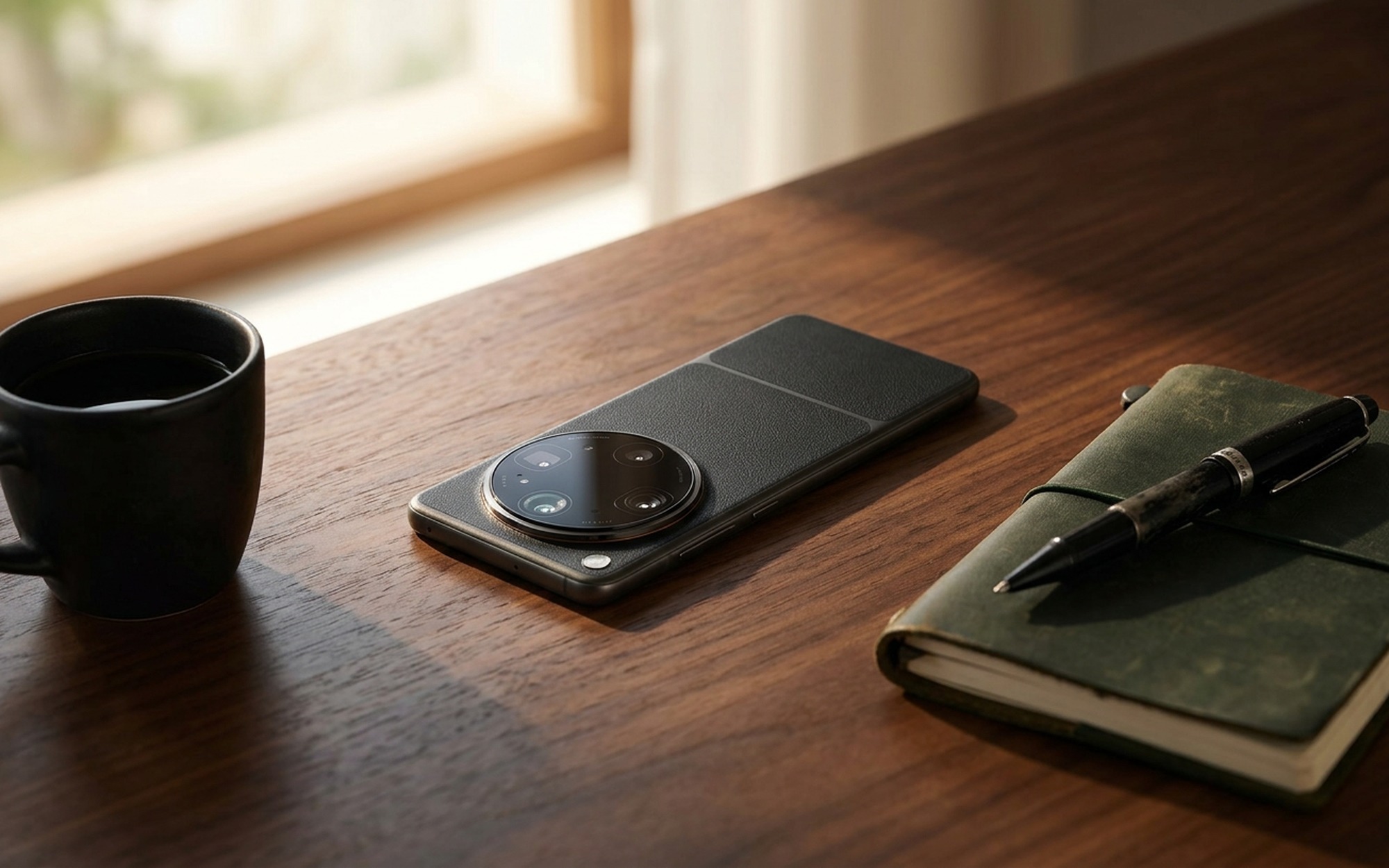
The OPPO Find X9 Ultra does not try to be the best smartphone. It tries to be the best camera that happens to be a smartphone. Announced April 21, 2026, and available globally from May 8, 2026, it ships with four Hasselblad-tuned lenses – including two 200-megapixel sensors – an O-Log2 video pipeline carrying ACES certification, and a 7050mAh battery designed to outlast a full day’s shoot. Starting at $1,499 for 12GB/512GB, it is the most focused camera phone OPPO has ever built.
What Is the OPPO Find X9 Ultra?
The Find X9 Ultra is the apex device in OPPO’s 2026 Find X lineup, built around a Snapdragon 8 Elite Gen 5 processor with OPPO’s Trinity Engine, delivering a claimed 20% faster CPU and 23% faster GPU performance versus the previous generation. The 6.82-inch 2K ProXDR AMOLED display runs at 144Hz with a 3,600-nit peak and drops to 1 nit for night viewing – a range that makes the screen equally usable under direct sunlight and in a dark room.
Configurations go up to 16GB RAM and 1TB storage. Triple water resistance – IP66, IP68, and IP69 certification – makes it genuinely usable in rain, surf spray, and dusty field conditions: exactly the environments where a capable camera matters most. ColorOS 16 adds AI tools including on-device transcription, real-time menu translation, and an AI writing assistant, but the software is in service of the hardware story, not the other way around.
Dual 200MP Cameras: The Hasselblad Advantage
Most 2026 flagships use a 200MP main sensor backed by lower-resolution supporting lenses. OPPO put two 200MP sensors in the Find X9 Ultra, and both carry Hasselblad tuning.
The main camera is built around a Sony LYTIA 901 chip measuring 1/1.12 inches – currently the largest sensor in any 200MP phone – at f/1.5 and 23mm equivalent focal length. At this aperture and sensor size, light intake exceeds a typical 1-inch compact camera sensor. In practice, this means richer shadow detail in indoor scenes and cleaner high-ISO performance when the light drops. OPPO’s second-generation Danxia Original Color lens delivers a rated 15-stop dynamic range; backlit portraits and high-contrast urban night scenes retain highlight and shadow detail that compresses to blown or crushed pixels on competing hardware.
The 3x Super Portrait Telephoto is a 1/1.28-inch 200MP sensor at 70mm equivalent and f/2.2. This focal length delivers the natural subject-to-background compression that makes portrait photography work, and having a full 200MP at 70mm means you can crop aggressively into the frame and still have a 50MP-quality image. The 70mm portrait telephoto outperforms every competing flagship at this specific range – the closest equivalent we’ve tested was the Huawei Pura 90 Pro Max, which brought a comparable 200MP telephoto approach to the 2026 flagship market.
Both cameras process through Hasselblad Natural Colour Solution, a colour calibration methodology that prioritises accurate skin tones and controlled highlight rolloff over the artificially vivid processing that most phone cameras default to. The resulting images look like they were taken by a camera, not optimised by an algorithm.
10x Periscope Zoom: 230mm in Your Pocket
The fourth camera achieves 230mm equivalent focal length through a five-reflection prism, compressing super-telephoto reach into the thickness of a jacket-pocket device. True 10x optical zoom captures at 50MP resolution; OPPO’s LUMO internal optical zoom technology extends this to lossless 20x zoom at 12MP, and digital zoom runs to 120x for extreme reach.

Where the periscope delivers: In daylight from 3x to roughly 8x, images have genuine optical clarity – wildlife, distant architecture, street candids from across a plaza. The 230mm macro mode at 200MP is a notable capability for product and nature photographers who need extreme close-up detail without a dedicated macro lens. At 10x, the Find X9 Ultra resolves detail that phone digital zoom simply cannot replicate.
The honest limits: The 1/2.75-inch periscope sensor is substantially smaller than the main and portrait cameras. Above ISO 400 in low light at 10x, noise becomes visible. At 20x and beyond, optical image stabilisation manages static hand-held shooting but not walking motion – a monopod or surface contact is recommended for critical work. These constraints are consistent with every optical periscope zoom available in 2026; physics defines what any phone-sized lens can do at 230mm equivalent.
For photographers working primarily in daylight at mid-to-long telephoto distances, the periscope is a genuine creative tool with few rivals. Night telephoto remains a limitation across the entire phone camera category. Full sensor specifications for all four lenses are available on the OPPO Find X9 Ultra specs page at GSMArena.
O-Log2 Video: A Pro Cinema Pipeline on a Phone
O-Log2 is OPPO’s second-generation logarithmic video format, and in the Find X9 Ultra it earns ACES (Academy Color Encoding System) certification – the colour management standard used in professional feature film post-production. This makes the Find X9 Ultra the first smartphone video pipeline to achieve this benchmark, and the practical implications are significant.
O-Log2 footage from this phone can be mixed with footage from RED, ARRI, or Sony Cinema cameras in a shared ACES colour space without a conversion step. It is no longer a matter of approximating a phone to look like camera footage – it is native pipeline compatibility.
Core video specifications:
- 8K at 30fps with 10-bit Log recording
- 4K at 120fps Dolby Vision on both the main and 3x telephoto
- 4K at 60fps Dolby Vision on all four lenses
- Live 3D LUT preview and LUT burn-in while recording O-Log2
- Custom LUT import from DaVinci Resolve, Capture One, or Lightroom
OPPO provides technical O-Log2 downloads – Input Device Transforms and colour matrix files – for editors working in DaVinci Resolve or Final Cut Pro. The recommended workflow is three steps: shoot O-Log2 on device, apply the IDT in your NLE, apply your LUT, export to delivery space. It works cleanly the first time, which cannot be said of most phone Log formats.
For colour-conscious videographers currently carrying a mirrorless for Log video and a phone for everything else, the Find X9 Ultra is the first phone where consolidating that loadout makes genuine creative sense.
Hasselblad Master Mode: Pro Results for Anyone
Hasselblad Master Mode minimises computational processing to deliver colour rendering, tonal gradation, and shadow handling drawn from Hasselblad medium-format camera profiles. The visual language is deliberately restrained – slightly lower saturation, lifted shadow detail, reduced edge sharpening – and produces images that stand apart from the algorithmically vivid output typical of computational phone photography.
In Auto, Master Mode handles exposure, focus, and white balance without input. The Hasselblad colour profile is applied automatically, and results are consistently good in natural and mixed light. There is no prerequisite knowledge to get compelling photographs.
In the Pro layer, full manual controls are exposed: ISO, shutter speed, white balance, focus peaking, real-time histogram, and RAW 200MP capture. Colour profiles – Natural, Vivid, Cinematic, and the custom XNP profile co-developed with Hasselblad – are selectable per shot. Switching between profiles takes a single tap; the histogram updates in real time.
Beginners can pick up Master Mode in an afternoon. The interface is clearly labelled, the feedback is immediate, and the default Auto behaviour produces photographs that are more interesting than what most phones deliver by default. Advanced controls are available when your skills grow into them – they do not get in the way before that point.
OPPO Find X9 Ultra vs. Galaxy S26 Ultra vs. iPhone 17 Pro Max
Tom’s Guide tested over 150 side-by-side images comparing the Find X9 Ultra against the Galaxy S26 Ultra across daylight, low-light, zoom, and portrait conditions. The findings reflect a clear hardware differentiation across the three platforms:
| OPPO Find X9 Ultra | Samsung Galaxy S26 Ultra | iPhone 17 Pro Max | |
|---|---|---|---|
| Main sensor | 1/1.12″ 200MP, f/1.5 | 200MP ProVisual | 1/1.28″ 48MP Fusion |
| Portrait telephoto | 200MP 3x (1/1.28″, 70mm) | 50MP 3x | 48MP 5x |
| Long-reach zoom | 50MP 10x optical | 200MP 5x + hybrid 10x | 25x digital |
| Video flagship feature | O-Log2 ACES, 8K 30fps | ProVisual 8K, best stabilisation | ProRes 4K 120fps |
| Low-light main camera | Best in comparison | Close second | Third |
| Video stabilisation (moving) | Good | Best in class | Excellent |
The OPPO’s 3x periscope sensor is roughly 5x larger by area than Samsung’s 3x telephoto lens. That means portrait and mid-range telephoto images at 70–200mm equivalent go clearly to the Find X9 Ultra – richer micro-detail, stronger subject separation, better dynamic range at the frame edges. Samsung holds its lead at extended reach (5x and beyond) and on stabilised video for moving subjects. Apple’s ProRes pipeline and consistent scene-to-scene processing still give the iPhone 17 Pro Max an advantage for narrative video production.
The conclusion is audience-specific. Still photographers – portraits, travel, street – have the strongest case for the OPPO. Videographers shooting handheld without a gimbal will find Samsung and Apple closer to ideal.
Battery Life: 7050mAh Under Heavy Camera Use
The 7050mAh Glacier Battery is rated at over 14 hours of continuous runtime. In real shooting conditions – a mix of stills, 4K video clips, and screen-on review throughout a day – the battery comfortably clears 10 hours before needing a charge. Sustained 8K video recording with live LUT preview running reduces that figure to 7–9 hours, which represents intensive professional use rather than typical day-trip photography.
The 100W SUPERVOOC charger takes the phone from flat to roughly 50% in 20 minutes – enough for a quick top-up between locations. The 50W AIRVOOC wireless charging is fast enough to make overnight pad charging the practical default without any planning overhead.
Relative to the iPhone 17 Pro Max, the Find X9 Ultra has a meaningfully larger battery. For photographers who monitor battery percentage nervously during long shoots, this is a substantive quality-of-life advantage.
Is the OPPO Find X9 Ultra Worth Buying?
The Find X9 Ultra is built around a single proposition: the best camera OPPO can put in a phone. For still photographers who want to carry one device instead of two, the argument it makes is the strongest in 2026. The dual 200MP Hasselblad system at 23mm and 70mm is unmatched in the current flagship market at the portrait focal length. O-Log2 with ACES certification is the most capable video pipeline available on any Android phone. The 7050mAh battery removes the anxiety of a long shooting day.
The $1,499 starting price is the honest counterargument. Samsung and Apple offer deeper third-party app ecosystems, more predictable long-term software support in Western markets, and superior stabilisation for video. If you are established in the Apple ecosystem and depend on ProRes workflows, the iPhone 17 Pro Max remains the lower-friction choice. If you shoot primarily stills, need the best zoom in its class, and want professional Log video without carrying a separate camera, the Find X9 Ultra earns its price.
For a broader look at what OPPO’s 2026 lineup offers, our OPPO Find N6 review covers the foldable alternative for those who also want a different form factor from the same brand.
- Dual 200MP Hasselblad cameras at 23mm and 70mm — unmatched at portrait focal length
- 1/1.12-inch main sensor with f/1.5 aperture: the largest 200MP sensor in any 2026 phone
- O-Log2 with ACES certification — natively compatible with professional film editing pipelines
- 8K 30fps and 4K 120fps Dolby Vision on both main lenses
- 7050mAh battery rated at 14+ hours of continuous use
- Triple water resistance: IP66, IP68, and IP69
- 100W SUPERVOOC wired + 50W AIRVOOC wireless charging
- Starts at $1,499 — a significant flagship investment
- Samsung and Apple retain edge on video stabilisation for moving subjects
- 10x periscope uses a smaller 1/2.75-inch sensor — low-light telephoto performance lags main lenses
- ColorOS 16 requires adjustment for users switching from iOS or stock Android
- Global availability narrower than Samsung or Apple at launch
Frequently Asked Questions
What is O-Log2 video recording on a smartphone?
O-Log2 is OPPO’s second-generation logarithmic video profile, which compresses the camera sensor’s full tonal range into a flat file that preserves shadow and highlight detail for colour grading in post-production. On the Find X9 Ultra, O-Log2 carries ACES (Academy Color Encoding System) certification, meaning the footage is natively compatible with professional film editing pipelines in DaVinci Resolve and Final Cut Pro without additional colour space conversions.
Is the OPPO Find X9 Ultra really good enough to replace a DSLR?
For still photography in daylight and controlled indoor settings, it comes remarkably close — the dual 200MP Hasselblad system, 15-stop dynamic range, and RAW 200MP capture deliver quality that competes with entry-level to mid-range mirrorless cameras. For professional video with moving subjects or in very low light, a dedicated mirrorless still holds advantages in stabilisation, lens choice, and thermal performance during extended recording sessions.
What are the best LUTs and editing workflows for OPPO Find X9 Ultra O-Log2 footage?
OPPO provides official Input Device Transforms (IDTs) and colour matrix files for DaVinci Resolve, Final Cut Pro, and Premiere Pro on their O-Log Technical Downloads page. For creative LUTs, Alexa-style warm film grades translate well to O-Log2’s wide colour gamut. The phone also supports importing custom 3D LUT files directly into the camera app for real-time preview and burn-in while recording — no desktop software required for quick colour work.
What are the pros and cons of the OPPO Find X9 Ultra 10x periscope lens?
Pros: 230mm equivalent optical reach in a phone body, lossless 20x zoom at 12MP via LUMO technology, and genuine macro capability at 200MP resolution. Cons: the 1/2.75-inch sensor is smaller than the main and portrait lenses, so noise becomes visible in low light above ISO 400 at 10x. Optical image stabilisation handles hand-held static shooting but not active walking motion at extreme zoom settings.
How long does the OPPO Find X9 Ultra battery last during heavy camera use?
OPPO rates the 7050mAh battery at over 14 hours of continuous runtime. During intensive camera sessions — extended 4K video recording, 200MP RAW stills, and live LUT preview active — expect 7 to 9 hours. A mixed day of photography combined with normal phone use typically yields 10 to 12 hours. The 100W wired charger restores around 50% in approximately 20 minutes.
Can beginners use OPPO Find X9 Ultra Master Mode without professional training?
Yes. In Master Mode’s Auto setting, the phone handles exposure, focus, and white balance automatically while applying the Hasselblad colour profile to every shot — no manual input required. The results have a more refined, film-influenced look than standard computational phone photography. Advanced manual controls including ISO, shutter speed, RAW capture, and custom colour profiles are available when needed, but are not required to produce excellent images from day one.