The problem is those plastic films use micro-louvers that block vertical light. They slice your maximum brightness by up to 30 percent, destroy color accuracy, and give the screen a fuzzy, headache-inducing texture. Samsung just killed the privacy screen protector.
At the launch event for the Galaxy S26 series, I managed to get some early hands-on time with the S26 Ultra. Samsung decided to focus on a very human problem instead of just throwing another megapixel at the wall.
The result is surprisingly effective, proving there are still meaningful hardware problems left to solve in the smartphone market.
The Screen That Hides Itself
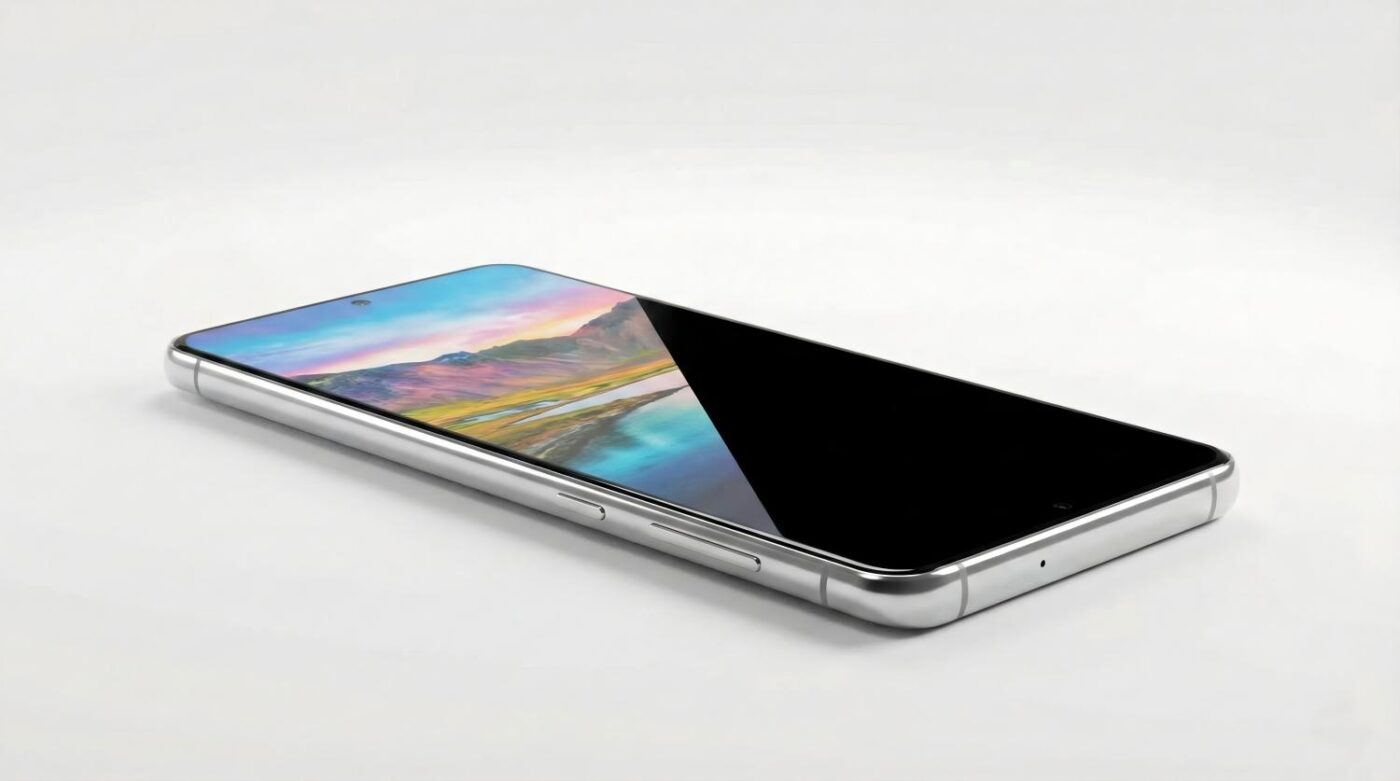
Samsung calls it a Privacy Display. This is a hardware-level solution built directly into the OLED substrate. Instead of slapping a dark filter over the top, the S26 Ultra uses a mix of wide-angle and narrow-angle pixels.
You can toggle it directly in the settings. Set it to the maximum level, and the viewing angle tightens to exactly 45 degrees. Anyone standing beside you just sees a dead, black panel.
Because this happens at the pixel level, the implementation is brilliant. You can set it up to trigger only on specific areas. If you get a text message, only the notification banner goes dark to onlookers.
The rest of your screen stays perfectly bright and vibrant. You get the crisp 2K resolution without the muddy film overlay.
The Front Camera Trade-Off
To house the necessary sensors for this new display tech, the front camera hole punch is noticeably larger and sits a bit lower this year.
It is a minor visual downgrade. But for anyone tired of people shoulder-surfing on flights, the trade-off is absolutely worth it.
The Return to Reason: Design and Ergonomics
For the past two years, premium phones chased titanium frames. Samsung has backtracked, as the S26 Ultra drops the titanium for traditional aluminum.
Aluminum offers several clear advantages:
- It dissipates heat better.
- It is lighter in the hand.
- It is cheaper to machine.
The sharp, right-angled corners of the S24 and S25 are also gone. Samsung finally softened the edges with a much wider radius. It feels like a normal phone again, not a chopping board digging into your palm.
Fixing the ergonomics created a new headache. Because the corners are rounded, the internal cavity for the S-Pen is pinched. The stylus now sticks out slightly from the bottom rail. Even worse, it has a strict orientation. If you slide the pen in backwards, a tiny plastic triangle protrudes from the frame. I just wish the S-Pen fit a little better, as it feels unrefined for a device that costs this much.
Additionally, do not expect magnetic Qi2 charging here. Magnets interfere with the Wacom digitizer layer required for the S-Pen. Samsung chose to keep the stylus working flawlessly over adopting the new wireless charging standard.
AI That Actually Does Things
Samsung wants to brand this as an “Agentic AI” phone. The marketing is heavy, but the execution is getting closer to reality.
The international models feature deep integration with Google’s Gemini and the Perplexity search engine. Bixby is no longer just a voice trigger for alarms.
The demo showed the assistant stringing together multiple commands. It understands complex, messy requests. For example, you can ask it to:
- Find photos from last weekend.
- Open a food delivery app.
- Compare prices.
- Place an order.
Photo editing gets the usual boost as well. You can drop a 3D element into a photo and just tell the AI how you want the lighting to look.
Familiar Cameras, New Look
The camera hardware itself is familiar. The back of the phone now features a generic, chunky camera island instead of the clean, individual lenses of the past.
The S26 Ultra retains the following camera setup:
- 200MP main sensor.
- 50MP ultrawide lens.
- 10MP 3x telephoto lens.
- 50MP 5x telephoto lens.
The primary physical change is a circular aperture on the telephoto lens, which should yield more natural background blur. We will need a full review unit to test that properly.
[IMAGE: Placeholder for S26 Ultra back panel showing the new camera island]
Battery Math and Processing Power
Under the hood, the S26 Ultra runs on the customized Snapdragon 8 Elite Gen 5.
Some regional standard models might see the return of Exynos built on Samsung’s new 2nm GAA process. This is a clear attempt to win back trust after recent manufacturing struggles.
The battery capacity stays at 5000mAh. The good news is the archaic 45W charging limit is dead. The S26 Ultra finally supports 60W wired charging.
The bad news involves battery longevity. Early regulatory filings indicate the S26 series battery health will drop to 80 percent after 1,200 charge cycles.
Previous generations advertised 2,000 cycles. To put this in perspective, Apple rates the iPhone 16 at 1,000 cycles. Samsung is just returning to the industry average, but it is a noticeable downgrade from last year.
Memory chip prices have skyrocketed globally over the past year. Samsung manufactures its own RAM, but the mobile division still has to pay the internal premium, and that cost is passed directly to the buyer.
The base S26 starts at roughly $970 (converted from 6999 RMB). The S26 Ultra, equipped with 12GB of RAM and 256GB of storage, pushes well past the $1,300 mark. The smartphone market peaked a long time ago, and we are living in an era of diminishing returns for raw performance.
Check back next week when we put the final retail unit through our full battery and camera gauntlet.