
It takes a special kind of confidence to look at the smoking crater where the Humane AI Pin used to be and say, “I can do that better.”
By now, we all know the story. Humane’s projected laser display was unreadable. The device overheated enough to leave marks. It was slow, confident only in its hallucinations, and eventually, the company’s remnants were reportedly scraped up by HP for a fraction of its valuation. The industry consensus was clear: nobody wants a phone without a screen.
Yet, reports emerging from Cupertino suggest Apple is ignoring this graveyard entirely. The company is allegedly developing a device that sounds suspiciously like a spiritual successor to that very failure. And they aren’t just testing the waters. If the leaks are accurate, they are preparing a first production run of 20 million units.
- The Concept: A screenless, magnetic “AirTag Pro” wearable designed for ambient computing.
- Release Date: Rumored for 2027 with a massive 20 million unit target.
- The Brains: Powered by “Project Campos,” a rebuilt Siri likely relying on Google’s Gemini servers.
- The Risk: Apple is betting it can solve the heat and latency issues that destroyed the Humane AI Pin.
⚔️ The Battle of the Badges: Apple vs. The Failures
| Feature | 🍎 Apple “AirTag Pro” (Rumored) | Humane AI Pin (Failed) | Rabbit R1 (Flop) |
|---|---|---|---|
| Form Factor | Circular, Magnetic (Alum & Glass) | Square Badge + Battery Booster | Orange Plastic Square |
| Display | None (Ambient Audio/Visual) | Laser Ink Projector (Palm) | 2.88″ Touchscreen |
| The Brains (AI) | Hybrid: New Siri + Google Gemini | GPT-4 (Cosmos OS) | “Large Action Model” (Scripts) |
| Sensors | 2 Cameras (Wide/Std), 3 Mics | 1 Camera, Depth Sensor | 360° Rotating “Eye” |
| Price / Sub | ❓ Unknown (Likely Apple One tied) | $699 + $24/mo (Required) | $199 (No Sub) |
| Status | 2027 Release Target | 💀 Discontinued / Sold to HP | ⚠️ Niche Toy / “Barely Reviewable” |
Table: Comparison of Apple’s rumored specs vs. failed market predecessors.
The “AirTag Pro” Concept
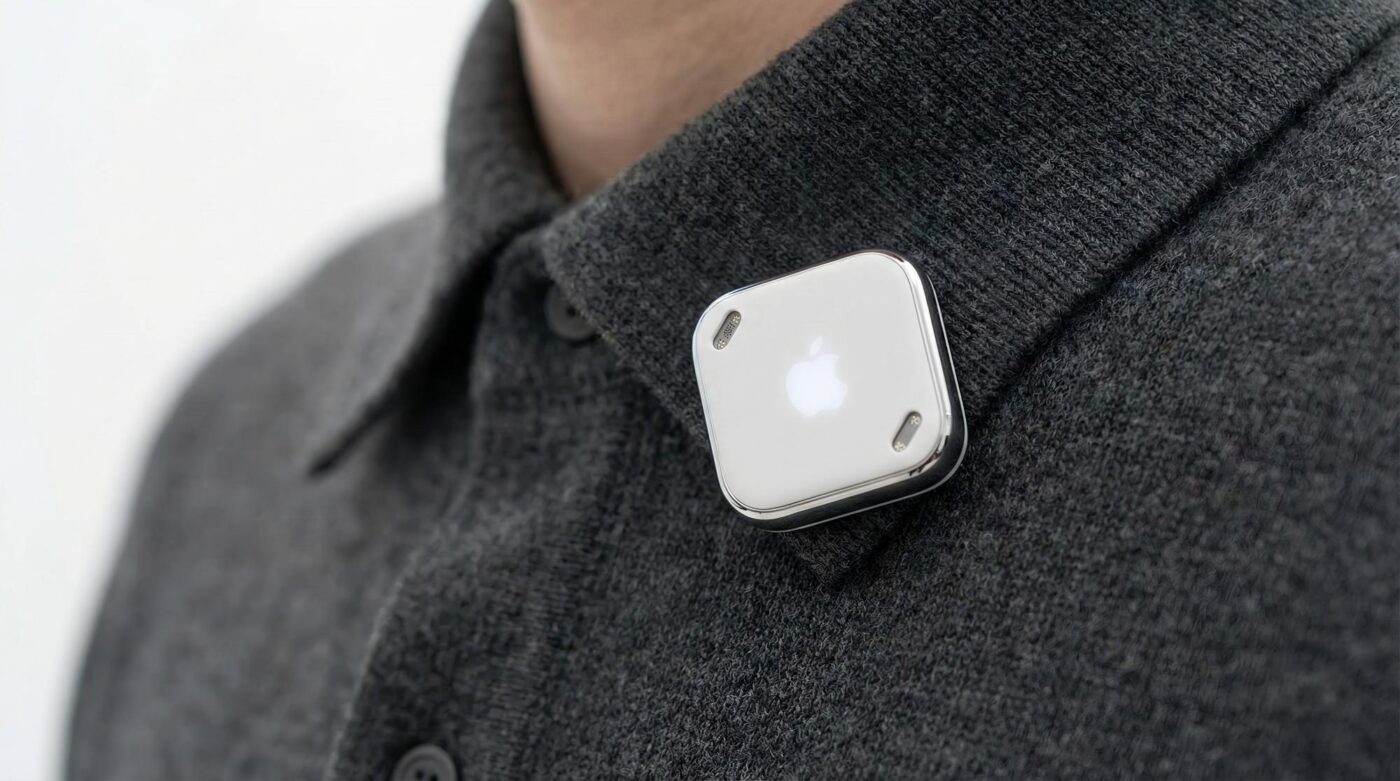
The hardware profile is austere. Imagine an AirTag that has been hitting the gym. It is thicker, denser, and packed with sensors.
According to supply chain chatter, this nameless rectangle features two cameras (wide and standard), three microphones, and a speaker array. It clips onto your shirt magnetically, borrowing the charging mechanism from the Apple Watch.
Form Factor: Magnetic “Clip-on” Badge (Screenless)
Sensors: Dual Camera Array (Wide + Standard), Triple Mic Array
Interface: Voice & Computer Vision (No tactile UI)
Connectivity: Likely reliant on tethered iPhone processing or cloud handoff to reduce thermal throttling.
Ambient Computing: The Interface
There is no screen. This is a pure “ambient computing” play. You don’t look at it; it looks at the world for you. It relies entirely on computer vision and voice interaction to parse your environment. It effectively wants to be the interface between you and reality, stripping away the friction of pulling a glass slab out of your pocket.
It sounds elegant on paper. In practice, it sounds like a privacy nightmare and a usability black hole. But Apple has one advantage Humane did not: silicon that doesn’t melt your shirt.
Brain Transplant: The Google Dependency
The hardware is only half the equation. The reason the Rabbit R1 and Humane Pin failed wasn’t just heat; it was stupidity. They promised a Jarvis-like assistant but delivered a laggy chatbot.
Apple’s solution involves swallowing its pride. The rumor mill indicates that the new Siri—code-named “Campos”—is being rebuilt from the floor up. But it’s not running entirely on Apple’s own metal.
Reports suggest a massive infrastructure deal where Apple is paying Google roughly $1 billion annually. The heavy lifting for this new AI isn’t happening on the A-series chip in your pocket alone; it’s being offloaded to Google’s Gemini models running on TPU servers.
This creates a weird dynamic. Apple, the company that sells you on “on-device privacy,” is potentially piping its most advanced intelligence through Mountain View’s servers. The trade-off is functionality. This new Siri is supposed to possess “Screen Awareness,” allowing it to read your emails, check your calendar, and “see” what you are doing in real-time to offer context-aware help.
Fear as a Motivator
Why build this? Why risk the brand on a form factor that has already been publicly shamed? Because the iPhone cannot live forever.
Eddy Cue has reportedly voiced concerns that within a decade, the smartphone as we know it might be redundant. If the “post-smartphone” era is coming, Apple is terrified of missing the door.
- Meta: Finding success with Ray-Ban smart glasses.
- OpenAI: Poking around hardware collaborations (Jony Ive rumors).
- Google: Partnering with Samsung on new XR headsets.
If the future is heads-up displays and ambient audio, Apple cannot afford to be stuck selling rectangular pocket weights.
The 2027 Gamble
The timeline for this device is allegedly set for 2027. That gives Apple a year to figure out how to make a screenless device useful rather than annoying.
The skepticism here is warranted. We have seen “voice-first” revolutions promised since the Amazon Echo first landed, and yet we still mostly use them to set kitchen timers. To sell 20 million units of a clip-on AI badge, Apple needs to solve the latency problem that killed its predecessors.
If Apple pulls this off, it validates the “ambient computing” dream. If they fail, it will be the most expensive experiment in the company’s history since the Lisa.
For now, keep your wallet closed. The graveyard of AI wearables is full, and there is always room for one more.
[CTA: Join the discussion. Would you wear a camera on your shirt if it meant leaving your iPhone at home? Drop a comment below.]
Frequently Asked Questions
❓ Will the Apple AI wearable record video without permission?
While Apple has not confirmed specific privacy protocols, the device is expected to feature a hardware-level “Privacy LED” similar to the Humane Pin to alert others when the camera is active. However, unlike competitors, Apple traditionally emphasizes “on-device” privacy processing. The concern lies in the reported partnership with Google; complex data requests may need to be offloaded to cloud servers, which introduces new privacy variables.
📱 Do I need an iPhone to use the Apple AI wearable?
Yes, it is highly likely. Industry leaks suggest the device will function similarly to the GPS-only Apple Watch. It will rely on a tethered iPhone in your pocket or bag for internet connectivity and heavy processing. This “tethering” strategy is crucial for preserving battery life and preventing the overheating issues that destroyed the Humane AI Pin.
🆚 How is this different from the failed Humane AI Pin?
The primary difference is the ecosystem and silicon. Humane attempted to build a standalone phone replacement from scratch. Apple is building an accessory that leverages the massive processing power of the iPhone you already own. Additionally, Apple is reportedly integrating a hybrid AI model (the new Siri + Google Gemini) rather than relying solely on a single, hallucination-prone LLM.
📅 When is the release date?
Current supply chain reports and analyst predictions point to a release window in 2027. This timeline suggests Apple is taking an extra year to refine the “Project Campos” AI integration to avoid a premature launch.

- Honor Magic V6 Specs Breakdown: The 7,150mAh Foldable That Undercuts Samsung by 47% - March 12, 2026
- Apple Spring 2026 Mac Lineup Review: M5 Pro/Max & Studio Display XDR - March 9, 2026
- Honor’s MWC 2026 Lineup: A Motorized Robot Phone and a Foldable That Finally Fixes Battery Anxiety - March 4, 2026

