
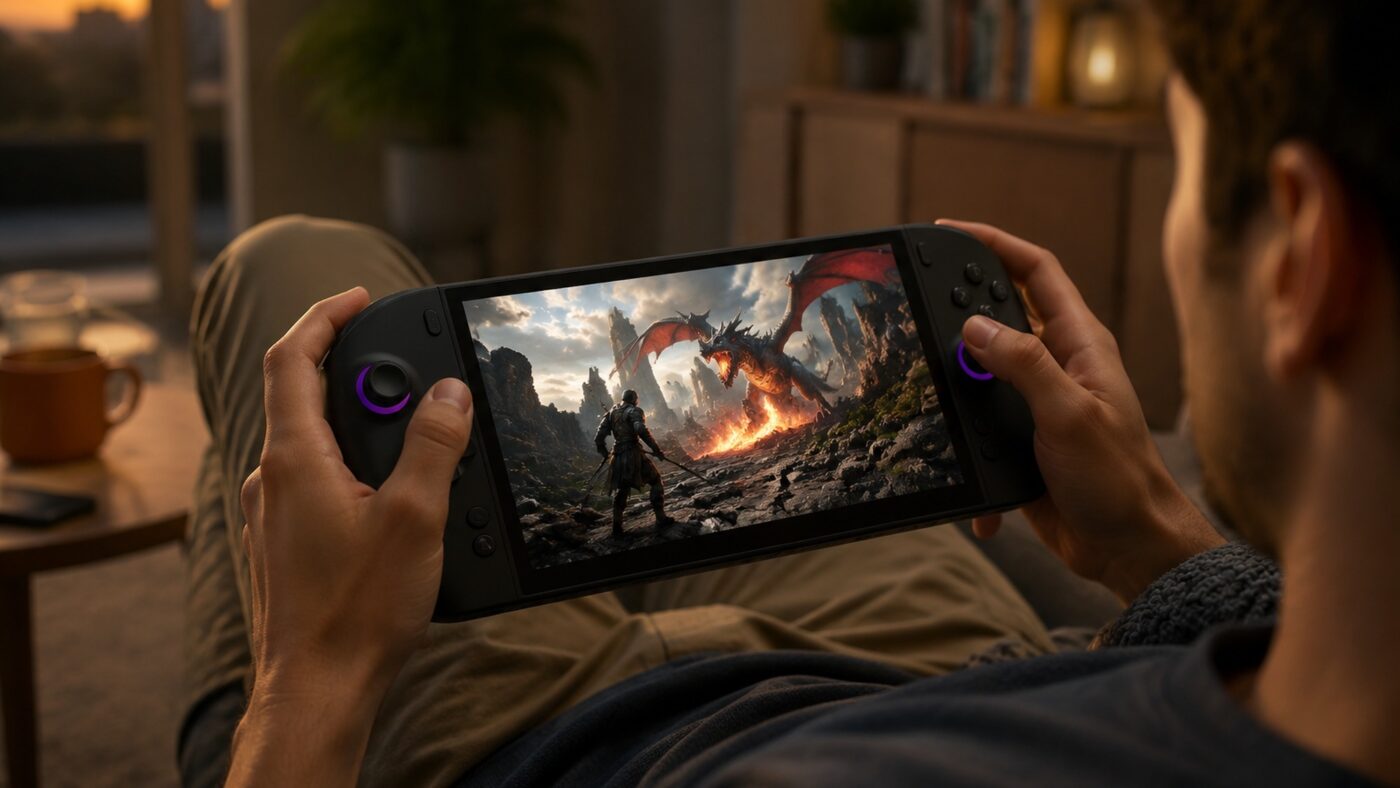
On June 23, 2026, OneXPlayer did something none of the big handheld brands had managed: it shipped a portable gaming PC built around Intel’s brand new Arc G3 Extreme chip before AMD’s partners could respond. The OneXPlayer 3 is not just another Windows handheld with a spec bump. It is the first device to carry Intel’s dedicated Panther Lake handheld silicon, and it wraps that chip in a four in one body that converts from a handheld into a tablet, a laptop, and a desktop console.
That combination makes this one of the most interesting handheld launches of the year, and also one of the most expensive. Starting at 1,399 dollars on its official Indiegogo launch page, the OneXPlayer 3 is priced like a premium laptop, not a Steam Deck rival. This review breaks down what the Arc G3 Extreme actually delivers, how the modular design works in practice, where the 85Wh battery and the swappable battery question land, and how it compares to the Steam Deck, ROG Ally, and Legion Go.
What Is the OneXPlayer 3 and What Are Its Key Specs?
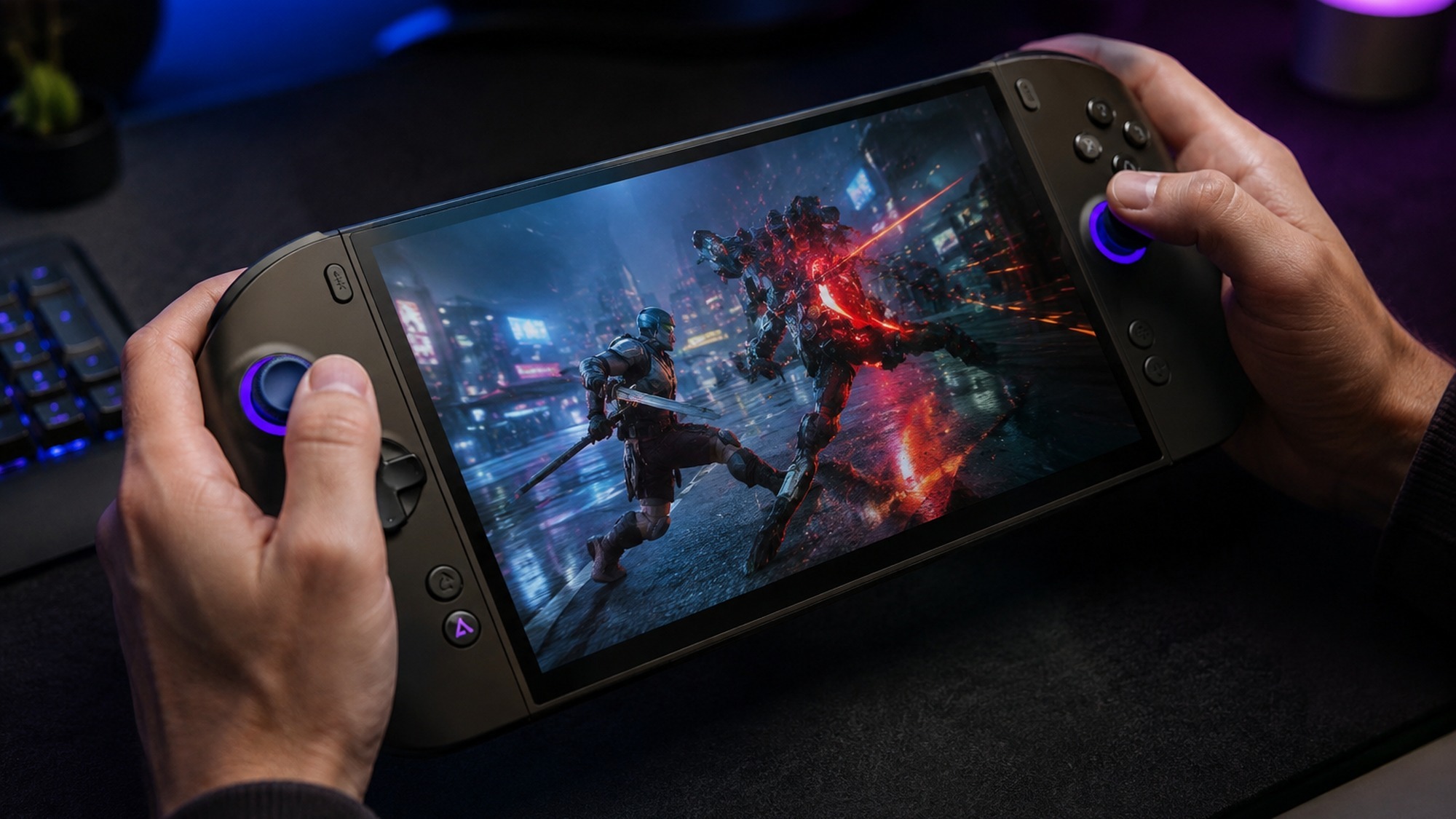
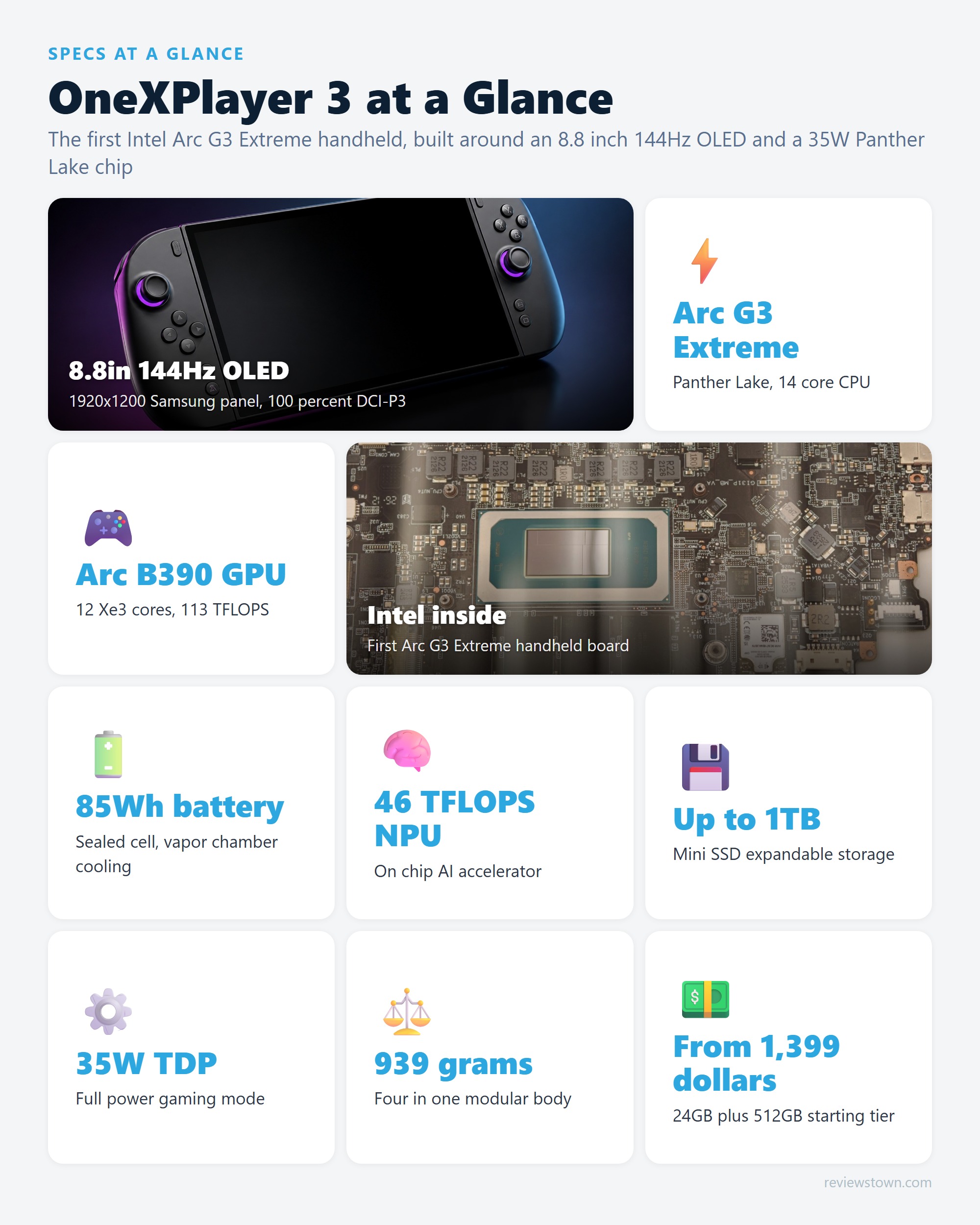
The OneXPlayer 3 is a three in one handheld gaming PC: a Windows 11 machine with an 8.8-inch widescreen OLED, detachable controllers, and a magnetic keyboard. At its core sits the Intel Arc G3 Extreme, a Panther Lake chip with a 14 core CPU (two performance cores up to 4.7GHz, eight efficiency cores, and four low power cores) and an Arc B390 GPU built from 12 Xe3 cores. OneXPlayer rates the GPU at 113 TFLOPS and the on chip NPU at 46 TFLOPS, fed by LPDDR5X memory running at 8533 MT/s. These are manufacturer figures from the launch, not independent test numbers, so treat them as the ceiling rather than the everyday result.
The rest of the sheet is just as aggressive. The display is an 8.8-inch Samsung OLED at 1920×1200, 144Hz, with HDR and 100 percent DCI-P3 coverage, which is brighter and more color accurate than the LCD panels on most AMD handhelds. Worth noting is the cooling. OneXPlayer pairs the 35W chip with a vapor chamber liquid cooling system it measures at 11,203 square millimeters of vapor chamber and a 16,644 square millimeter aluminum fin array, a clear signal the brand expects to sustain that 35W rather than throttle it. Storage comes in 512GB or 1TB, both expandable through a Mini SSD slot, and the whole device weighs 939 grams.
What is a three in one handheld gaming PC?
It is a full Windows gaming computer the size of a tablet that splits into separate parts, so one device works as a game console, a tablet, and a laptop.
It runs desktop Windows 11 on the Arc G3 Extreme, so any PC game store, from Steam to Game Pass, installs natively.
The grips slide off the sides, each with Hall-effect sticks and its own 1,100mAh battery for up to 12 hours of wireless play.
A backlit keyboard clips to the bottom edge, turning the 8.8-inch screen into a small Windows laptop for work or browsing.
Dock it to a monitor over USB4 and the same machine becomes a small desktop, no second computer required.
Intel Arc G3 Extreme: The First Dedicated Intel Handheld Chip
The headline reason to care about the OneXPlayer 3 is the silicon. The Intel Arc G3 Extreme is the first chip Intel has designed specifically to fight AMD on its home turf of handheld gaming, and it is the Extreme tier of the Panther Lake family. Where AMD’s Z2 Extreme leans on a Radeon 890M integrated GPU, Intel built the Arc B390 with 12 of its newest Xe3 graphics cores, the same architecture you find in Intel’s discrete Arc B series cards, shrunk to fit a handheld power budget.
The CPU layout tells you how Intel approached efficiency. Instead of AMD’s all big core design, Panther Lake splits work across two fast performance cores, eight efficiency cores, and four ultra low power cores that handle background tasks while sipping battery. According to Tom’s Hardware’s breakdown of the Arc G3 launch, this is the same Panther Lake silicon Intel is pushing across thin laptops, which means handhelds inherit laptop class power management. We cover that chip on its own in our Intel Core Ultra X9 388H Panther Lake review, and the OneXPlayer 3 is essentially that platform tuned for games.
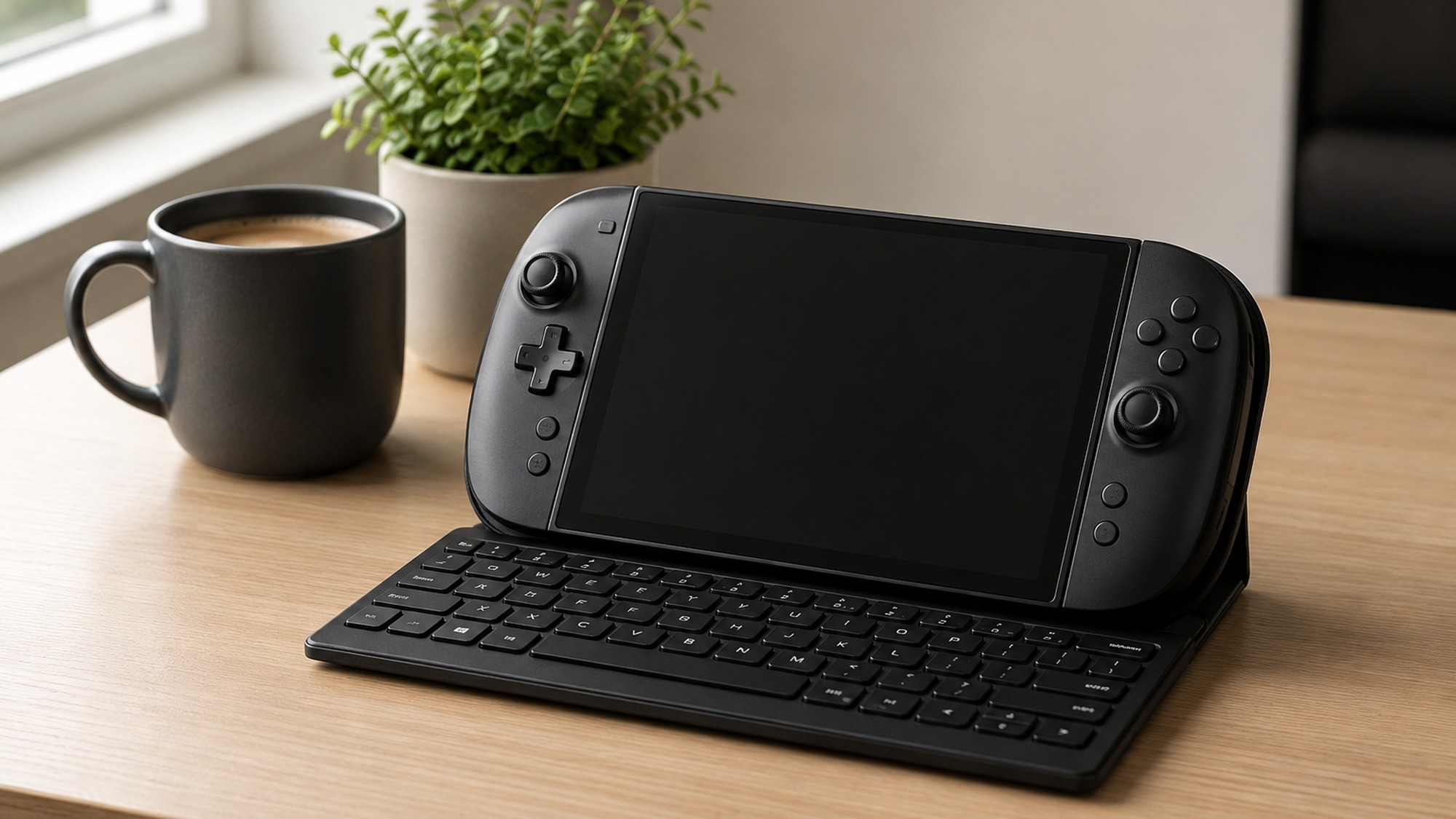
Early leaked CPU-Z captures of an engineering sample confirm the chip identifies as Arc G3 Extreme on the Panther Lake node with a 14 thread layout, which matches OneXPlayer’s claims rather than contradicting them. That is a good sign this early: pre release silicon often disappoints, and here the leaks line up with the marketing.
How Does the Arc G3 Extreme Compare to AMD’s Z2 Extreme?
This is the question that decides whether the OneXPlayer 3 is a genuine leap or just a price hike, so it deserves real numbers with sources attached. On CPU work, benchmark leaks reported by Tom’s Hardware put the Arc G3 Extreme around 25 percent ahead of the AMD Z2 Extreme in multi threaded tasks and about 8 percent ahead in single thread. That is a meaningful gap, not a rounding error, and it is rare for Intel to lead AMD on a mobile chip at all.
Graphics is where it gets interesting. In Cyberpunk 2077 testing at a 25W power level, independent handheld benchmark coverage measured the older AMD Z1 Extreme at 42 fps, the Z2 Extreme at 46 fps, and Intel’s Panther Lake B390 silicon at 63 fps. That is roughly a 37 percent gaming lead at the same wattage, which lines up with OneXPlayer’s own launch slides claiming a 42 percent advantage over the Z2 Extreme at the full 35W. Manufacturer slides always flatter the product, so the fact that third party Cyberpunk numbers land in the same range is the more convincing evidence. In our view, the GPU, not the CPU, is the real story here, because handhelds are almost always graphics limited.
The one honest caveat is software, not silicon. Intel’s Arc GPU drivers have a shorter track record than AMD’s in games, and day one compatibility on brand new titles has been Arc’s historical weak spot on the desktop. XeSS upscaling helps close the gap and even pushes ahead of AMD’s FSR in some scenes, but anyone buying an Intel handheld is making a small bet that Intel keeps the driver updates coming. That risk is the price of being first.
The Four in One Design: Handheld, Tablet, Laptop, and Desktop
Specs aside, the modular body is what physically sets the OneXPlayer 3 apart from a Steam Deck or a ROG Ally, which are sealed single shape devices. Here the controllers detach from both sides on a connector rail, and a magnetic backlit keyboard clips to the bottom edge. That turns one machine into four different tools depending on what you are doing, and it is the clearest expression yet of the idea that a handheld PC should replace your tablet and travel laptop too.
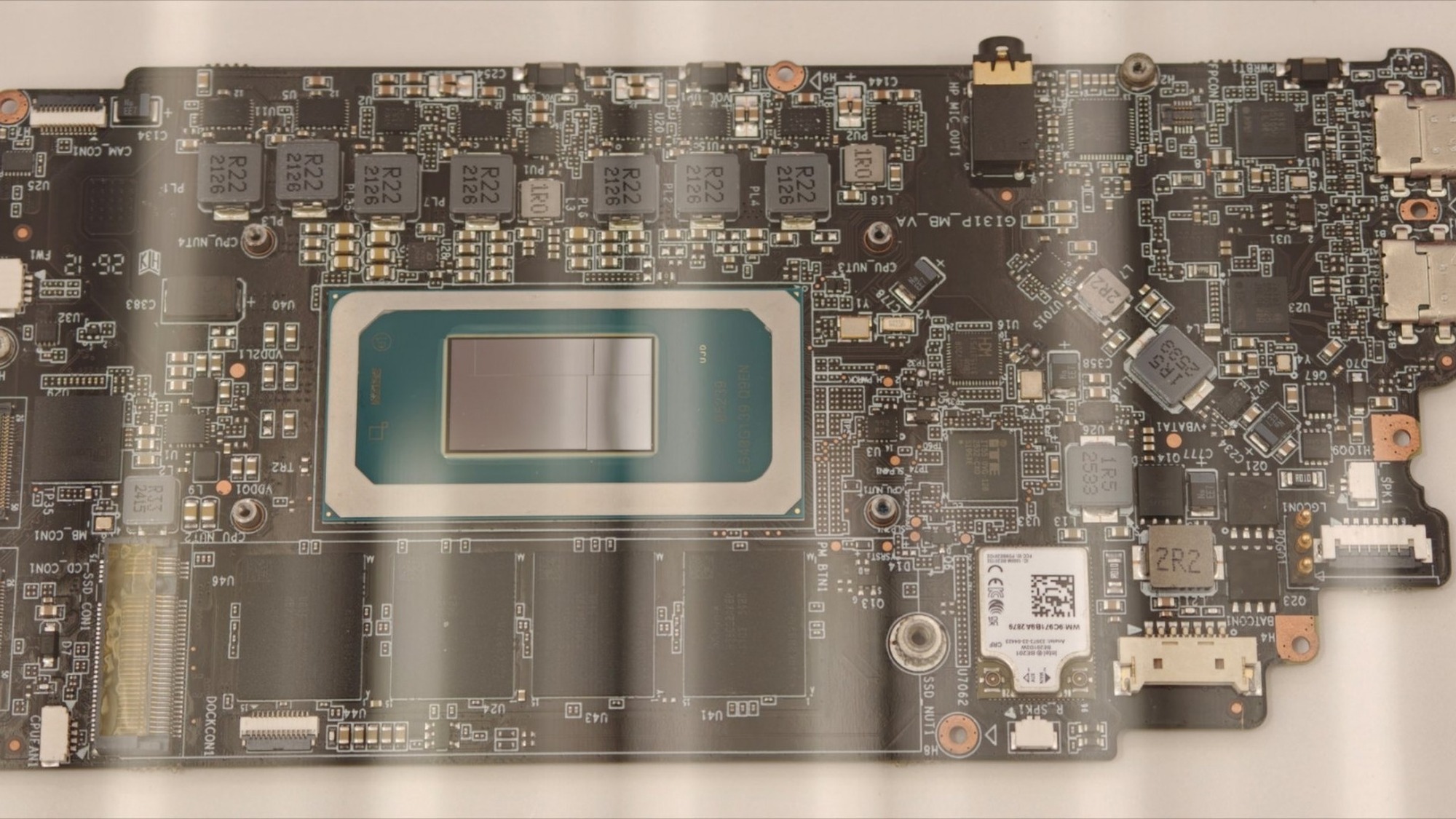
In practice the appeal is real but situational. Detaching the controllers to read on a couch or docking the keyboard to answer email on a plane genuinely removes a second device from your bag. The honest counterpoint is weight and friction: at 939 grams the screen unit alone is heavier than an iPad, and swapping modes means carrying and tracking extra parts. This is a versatility play, and how much you value it depends on whether you actually travel with a tablet and laptop today.
How the detachable controller and keyboard system works
Each part connects independently, so you change form factor in seconds without tools and without powering the device down.
Controllers locked to both sides give a console grip with Hall-effect sticks that resist the stick drift older handhelds suffer.
Slide both grips off and the 8.8-inch OLED becomes a touch tablet, with the controllers playing on for up to 12 hours wirelessly.
The magnetic keyboard snaps to the bottom edge, turning the screen into a pocket Windows laptop for real desk work.
Dock to a monitor over USB4 and pair the wireless controllers for a small living-room console setup.
The Battery Question: Sealed 85Wh vs Detachable Power
The keyword that keeps coming up around this category is the detachable battery, so it is worth being precise, because the OneXPlayer 3 is not actually a swappable battery handheld. The OneXPlayer 3 carries an 85Wh battery sealed inside the chassis, roughly 22,050mAh, which is one of the largest cells in any handheld and the reason OneXPlayer can justify the 35W chip. What it does not do is let you hot swap that pack.
The swappable battery feature lives on OneXPlayer’s sibling models instead. The launch lineup shown alongside the OneXPlayer 3 included the X2 Mini and the Apex Air, both of which use external hot-swappable 85Wh packs you can change mid session without shutting down. So the detachable battery benefit is genuinely part of OneXPlayer’s 2026 strategy, just not on this specific model. The detachable power design, where you carry a spare charged pack and clip it on when the first runs flat, is the closest a handheld gets to unlimited away from outlet runtime, and it is far from a gimmick for long flights or commutes. The trade is weight and a thicker back, which is exactly why the OneXPlayer 3 chose a sealed cell to keep the modular controllers and keyboard as its headline instead. Engadget’s coverage of OneXPlayer’s external battery handheld design is a useful read on how that swappable approach works across the brand’s range.
OneXPlayer 3 vs Steam Deck, ROG Ally, and Legion Go
No handheld is bought in a vacuum, so here is how the OneXPlayer 3 lines up against the three machines most buyers cross shop in 2026. The table focuses on the specs that actually change the experience: chip, screen, battery, and price.
| Spec | OneXPlayer 3 | Steam Deck OLED | ASUS ROG Ally X | Lenovo Legion Go |
|---|---|---|---|---|
| Chip | Intel Arc G3 Extreme | AMD custom (Zen 2) | AMD Z1 Extreme | AMD Z1 Extreme |
| GPU | Arc B390, 12 Xe3 cores | 8 RDNA 2 CUs | Radeon 780M | Radeon 780M |
| Display | 8.8-inch OLED, 1920×1200, 144Hz | 7.4-inch OLED, 800p, 90Hz | 7-inch LCD, 1080p, 120Hz | 8.8-inch LCD, 1600p, 144Hz |
| Battery | 85Wh (sealed) | 50Wh | 80Wh | 49.2Wh |
| Modular | Controllers plus keyboard | None | None | Detachable controllers |
| Weight | 939g | 640g | 678g | 854g |
| OS | Windows 11 | SteamOS | Windows 11 | Windows 11 |
| Starting price | 1,399 dollars | 549 dollars | 799 dollars | 699 dollars |
The cleanest way to read this is by priority. The Steam Deck OLED is still the value and software champion: SteamOS is the smoothest handheld experience and it costs less than half as much, which is why it remains the default recommendation for most people. The ROG Ally X and Legion Go are the mainstream Windows middle ground. The OneXPlayer 3 sits clearly above all of them on raw GPU power, screen quality, and versatility, and clearly above on price too. Against the closest Intel rival, the MSI Claw 8 EX, the OneXPlayer 3 brings the newer and faster Arc G3 Extreme but gives up the Claw’s wider retail availability and established support network.
The Steam Deck comparison also raises an obvious question for 2026: where is the Steam Deck 2? The answer is that it is not close. According to Tom’s Hardware, Valve is deliberately waiting for a major silicon leap before building a true next generation Deck, with most estimates pointing to a 2027 announcement at the earliest. Valve even raised the current OLED model to 949 dollars in May 2026. That gap is precisely the opening Chinese brands like OneXPlayer are racing to fill, and the Arc G3 Extreme is the kind of generational jump Valve says it is still waiting for.
What Panther Lake Means for the Future of Handheld Gaming
Step back from this one device and the OneXPlayer 3 is a preview of a bigger shift. For three years AMD has had the handheld chip market almost to itself, and that lack of competition is part of why progress felt slow and prices crept up. Intel’s Panther Lake handheld push changes the math: a credible second supplier forces both companies to move faster on performance per watt, which is the single metric that matters most on a battery powered device.
The more important detail is architecture. Panther Lake brings a real GPU architecture, Xe3, and dedicated NPU silicon to handhelds, not just a faster version of last year’s design. That NPU, rated at 46 TFLOPS here, is the part that points furthest forward, because the next wave of upscaling and frame generation is moving onto AI accelerators rather than raw shader cores. A handheld that already ships with a capable NPU is better positioned for whatever XeSS and its rivals become in 2027. In our judgment, the lasting significance of the OneXPlayer 3 is less about this exact device and more about proving that an Intel handheld can lead AMD on a benchmark at all, which reshapes the roadmap for everyone.
Price and Value: Is the OneXPlayer 3 Worth 1,399 Dollars?
Value is where the OneXPlayer 3 gets complicated. The three configurations run 1,399 dollars for 24GB and 512GB, 1,499 dollars for 24GB and 1TB, and 1,699 dollars for 32GB and 1TB. The early bird bundle adds a controller connector, the magnetic keyboard, and a protection bag, which softens the sticker shock a little since those parts would otherwise be paid extras.
Still, this is laptop money for a handheld, and that frames who should buy it. If you only want to play your Steam library on the couch, you are overpaying compared to a Steam Deck OLED or a ROG Ally X. The OneXPlayer 3 earns its premium only if you genuinely use the four in one design, want the best handheld GPU and OLED panel available, or specifically need an Intel platform. For that narrower buyer it is defensible. For everyone else it is aspirational. The buying advice is honest: this is a halo device, priced like one.
What Owners and Early Coverage Actually Report
Because the OneXPlayer 3 only went up for preorder on June 23, 2026, there is no pool of long term ownership data yet, so the most useful signal comes from two places: hands on coverage of the launch units and the recurring themes from owners of previous OneXPlayer handhelds, since the build philosophy carries over. Early hands on coverage, including PCWorld’s framing of it as a faster Legion Go 2, consistently singles out the Arc B390 performance and the OLED panel as the standout, the parts that immediately feel a tier above the AMD competition.
From the established OneXPlayer community, two patterns surface consistently across long term ownership threads. On the positive side, owners report that the brand’s metal build quality and screens genuinely punch above mainstream rivals, which is the main reason buyers tolerate the price. The recurring complaint, flagged repeatedly by owners of earlier X1 and X2 models, is software polish and support: BIOS and driver updates arrive slower than from a major brand, and customer service can be slow when something goes wrong. Layer Intel’s young Arc drivers on top of that and software, not hardware, is the area to watch. In practice, this is a device for enthusiasts comfortable troubleshooting a Windows handheld, not a plug and play console buyer.
Final Verdict: A Genuine Leap With a Premium Asterisk
The OneXPlayer 3 is the most exciting handheld launch of 2026 because it is the first to prove an Intel chip can beat AMD’s best at handheld gaming, and it surrounds that chip with the best display, the biggest battery, and the most flexible body in the category. The Arc B390 leap is real, the 8.8-inch 144Hz OLED is gorgeous, and the four in one design is the boldest answer yet to what a portable PC could be.
The asterisk is just as real. At 1,399 dollars and up, with a 939 gram body, young Intel GPU drivers, and a smaller brand’s support behind it, this is a halo product, not a mainstream recommendation. Our verdict is that the OneXPlayer 3 is the best Intel powered handheld you can buy in 2026 and a clear sign of where the category is heading, but most players are still better served by a cheaper Steam Deck or AMD handheld. Buy it if you want the bleeding edge and the versatility, and you understand you are paying first adopter prices to get there.
- First handheld with Intel Arc G3 Extreme, the Arc B390 GPU posts the biggest generational leap any portable chip has shown against AMD’s Z2 Extreme
- 8.8-inch 1920×1200 Samsung OLED at 144Hz with 100 percent DCI-P3, one of the best panels in any handheld
- Genuine four-in-one design: detachable Hall-effect controllers plus a magnetic keyboard turn it into a tablet and a mini laptop
- Large 85Wh battery and a vapor chamber liquid cooling system built for the full 35W power mode
- Mini SSD slot keeps storage expandable without cracking the chassis open
- Starts at 1,399 dollars, far above a Steam Deck OLED and most AMD handhelds
- At 939 grams it is heavier than a ROG Ally X, and the four-in-one parts add bulk to the bag
- The 85Wh battery is sealed internally, while OneXPlayer’s own X2 Mini and Apex Air offer hot-swappable packs
- Intel’s Arc GPU drivers still trail AMD on day-one game compatibility, a real risk on a Windows handheld
- As a crowdfunded launch from a smaller Chinese brand, warranty and long-term driver support are unproven
Frequently Asked Questions
How much does the OneXPlayer 3 cost and is it worth the price?
Pricing starts at 1,399 dollars for the 24GB memory plus 512GB storage model, rises to 1,499 dollars for the 24GB plus 1TB version, and reaches 1,699 dollars for the 32GB plus 1TB configuration. That is roughly 50 percent more than a Steam Deck OLED, so it only makes sense if you specifically want the Arc B390 performance and the four in one form factor. For buyers who just want to play a Steam library on the couch, a cheaper AMD handheld remains the value pick.
Is an external or detachable battery gaming handheld actually portable or just a gimmick?
It is genuinely useful for long sessions, but the OneXPlayer 3 itself does not use a swappable pack. Its 85Wh battery is sealed inside the body, while OneXPlayer’s sibling models, the X2 Mini and the Apex Air, carry external hot-swappable 85Wh packs you can change without shutting down. A swappable battery is the closest a handheld gets to unlimited runtime away from an outlet, so it is far from a gimmick, but it adds weight and the OneXPlayer 3 chose a sealed cell to keep its modular controllers and keyboard the headline feature instead.
What games can the Intel Arc G3 Extreme run at 35W on a handheld?
At its full 35W mode the Arc B390 GPU is built for native 1080p gaming with XeSS upscaling doing the heavy lifting. Leaked benchmarks shared by Tom’s Hardware show the Panther Lake silicon running Cyberpunk 2077 well above the AMD Z2 Extreme at the same wattage, which points to demanding 2025 and 2026 titles being playable at 40 to 60 fps with upscaling. Lighter esports and indie games will easily clear the 144Hz the OLED panel supports.
What are the pros and cons of buying a Chinese-brand handheld like OneXPlayer?
The upside is that brands like OneXPlayer, Ayaneo, and GPD push hardware faster than the big names, which is why the OneXPlayer 3 has Intel’s newest chip before anyone else. The trade-offs are a higher price, a crowdfunding launch model with less retail support, and the open question of long-term driver and warranty service. Owners of past OneXPlayer devices report strong build quality but slower customer service than a mainstream brand, so factor support into the decision.
Is the OneXPlayer 3 the best Intel-powered gaming handheld available in 2026?
On raw silicon it is the most powerful Intel handheld announced so far, because it pairs the Arc G3 Extreme with the best display and cooling in the category. The MSI Claw 8 EX is the more mainstream Intel alternative with wider retail availability and support. In our view the OneXPlayer 3 wins on performance and versatility, but the Claw remains the safer buy for anyone who values a known warranty over bleeding-edge specs.
How does the OneXPlayer 3 detachable controller and keyboard system work in practice?
The two controllers slide off the sides on a connector rail, each carrying its own 1,100mAh battery for up to 12 hours of wireless play, which leaves the 8.8-inch screen as a standalone tablet. A magnetic keyboard then clips to the bottom edge to turn the tablet into a small Windows laptop. The result is four usable modes from one device: handheld, tablet, laptop, and a desktop console when docked to a monitor.