
Flagship phone features usually arrive at flagship prices, and Huawei has spent years reinforcing that rule with its Pura and Mate lines. The Huawei nova 16 Ultra quietly breaks it. Launched on 1 June 2026 as the top model in the nova 16 family, it packs a 200MP camera, a 7000mAh battery, satellite connectivity, and an IP68 plus IP69 rating into a body that starts at 4,699 yuan. On paper it is the clearest example yet of a mid-range phone with flagship specs.
This Huawei nova 16 Ultra review digs into whether the experience matches the spec sheet. We cover the camera test results from real shooting, Kirin 9010S performance, the HarmonyOS 6.1 features that define daily use, battery endurance, and the single biggest caveat for anyone reading this in English: there is no Google. If you want the short version, it is a brilliant camera phone held back by a closed software ecosystem, and the rest of this review explains exactly who that trade works for.
What Is the Huawei nova 16 Ultra and Who Is It For
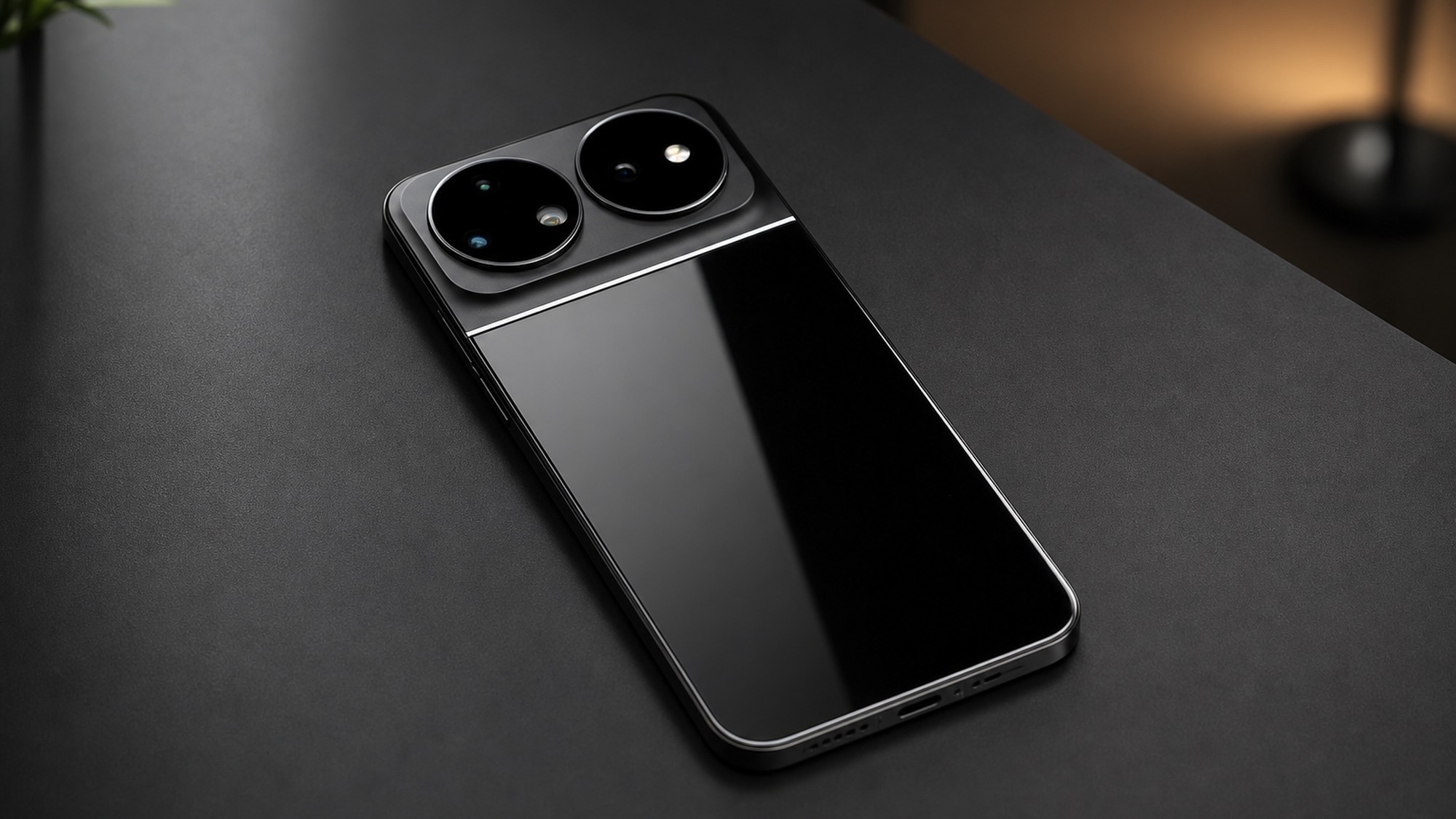
The nova 16 Ultra is the halo model of Huawei’s 2026 nova 16 series, which also includes the nova 16z, nova 16, and nova 16 Pro. Historically the nova line was Huawei’s stylish mid-tier range, but the Ultra pushes it into near-flagship territory by borrowing hardware that used to be reserved for pricier phones. It is a large, camera-led device aimed at buyers who want top-tier imaging and standout extras without paying Pura or Mate money.
The target buyer is specific. This phone makes the most sense for someone already inside the Huawei and HarmonyOS ecosystem in China, who values a 200MP camera, multi-day battery, and satellite communication over raw benchmark scores or app-store flexibility. In our view it is a camera-first phone before it is a performance phone, and reading it that way makes its compromises easier to accept. For anyone who depends on Google apps, the appeal narrows sharply, which we cover in detail further down.
What is the Huawei nova 16 Ultra?
It is the 2026 flagship of Huawei’s nova 16 series, a mid-range phone with flagship specs built around a 200MP RYYB camera, the Kirin 9010S, a 7000mAh battery, and HarmonyOS 6.1, starting at 4,699 yuan in China.
A large RYYB main sensor with a 50MP periscope and Red Maple color tuning.
100W wired and 50W wireless charging in a 7.1mm body.
Huawei’s own OS with the immersive light-sense interface, no Google apps.
Satellite calling, BeiDou messaging, IP68 and IP69, Wi-Fi 7.
Huawei nova 16 Ultra Specifications and Key Features
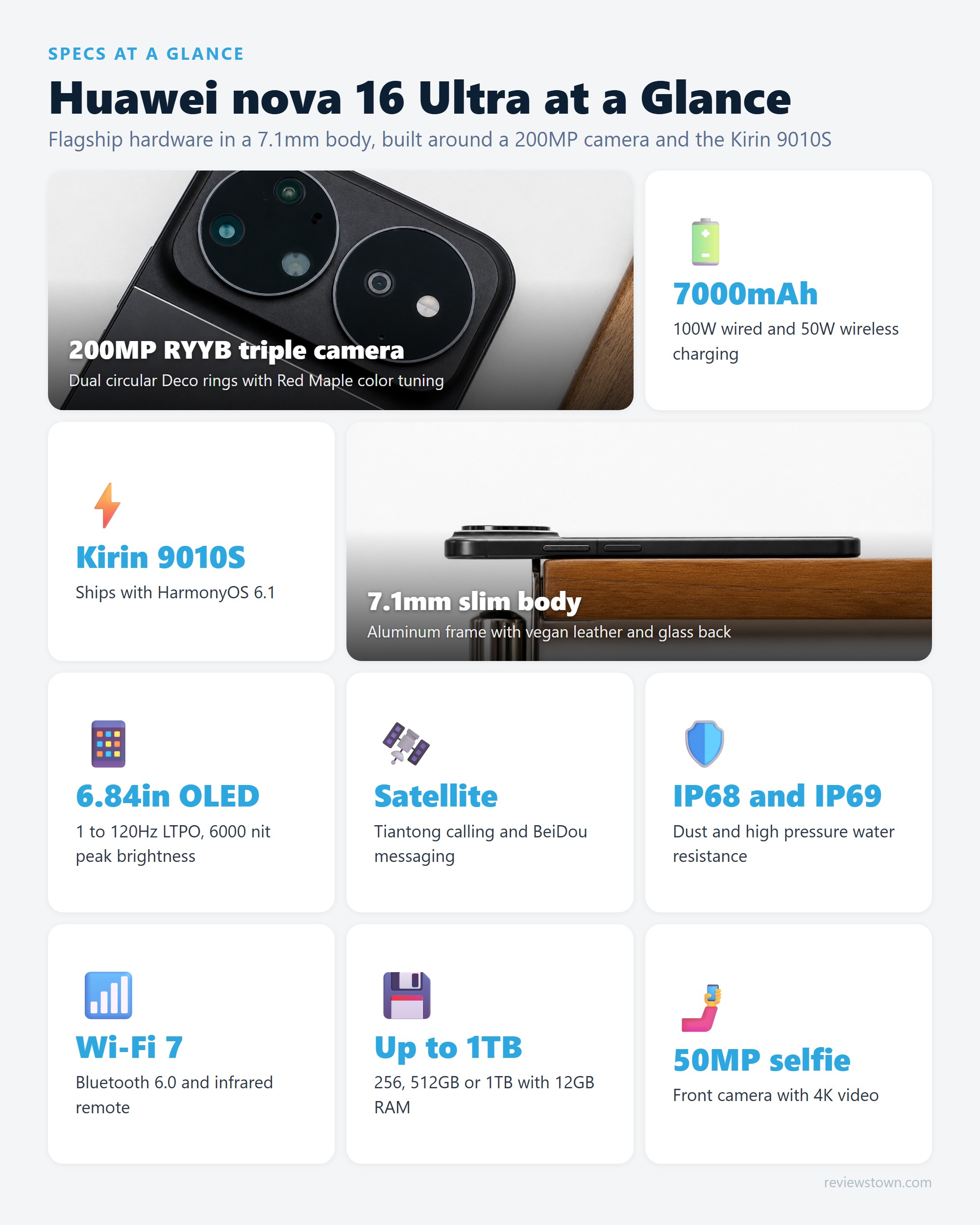
The spec sheet is where this phone earns its Ultra name. According to GSMArena’s listing, the display is a 6.84 inch LTPO OLED with a 1 to 120Hz adaptive refresh rate, a 1320 by 2856 resolution, 2160Hz PWM dimming, and a 6000 nit peak brightness under Kunlun Glass. Inside sits the Kirin 9010S paired with 12GB of RAM, and storage scales from 256GB to 512GB to a 1TB option. Huawei rates the battery at 7000mAh with 100W wired charging, 50W wireless charging, and 7.5W reverse wireless, all inside a frame just 7.1mm thick.
The extras are what separate it from ordinary mid-rangers. It includes Tiantong satellite calling and two-way BeiDou messaging for off-grid communication, IP68 and IP69 ratings for dust and high-pressure water resistance, Wi-Fi 7, Bluetooth 6.0, and an infrared remote. The build mixes an aluminum frame with a back panel that uses vegan leather around the cameras and AG glass below, finished in Sky White, Clear Blue, and Star Black. It is a genuinely premium hardware package, and the photo grid below sums up the headline numbers at a glance.
The 200MP Camera System and How RYYB and Red Maple Color Work
The camera is the reason this phone exists. The rear array uses a 200MP RYYB main sensor measuring 1/1.28 inches with optical stabilization, a 50MP RYYB periscope telephoto, also stabilized, and a 50MP ultra-wide that doubles as a macro lens. A 50MP front camera handles selfies and 4K video. Crucially, all three rear cameras share the same RYYB color philosophy and Huawei’s Red Maple original color tuning, which is meant to keep skies, skin, and foliage consistent as you switch between lenses.
RYYB matters more than the megapixel count. Where most sensors use a standard RGGB filter, Huawei swaps the two green pixels for yellow, letting the sensor gather noticeably more light, which is why Huawei phones tend to punch above their class after dark. The trade-off is that color science has to work harder to keep yellows and greens accurate, and that is exactly the job Red Maple tuning is built to do. The panel below breaks down how the system is meant to fit together.
One color science across three lenses
The nova 16 Ultra builds its photos from three RYYB cameras tuned to a single Red Maple color target, so shots look consistent whether you shoot wide, zoom, or up close.
A 1/1.28 inch sensor that pixel-bins for low light and crops for detail.
A stabilized telephoto for portraits and distant subjects.
Wide landscapes plus close-focus macro from one lens.
A shared tuning target that keeps tone consistent across all three.
Huawei nova 16 Ultra Camera Test: Everyday Photography
Specs only matter if the photos hold up, so this is the part of any camera test that counts. In daylight the 200MP sensor resolves impressive detail, and the RYYB advantage shows at night, where the nova 16 Ultra pulls in light that cheaper phones miss. The periscope is genuinely useful for portraits and reaching distant subjects, and because all three lenses share Red Maple tuning, colors stay consistent as you zoom. For everyday photography, the headline result is that this camera is sharp, flexible, and confident in low light.
There are honest caveats, and the ifanr hands-on review is direct about them. Its testing found that Huawei’s default algorithm tends to overexpose scenes and weaken shadow detail, so high-contrast shots can lose mood unless you dial exposure down manually. The reviewer also noted a visible gap between what the viewfinder previews and the final processed output, which makes precise composition harder. None of this undermines the core quality, but it means the best results come from a photographer who is willing to adjust settings rather than fully trust auto mode.

The sample pair below, shot on the nova 16 Ultra, shows both sides of that story: strong detail and color in mixed lighting, with the bright, slightly punchy exposure that defines the default look.

Kirin 9010S Performance and Gaming
Kirin 9010S performance is the spec most people misread. Huawei’s in-house chip is built on a domestic process rather than the cutting-edge 3nm nodes that power rivals, so in pure benchmark numbers it lags behind the latest MediaTek and Qualcomm flagships. Compared to a Dimensity 9500 device, it will post lower scores, and there is no point pretending otherwise. What matters more is how it feels day to day, and here the picture is far better than the numbers suggest.
In practice the chip drives HarmonyOS 6.1 smoothly and handles demanding games well. The ifanr review found it ran Honor of Kings at high frame rates without trouble, which covers what most buyers actually play. The honest caveat is thermals: the same review noted the body heats up quickly during sustained 200MP capture, and heavy gaming will warm it too. For everyday apps, multitasking, and mainstream gaming the Kirin 9010S is more than enough, but this is not the phone to buy if chasing the top of a benchmark chart is your priority. The hands-on video below shows the hardware in action.
HarmonyOS 6.1 Features and the Software Experience
The nova 16 Ultra ships with HarmonyOS 6.1, and the headline among the HarmonyOS 6.1 features is the immersive light-sense interface, a glass-like visual layer with translucent panels and fluid animations. The ifanr review describes the nova’s version as softer and more restrained than the more intense treatment on the Pura 90 Pro, which suits a phone meant for daily use rather than showing off. Beyond the look, HarmonyOS leans on Huawei’s ecosystem strengths: tight handoff with Huawei tablets, laptops, and smart home gear, plus the Xiaoyi assistant and Celia features.
The defining fact, though, is that HarmonyOS here is not Android. There is no Google Play layer, and apps come from Huawei AppGallery, so your software experience depends entirely on what is available there. For users embedded in Huawei’s wider ecosystem this is a strength, and the same continuity extends to gear like the Huawei HarmonyOS smart home lineup. For everyone else it is the single biggest adjustment, and worth understanding before purchase rather than after.
Battery Life and How to Maximize It on the nova 16 Ultra
The 7000mAh battery is one of the phone’s strongest features. A cell this large in a 7.1mm body is impressive engineering, and in practice it comfortably clears a heavy day with room to spare, while lighter users can stretch toward two days. Huawei officially rates charging at 100W wired and 50W wireless, so even when you do run low, a short top-up restores a meaningful chunk, and the reverse wireless mode can trickle-charge earbuds or a watch in a pinch.
Getting the most from it comes down to a few habits. Leave the display on its 1 to 120Hz adaptive mode rather than forcing 120Hz, since the panel can drop to low refresh rates for static content and save power. Use the system dark theme so the OLED switches off black pixels, keep brightness sensible instead of letting the 6000 nit peak fire indoors, and lean on Huawei’s optimized and scheduled charging to protect long-term capacity. The heaviest drains are 200MP capture and 4K video, so reserve those for when you need them. Done consistently, these steps turn an already strong battery into a genuine two-day phone.
Huawei nova 16 Ultra vs Pura 90, OPPO Reno 16 Pro, and vivo X300
The most common in-house comparison is the nova 16 Ultra against the Huawei Pura 90. The Pura 90 sits a tier higher as Huawei’s imaging flagship, with a more advanced variable-aperture camera and the more dramatic version of the light-sense interface. The nova 16 Ultra answers with the same 200MP-led philosophy, satellite features, and a lower price, so it is the value-focused sibling rather than a Pura replacement.
The trickier question is the nova 16 Ultra vs OPPO Reno 16 Pro vs vivo X300, because all three are stylish mid-flagships, but they split along one decisive line. The OPPO Reno 16 Pro and vivo X300 both run Android with full Google services and use current MediaTek Dimensity silicon, with the vivo X300 in particular pairing a Dimensity 9500 with a Zeiss-tuned camera. The Huawei wins on raw camera hardware, battery size, and satellite connectivity, but loses on chip benchmarks and Google support. If you need Google apps, the OPPO or vivo is the easier pick; if camera reach and endurance lead your list and you are fine with AppGallery, the Huawei stands out. Our vivo X300 Ultra hands-on review covers where vivo’s imaging sits in 2026.
| Feature | Huawei nova 16 Ultra | OPPO Reno 16 Pro | vivo X300 |
|---|---|---|---|
| Chipset | Kirin 9010S | MediaTek Dimensity (mid-flagship) | MediaTek Dimensity 9500 |
| Main camera | 200MP RYYB | High-res mid-flagship | 200MP Zeiss-tuned |
| Battery | 7000mAh | Large, fast charging | Large, fast charging |
| Software | HarmonyOS 6.1, no Google | Android with Google | Android with Google |
| Satellite | Tiantong and BeiDou | Limited or none | Limited or none |
| Best for | Camera and ecosystem buyers | Balanced all-rounder | Performance and imaging |
Does It Support Google Services and Work Outside China
For an English-speaking audience this is the make-or-break section. The nova 16 Ultra does not support Google Mobile Services, so there is no Play Store, Gmail, Google Maps, or Google account sign-in, and apps that rely on Play Integrity for security, including many banking and payment apps, may refuse to run. This is not a nova-specific flaw but the ongoing result of US trade restrictions, and Engadget has explained in detail why Google cannot certify new Huawei phones. That ruling still stands in 2026.
Working around it means living in Huawei’s world: AppGallery for apps, Petal Search to find APKs, and Huawei alternatives for maps and payments. Compatibility layers like microG or GBox exist but are inconsistent and can break after updates. On top of that, the phone is officially a China-only release, so global cellular bands, warranty coverage, and timely software updates are not guaranteed on an imported unit. The honest verdict is that it suits buyers in China or dedicated Huawei fans, and most users outside that group are better served by an Android phone with Google support.
Price and Is the nova 16 Ultra Worth It
As confirmed in GSMArena’s launch coverage, Huawei prices the nova 16 Ultra from 4,699 yuan for 256GB, rising to 5,199 yuan for 512GB and 5,799 yuan for 1TB, which works out to roughly 655 to 810 US dollars. For that money you get a 200MP camera system, a 7000mAh battery, satellite communication, and IP68 plus IP69 durability, a combination that genuinely lives up to the mid-range phone with flagship specs label and undercuts Huawei’s own Pura and Mate flagships.
So is it worth the price? Within China the answer is a confident yes for camera-led buyers, where the value is hard to beat and the software ecosystem is fully supported. The 256GB model is the sweet spot for most people, with the 1TB version reserved for heavy 200MP and 4K shooters. Outside China the value equation flips, because the missing Google services and uncertain support erode much of the appeal no matter how good the hardware is. The phone is worth it for the right buyer in the right market, and overpriced for the wrong one.
What Reviewers and Early Owners Report
Early sentiment tracks closely with the hands-on coverage. Reviewers consistently praise the camera versatility and the standout battery life, the two pillars of the phone’s appeal. The recurring criticism is just as consistent and refreshingly concrete: the ifanr review found the default processing overexposes images and weakens shadow detail, the body warms up quickly during 200MP capture, and there is a noticeable gap between the rear glass and the metal frame that can catch the hand as a sharp edge. Owners report that the glossy black finish also shows fingerprints almost immediately.
What stands out is that none of these complaints target the core hardware. They are about tuning and finish rather than capability, which fits a phone that nails the big decisions and stumbles on small ones. Taken together, the real-world feedback says the camera and battery deliver, while the rough edges, both literal and in the software, are the price of admission.
The Verdict: Flagship Camera Hardware With One Big Asterisk
The Huawei nova 16 Ultra is one of the most capable cameras you can get at its price, wrapped around a battery and feature set that shame phones costing far more. The 200MP RYYB system, 7000mAh cell, satellite connectivity, and 6000 nit display are flagship-grade, and at 4,699 yuan they make a compelling case for anyone who leads with photography and endurance.
The asterisk is impossible to ignore. No Google services, a China-only release, and a Kirin 9010S that trails the benchmark leaders mean this phone is brilliant for a specific buyer and frustrating for everyone else. If you are inside Huawei’s ecosystem and want the best camera value of 2026, it belongs at the top of your list. If you need the Play Store or live outside China, admire the hardware, then buy something that fits your software life instead.
- 200MP RYYB main camera with a 50MP periscope and Red Maple color tuning delivers genuinely flagship-grade imaging
- Large 7000mAh battery in a 7.1mm body, with 100W wired, 50W wireless, and reverse wireless charging
- 6.84 inch LTPO OLED runs 1 to 120Hz and hits 6000 nits peak for easy outdoor reading
- Rare extras at this price: Tiantong satellite calling, BeiDou messaging, IP68 and IP69, Wi-Fi 7, and an IR blaster
- HarmonyOS 6.1 immersive light-sense interface is smooth and visually polished
- Flagship hardware starting at 4,699 yuan undercuts Huawei’s own Pura and Mate flagships
- No Google Mobile Services or Play Store, so it leans entirely on Huawei AppGallery and is hard to live with outside China
- Default camera processing tends to overexpose and crush shadow detail, per the ifanr hands-on
- The body warms up quickly during sustained 200MP shooting
- A noticeable gap between the glass and the frame can feel sharp, and the black finish shows fingerprints
- Kirin 9010S is capable but trails the latest Dimensity 9500 rivals in raw benchmark numbers
- Officially a China-only release, so global bands, warranty, and updates are not guaranteed
Frequently Asked Questions
Does the Huawei nova 16 Ultra support Google Mobile Services and the Play Store?
No. Like every Huawei phone launched since the 2019 US trade restrictions, the nova 16 Ultra ships without Google Mobile Services, so there is no Play Store, Gmail, Maps, or Google account sign-in out of the box. It runs Huawei Mobile Services with the AppGallery store and Petal Search instead. Engadget has documented why Google cannot certify new Huawei devices, and that situation still applies in 2026, so plan your app library around AppGallery before buying.
How much does the Huawei nova 16 Ultra cost?
Huawei lists the nova 16 Ultra from 4,699 yuan for 256GB, 5,199 yuan for 512GB, and 5,799 yuan for the 1TB model, which is roughly 655, 725, and 810 US dollars converted. That undercuts Huawei’s Pura and Mate flagships while keeping the headline 200MP camera and satellite features, which is the core of its mid-range phone with flagship specs pitch.
Is the Huawei nova 16 Ultra suitable for users outside China?
Only for a specific buyer. It is officially a China-only release, so global cellular bands, warranty, and software localization are not guaranteed, and there is no Google services support. If you live outside China and rely on Gmail, Google Pay, or banking apps that need Play Integrity, this phone will frustrate you. If you are comfortable with AppGallery and mainly want the camera and battery, an imported unit can work, with caveats.
How do I maximize battery life on the Huawei nova 16 Ultra?
The 7000mAh cell already lasts well, and a few habits stretch it further. Leave the display on its 1 to 120Hz adaptive mode rather than locking it to 120Hz, use the system dark theme so the OLED can switch off black pixels, and cap brightness instead of letting the 6000 nit peak fire indoors. Huawei’s optimized and scheduled charging also reduce long-term wear, and 200MP capture plus 4K video are the heaviest drains to use sparingly.
How does the Huawei nova 16 Ultra compare to the Huawei Pura 90?
The Pura 90 line sits a tier above as Huawei’s imaging flagship, with a more advanced variable-aperture camera system and the more intense version of the immersive light-sense interface. The nova 16 Ultra borrows the 200MP sensor philosophy and satellite features but uses a softer interface look and the Kirin 9010S, and it costs less. Think of the nova 16 Ultra as the camera-forward value pick and the Pura 90 as the no-compromise flagship.
What are the real-world downsides of the Huawei nova 16 Ultra?
Beyond the missing Google services, the ifanr hands-on review flags three practical issues: the default camera algorithm tends to overexpose scenes and weaken shadow detail, the body heats up quickly during sustained 200MP shooting, and there is a noticeable gap between the rear glass and the metal frame that can feel sharp in the hand. The glossy black finish is also a fingerprint magnet.