

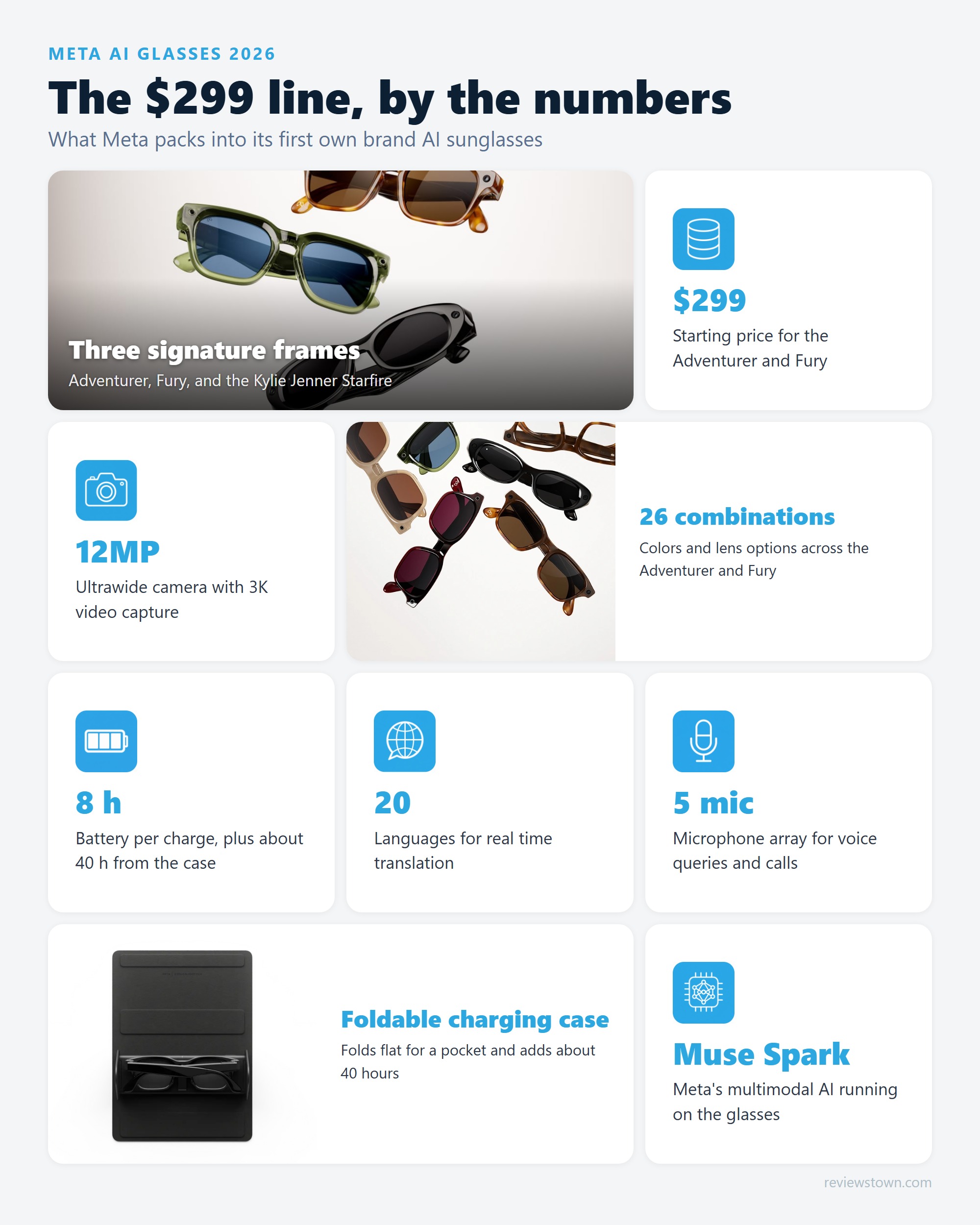
For three years the smartest glasses you could buy had someone else’s name on the temple. That changed on June 23, 2026, when Meta launched its own branded eyewear and quietly retired the Ray-Ban label it had ridden to the top of the category. The headline is the price. The Meta Adventurer and Meta Fury start at $299, which is $80 less than second generation Ray-Ban Meta for the same core hardware, according to Meta’s launch announcement. A Kylie Jenner designed Starfire model sits above them at $399.
That price cut is not a discount. It is a strategy. Meta is no longer selling you smart glasses. It is selling you sunglasses that happen to think. This Meta AI glasses review 2026 looks past the celebrity launch and the new logo at what the hardware does, where Muse Spark earns its keep, and whether AI powered smart sunglasses are finally worth choosing over the regular pair already on your face.

What Are Meta AI Glasses, and What Changed in 2026
Meta AI glasses are sunglasses with a camera, open ear speakers, a microphone array, and an onboard AI assistant you talk to by saying \”Hey Meta.\” The 2026 range is the first to drop the Ray-Ban and Oakley co branding entirely and ship under Meta’s own name, built with eyewear giant EssilorLuxottica. There are three families. The Adventurer is a clean rectangular frame, the closest to classic eyewear. The Fury is thicker and bolder, aimed at streetwear taste. The Starfire is a slim oval designed with Kylie Jenner, the only one that lets you set her AI generated voice as the assistant.
Underneath the branding shift, the hardware is a measured upgrade rather than a reinvention. Meta’s spec sheet lists a 12 megapixel ultrawide camera, 3K video capture, and a five microphone array, paired with a foldable charging case that the company says folds flat enough to disappear into a pocket. The real story is who the glasses are for now. By pricing the Adventurer at $299, the same bracket as a mid range pair of quality sunglasses, Meta is betting that the camera and the AI ride along as added value rather than the reason you buy. It is a far more honest pitch than the wearable computing promises that sank earlier smart glasses.
What are Meta AI glasses?
Meta AI glasses are camera equipped sunglasses that run Muse Spark, Meta’s multimodal AI, so you can ask spoken questions about what you see, get real time translation, capture photos and video, and hear turn by turn directions, all without a screen and without reaching for your phone.
Across the Adventurer and Fury alone Meta lists 26 color and lens combinations, from Racing Green to a warm tortoiseshell, with sun, clear, polarized, and Transitions photochromic options. That range matters more than it sounds. The single biggest reason earlier smart glasses stayed in drawers was that they looked like gadgets. These look like eyewear you would buy anyway.
AI Glasses vs Smart Glasses: The Distinction Meta Is Betting On
The terms get used interchangeably, but in 2026 they describe two different things, and the gap is exactly what justifies the new name. A pair of plain smart glasses captures: it has a camera, speakers, and a microphone, and it does what you explicitly tell it. Smart glasses with multimodal AI add a model that interprets the camera feed and your voice together, so the glasses can answer questions about the world in front of you rather than just record it. Ask \”what am I looking at\” and a multimodal system actually tries to tell you.
This is the line Meta is drawing with Muse Spark. The previous Ray-Ban Meta generation already shipped a capable assistant, so the 2026 jump is incremental rather than magical. What changed is the framing. Meta now leads with the intelligence and treats the camera as the AI’s eyes, not as a standalone GoPro for your face. In our view that reframing is the most important thing about this launch, more than the price or the Kylie Jenner tie in, because it sets the expectation that the glasses should understand context, not just collect it. The closest comparison on the market is the audio first approach of glasses like Huawei’s, which lean on sound rather than a camera led AI loop.
Same frame, different brain
The hardware can look identical. The difference is whether the glasses simply capture what you do or actually reason about what you see and say.
Plain smart glasses take photos, play audio, and run fixed voice commands you trigger yourself.
Multimodal AI reads the camera view and your question together, then answers about the scene.
Muse Spark is Meta’s first model tuned for wearable inference, not a phone app bolted on.
Translation, navigation, and object lookups all draw on what is actually in front of you.
What Can Meta AI Glasses Actually Do With Muse Spark?
Muse Spark is Meta’s first AI model built specifically for inference on a wearable, and it is the reason these are AI glasses rather than another camera frame. Three jobs define what it does day to day. First, visual queries: look at a plant, a landmark, or a menu and ask what it is, and Muse Spark uses the camera as its input. Second, real time translation, now spanning 20 languages after Meta added 14 at this launch, including Mandarin, Japanese, and Korean. Someone speaks, you hear the translation in your ears moments later. Third, a Dynamic Photo mode that captures a short burst and recommends the best frame, which is a small touch but a genuinely useful one given you cannot see a viewfinder.
Worth noting, not all of this runs locally. Heavier reasoning still reaches out to Meta’s cloud through your paired phone, so the smartest answers depend on a connection. That is the same architecture every camera led AI wearable uses today, and it is the honest limit behind the marketing. Meta has also confirmed Muse Spark features will roll out to older Ray-Ban and Oakley Meta frames over the air, which means the 2026 software is the upgrade even for owners who do not buy new hardware. For anyone weighing the broader assistant landscape, it is worth reading our take on where Apple’s own smart glasses project, codenamed N50, is heading, because the platform war behind these frames will decide which assistant you are actually living with.
Screen Free Navigation and the Best Ways to Use Them Every Day
The question that trips up most first time buyers is simple. How do AI glasses give you turn by turn navigation without a screen? On these models there is no in lens display, so directions arrive as spoken prompts through the open ear speakers in the temple arms. Muse Spark pulls your route from the phone and calls out each turn as you approach it, exactly the way a car does, while your phone stays in your pocket. However, it is less precise than a heads up arrow floating in your vision, which is what the separate Ray-Ban Meta Display delivers. For walking a new city it is enough, and it keeps your eyes up.
That screen free constraint actually shapes the best everyday uses. The glasses shine when the task is hands busy and eyes forward. Cooking from a recipe you ask about mid stir. Cycling with directions in your ears. Capturing a child’s first steps without a phone between you and the moment. Asking the price of something in a language you do not read while traveling. The weakest uses are the ones that want a screen: reading long messages, watching video, or anything you would rather glance at than hear. Knowing that divide is the difference between glasses you wear daily and glasses you charge once and forget, a fate that befell most of the field before Meta’s own EssilorLuxottica partnership reset expectations.

Meta AI Glasses vs Ray-Ban Meta: The 2026 Comparison
If you already own a pair of Ray-Ban Meta, the obvious question is whether the new own brand frames are an upgrade or just a rebrand. The short answer: the core camera and audio hardware is shared, so the gains are price, design choice, and the Muse Spark software, which is also coming to your existing glasses over the air. The table below sets the 2026 Meta frames against the two Ray-Ban Meta tiers still on sale, with figures drawn from Meta’s published specs.
| Spec | Meta Adventurer / Fury (2026) | Ray-Ban Meta (Gen 2) | Ray-Ban Meta Display |
|---|---|---|---|
| Starting price | $299 | $379 | About $799 |
| Branding | Meta own brand | Ray-Ban | Ray-Ban |
| In lens display | No | No | Yes, monocular |
| Camera | 12MP, 3K video | 12MP, 3K video | 12MP |
| AI model | Muse Spark | Meta AI | Meta AI |
| On glasses battery | About 8 hours | About 8 hours | About 6 hours |
| Prescription range | -12 to +2.25 | -4 to +4 | Limited |
The pattern is clear. For most buyers the Adventurer at $299 is simply the better value version of the same idea, $80 cheaper than the Ray-Ban Gen 2 with a wider prescription range and the newest AI. You only step up to the Ray-Ban Meta Display if you genuinely want a visual heads up display and will pay more than double for it. In our read, Meta has split its own lineup cleanly: cheap and screen free for the mainstream, expensive and screen equipped for the enthusiast. The hands on coverage from Engadget reaches the same conclusion, calling the new frames the volume play rather than the showcase.

Lenses, Fit, and Prescription Support
Because Meta builds these with EssilorLuxottica, the optical side is more serious than most tech companies manage. All three styles take prescription lenses, and Meta lists support from -12 to +2.25 diopters, a wider range than the older Ray-Ban Meta and broad enough for most short and long sighted wearers. You fit them through the same LensCrafters and Sunglass Hut network that handles ordinary designer frames, which removes the usual friction of buying smart eyewear online and hoping it suits your face.
Lens choice is equally grown up: clear, polarized, or Transitions photochromic that darken in sunlight and clear indoors, so a single pair works from a morning commute to an evening walk. Fit gets the same attention, with adjustable three position nose bridges and metal core temple arms you can bend to your face. The catch is weight. At about 62 grams for the standard build, or 56 grams with the lighter frame option, they sit noticeably heavier compared to display free audio glasses such as the iFlytek AI Glasses at 40 grams. That weight is the price of carrying a camera and battery, and after a long day you feel it on the bridge of your nose.
Can AI Glasses Record Video Without People Knowing?
This is the question that follows every camera you wear into a room, and it deserves a straight answer. By design, no. A white LED on the front of the frame lights whenever the camera is recording, and Meta blocks capture if you try to cover that light with tape or a finger. The system is built so that filming is supposed to be visible to the people around you.
In practice the honesty of that system has limits. Reviewers consistently note that the indicator LED is small, and in bright daylight or across a busy room it is easy to miss. So the fair conclusion is that these are far more transparent than a hidden spy camera, but they are not foolproof, and someone who is not looking for the light may not notice it. The etiquette burden lands on the wearer. Meta’s own answer is a \”social signals\” push to normalize the LED, but until that recognition is widespread, the responsible move is the obvious one: do not film people who would not expect it. It is a genuine drawback, not a dealbreaker, and worth weighing honestly before you wear a camera onto your face in public.
Are Meta AI Glasses Worth Buying Over Regular Sunglasses?
This is where the $299 price does its real work. A quality pair of branded sunglasses already runs $150 to $300, so for anyone in that bracket the Adventurer is not a $299 gadget, it is a $299 pair of sunglasses with a camera, audio, and Muse Spark thrown in. Framed that way, the AI is upside rather than cost. That is the most persuasive argument for the best AI glasses 2026 has produced so far, and it is why Meta abandoned the smart glasses label: nobody budgets for a face computer, but plenty of people budget for sunglasses.
However, the honest counterpoint is the floor. If you normally spend $20 on gas station shades, then $299 is a real jump and the value math changes. The AI has to earn the gap, and for a casual user who rarely translates a conversation or navigates a strange city, it may not. There is also the running cost of the ecosystem: the smartest features want the Meta AI app and your phone nearby. Still, the trajectory is unmistakable. You can configure and price every frame on the official Meta Glasses page, and the spread of lens and prescription options means the sticker you see is rarely the sticker you pay once an optician is involved.
What Buyers Actually Report
Because the line launched on June 23, 2026, long term ownership data is still thin, but the early signal from hands on reviews and the first owner threads is already consistent on a few points. The most repeated praise is the disappearing act: reviewers note that strangers stop clocking these as tech, which was the social barrier that killed earlier smart glasses. The most repeated complaint is weight on longer days, the same 62 gram tax the spec sheet predicts, with several first impressions flagging pressure on the nose after a few hours. The Kylie Jenner voice option draws the most polarized reaction, treated as a fun novelty by some and a gimmick by others, while a recurring practical worry is the recording LED being hard to spot in daylight, the exact concern reviewers raised at launch.
The demand behind that reaction is not hype. EssilorLuxottica reported it more than tripled Meta AI glasses sales in 2025, reaching roughly 7 million units in the year and around 9 million cumulatively since the first Ray-Ban Meta, according to CNBC’s coverage of the earnings. Counterpoint’s H2 2025 shipments tracker likewise ranked Meta Ray-Ban as the single best selling smart glasses model worldwide, well ahead of rivals. The $299 line is Meta’s bet that it can turn that early adopter momentum into mainstream volume, and the production targets, reportedly scaling toward tens of millions of units a year, suggest the company believes it.
Will AI Glasses Eventually Replace Traditional Sunglasses?
Not soon, and maybe never completely, but the direction is set. Meta’s whole strategy this year is to stop treating AI glasses as a separate product category and fold them into the sunglasses people already buy. If that works, the question stops being whether you want smart glasses and becomes whether your next ordinary sunglasses should also happen to think. That is a much easier yes. The barriers that remain are real: weight, battery anxiety, the privacy etiquette of a worn camera, and a dependence on the phone in your pocket. None of them are solved here. But each one is smaller than it was a generation ago.
The likely future is not replacement but absorption. Plain sunglasses will not vanish, the same way plain watches did not vanish after smartwatches arrived. Instead the intelligence becomes an option on the frame you were going to buy anyway, and a slice of buyers tick the box every cycle. At $299, with real eyewear styling and an AI that finally does a few things well, Meta has made that box easier to tick than anyone before it.
The Verdict
The 2026 Meta AI glasses are the most convincing version of this idea so far, not because the hardware leaps ahead, but because the pricing and the positioning finally make sense. By dropping the Ray-Ban tax, widening the prescription range, and leading with Muse Spark instead of the camera, Meta has built AI powered smart sunglasses that a normal person can justify buying as sunglasses. The compromises are honest ones: no display on these models, real weight on long days, and an LED that asks the wearer to be considerate. If you want a heads up display, wait for the Ray-Ban Meta Display and pay for it. But if you want the best AI glasses 2026 has for everyday wear, and you were going to buy good sunglasses anyway, the $299 Adventurer is the first pair that does not require you to compromise on looking normal to get there.
- At $299 the Adventurer and Fury undercut second generation Ray-Ban Meta by $80 for the same core hardware
- Muse Spark adds genuinely useful multimodal AI, with real time translation across 20 languages and screen free navigation
- Three frame families and 26 color and lens combinations make them read as real sunglasses, not gadgets
- Prescription support from -12 to +2.25 diopters covers most wearers without a second pair
- The foldable charging case adds about 40 hours on top of the 8 hour on glasses battery
- These models have no in lens display, so notifications and navigation are audio only
- The recording LED stays small, and bystanders may not notice when the camera is active
- The smartest Muse Spark features still lean on a phone connection and the Meta AI app
- At 62 grams they sit heavier than display free audio rivals like Huawei’s AI glasses
Frequently Asked Questions
What is the difference between AI glasses and smart glasses?
Smart glasses bolt fixed features onto eyewear: a camera, open ear speakers, and a microphone you trigger with set commands. AI glasses add an onboard multimodal model, in this case Muse Spark, that sees what you see through the camera, hears your question, and reasons about both at once. The hardware can look identical. The difference is whether the glasses simply capture or actually understand.
How do Meta AI glasses give turn by turn navigation without a screen?
These models have no in lens display, so navigation is delivered as spoken turn by turn directions through the open ear speakers in the temple arms. Muse Spark reads your route from the paired phone and calls out each turn as you approach it, the same way a car does. You keep your phone in your pocket and your eyes on the street, which is the entire point.
Can Meta AI glasses record video without people knowing?
Not by design. A white LED on the front lights up whenever the camera records, and Meta disables capture if you cover it. In practice the indicator is small and easy to miss in bright daylight or from a distance, which is the recurring privacy criticism reviewers raise. They are far more visible than a hidden camera, but not impossible to overlook.
Which Meta AI glasses support prescription lenses in 2026?
All three 2026 styles, the Adventurer, the Fury, and the Kylie Jenner Starfire, accept prescription lenses through EssilorLuxottica’s optical network at LensCrafters and Sunglass Hut. Meta lists support from -12 to +2.25 diopters, which covers most short and long sighted wearers. You can also choose clear, polarized, or Transitions photochromic lenses instead of a fixed sunglass tint.
Are Meta AI glasses worth buying over regular sunglasses?
If you already spend $150 to $300 on quality sunglasses, the $299 Adventurer is an easy upgrade, since you get the same sunglasses plus a camera, audio, and Muse Spark for little extra. If you only ever buy $20 gas station shades, the value case is weaker. The AI is a bonus on top of eyewear, not a reason to wear glasses you otherwise would not.
How much do Meta AI glasses cost in 2026?
The Meta Adventurer and Meta Fury start at $299, and the Kylie Jenner Starfire edition costs $399. That is $80 less than second generation Ray-Ban Meta and $200 less than the Ray-Ban Meta optical models from earlier in 2026. Prescription and Transitions lenses add to the base price through the optician.