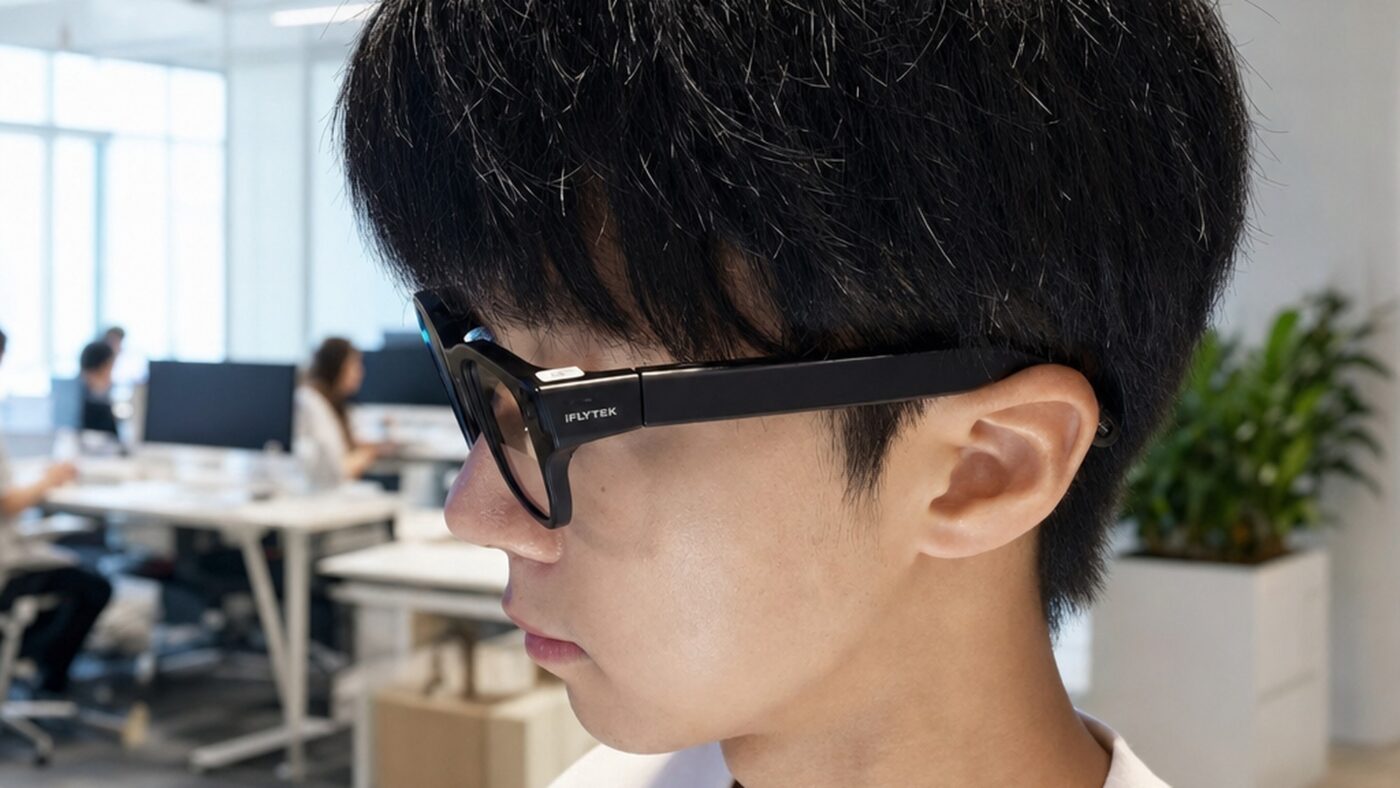
Smart glasses have spent years promising to free us from our phones and then quietly disappointing everyone who tried them. The iFlytek AI Glasses arrive with a sharper pitch: forget novelty filters and step counting, this is a translation and productivity tool you can wear all day. Announced globally at MWC26 in Barcelona and shown again at BEYOND Expo in Macau, the headline number is small but loud. Forty grams, with a working display on your face.
That weight matters more than any spec sheet suggests, and it frames everything else this product tries to do. This iFlytek AI glasses real-time translation review looks past the launch theater at what the hardware actually delivers for people who cross languages for a living.

What iFlytek AI Glasses Actually Are, and How They Work
iFlytek is one of China’s largest speech and language AI companies, and the glasses are essentially its translation engine moved from your phone to your line of sight. The core promise is a pair of lightweight AI glasses with display that listen, translate, and answer back in near real time, without you ever reaching for a screen.
The system runs on three layers working together: the glasses themselves, a nearby edge connection, and iFlytek’s cloud model, called Xinghuo X2, a 293 billion parameter mixture of experts system, according to iFlytek’s launch briefing. The glasses capture sound and lip movement, the heavy reasoning happens in the cloud, and the translated result returns to a bone conduction speaker that vibrates against your cheekbone so you still hear the room around you.
In plain terms: what is it?
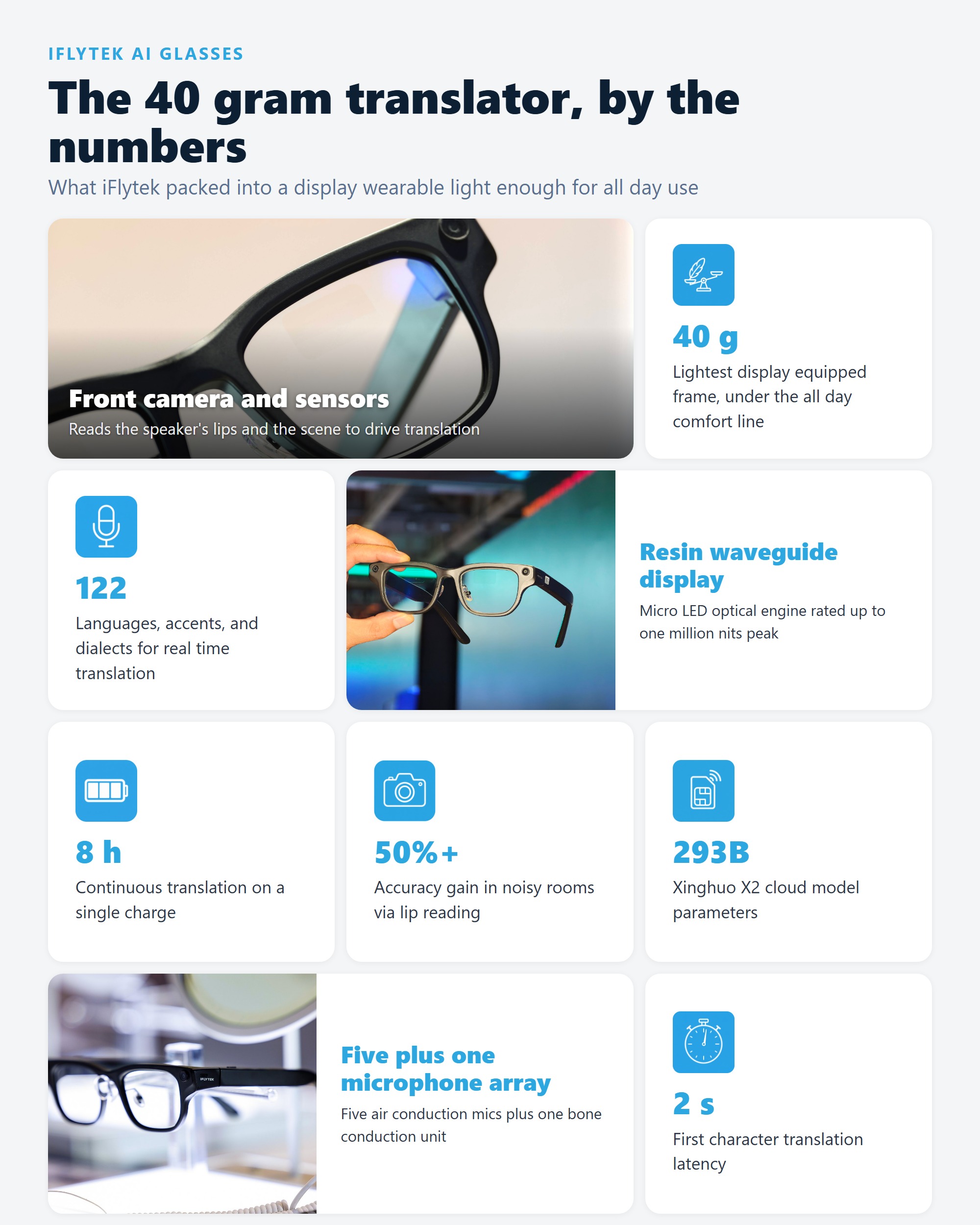
The iFlytek AI Glasses are a 40 gram wearable with a built in display that translate speech across 122 languages and run a voice controlled assistant. You look at the person speaking, the glasses pick out their voice, and the translation appears on the display and plays through your cheekbone. The same assistant can take meeting notes, draft an email, or set a reminder when you ask out loud.
The 40 Gram Threshold: Why Weight Is the Real Story
Ask anyone who has worn display glasses for a full day and the first complaint is never resolution. It is the pressure on the nose and ears after hour three. So what is the ideal weight for smart glasses with display for all-day wear? According to industry comfort research that iFlytek cited at launch, the threshold for many Asian face shapes sits near 45 grams, beyond which long sessions start to ache. At 40 grams, the glasses sit just under that line while carrying a display, which most rivals cannot claim.
Hitting that number came down to a material choice. Traditional waveguide displays bond to glass lenses, which are heavy. iFlytek switched to a resin waveguide bonded with a full lamination process, paired with an aerospace grade magnesium aluminum alloy frame, a build TechNode describes as roughly 20 percent lighter than comparable products. That raises a fair manufacturing question about the pros and cons of resin versus glass lenses in smart glasses. Resin is lighter and far more impact resistant, which suits a device that lives on your face and in your bag. The trade off is that resin can be softer and more prone to surface scratching over years of use, and high end optical clarity is historically easier to guarantee in glass. For an all day wearable, iFlytek clearly decided that shaving grams and surviving drops outweighs the long term scratch risk.
The display itself is no afterthought. iFlytek specifies a Micro LED optical engine with a 4 micron pixel size in a 0.15 cubic centimeter package, with peak brightness rated up to one million nits so text stays readable in direct sunlight. If you have only ever seen dim indoor demos of smart glasses, that brightness figure is the part worth taking seriously.
Real-Time Translation, Put to the Test
Translation is the reason most people will buy these, so it deserves scrutiny. How do AI-powered translation glasses enable real-time multilingual communication without the awkward lag that kills a conversation? iFlytek’s answer is an end to end speech model that skips the usual text middle step, going straight from spoken source to spoken target. The company reports first character latency compressed to about two seconds, and support for 122 languages, accents, and dialects across face to face chat, phone calls, online meetings, and even camera based reading of menus and slides.
The cleverest piece sits where translation usually falls apart, which is noise. A loud conference hall or a busy street normally turns speech recognition into guesswork. iFlytek attacks this with lip-reading noise reduction, a first for AI glasses. Here is how lip-reading noise reduction technology improves translation accuracy in noisy environments: a 5 plus 1 microphone array, five air conduction microphones and one bone conduction unit, captures audio while the front camera reads the speaker’s lip movements. The system fuses sound and vision to lock onto the one person you are looking at and ignore the rest, a “translate whoever you look at” approach. iFlytek claims this lifts accuracy by more than 50 percent in high noise settings, the single most useful number in the entire spec sheet for real world business use.
When Glasses Do the Work: The Voice Agent Workflow
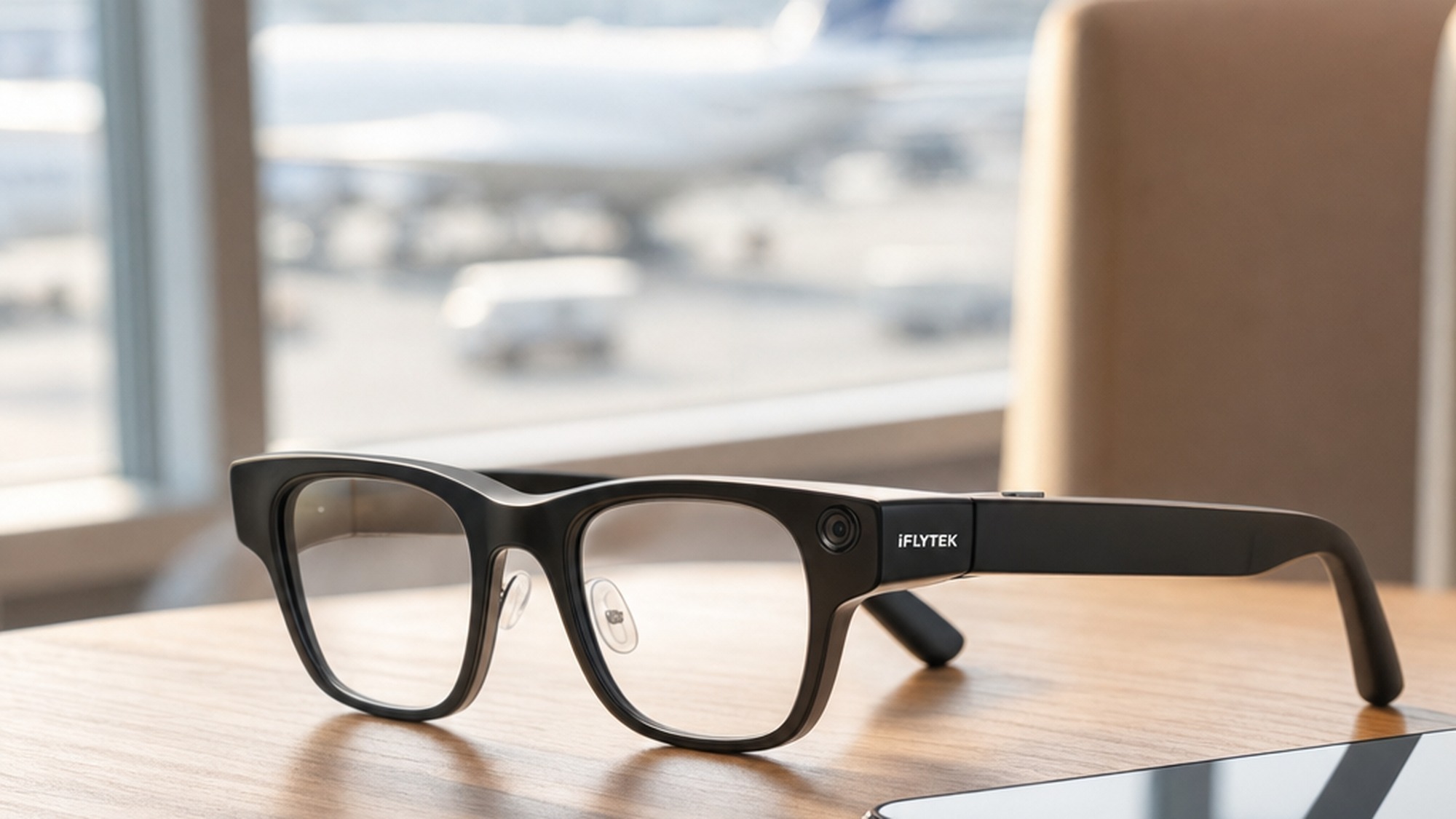
Translation gets the headlines, but the AI glasses with voice agent workflow is where iFlytek is quietly more ambitious. Built in is an agent called GlassClaw, and its goal is what iFlytek calls a hear to do loop. You speak an intention and the glasses execute it, rather than just transcribing it.
So how do you use AI glasses for business meetings and cross-language calls in practice? In a meeting, the glasses transcribe who said what, separate speakers by role, and then generate structured minutes you can send on. During a cross border call, the translation modes mean both sides hear their own language with no third device on the table. After the call, a spoken command can have GlassClaw draft and send the follow up email, sync the next step to your calendar, or pull a document from a connected device. It is the kind of voice driven control that desktop tools have chased for years, and it sits closer to the always listening assistant idea than the voice first input methods we have tested on the desktop. The official iFlytek launch materials frame this as the device moving from understanding to action.
There is a battery story here too, because all of this listening and processing is hungry. According to iFlytek, algorithmic optimization delivers the same functions on roughly half the power of rivals, with up to 8 hours of continuous translation per charge, and a charging capsule that doubles as a remote control. In practice that endurance claim is the one we would most want to verify with independent long term testing.
iFlytek vs Meta Ray-Ban vs Rokid: Picking for Professionals
The obvious question is iFlytek AI glasses vs Meta Ray-Ban vs Rokid Glasses, which is better for professionals. The honest answer depends on what you actually need on your face, and weight tells most of the story.
| Model | Weight | Built in display | Core strength |
|---|---|---|---|
| iFlytek AI Glasses | 40 g | Yes | 122 language translation, voice agent |
| Meta Ray-Ban | 49 g | No | Camera, audio, social capture |
| Rokid Glasses | 49 g | Yes | AR display, teleprompter |
| Huawei AI Glasses | 35.5 g | No | Audio, light all day wear |
The pattern is clear. Meta Ray-Ban and Rokid both land near 49 grams, and Huawei goes lighter only by dropping the display entirely. iFlytek is the one pair here carrying a display while staying at 40 grams, with the weight figures drawn from each maker’s own published specs. For the best AI glasses for international business travelers and conference attendees, that combination of a readable display, deep translation, and genuine all day comfort is the strongest case on paper. Meta still wins for casual capture and a mature app ecosystem, and these are part of a wider wave of consumer AI hardware companion devices all chasing the same wrist and face real estate.
How real time translation happens on your face
From the moment you look at a speaker to the translated reply in your ear, four things happen in about two seconds.
The camera and lip reading lock onto the one person you are facing, even in a crowd.
The five plus one microphone array separates that voice from the background noise around you.
An end to end speech model converts speech straight to speech across 122 languages, with no text step in between.
Bone conduction plays the reply while GlassClaw can turn it into notes, an email, or a calendar entry.
Are AI Glasses Worth It in 2026, or Just Hype?
So are AI glasses worth buying in 2026, or is it just hype? For most casual buyers, honestly, it is still early. But for a specific person, the frequent traveler, the salesperson working across borders, the conference regular, a 40 gram pair that translates 122 languages and drafts your follow up emails is a real tool, not a toy.
That leads to the bigger debate: can AI glasses replace smartphones as the next personal computing device? iFlytek’s own framing is bold, describing the glasses as an independent host on your nose rather than a phone accessory. The reality in 2026 is more modest. The cloud first design means the smartest features still lean on a connection, and no display this small replaces the screen you type on. What these glasses do prove is the direction of travel. When the device that translates a negotiation and writes the recap lives on your face instead of in your pocket, the phone stops being the obvious center of gravity.
Community reaction so far reflects that split. Early threads on the r/augmentedreality subreddit and hands on clips treat the weight and the noise handling as the genuinely impressive parts, while the most common worry is the same one that follows every camera and microphone you wear into a room: who is comfortable with a display and a lens pointed at them during a meeting. It is a fair question, and one iFlytek will have to keep answering as these reach more wrists and faces.
The Verdict
The iFlytek AI Glasses are the most convincing argument yet that translation, not entertainment, is the killer app for smart glasses. The 40 gram weight, the lip reading noise reduction, and the GlassClaw agent each solve a problem that previous glasses ignored. The open questions are price, real international availability, and how the cloud dependency feels day to day once the launch shine fades. As an AI translation glasses for business buy, this is the first pair that earns a serious look from people who actually need it. You can compare the full specifications on the official iFlytek product page and through independent coverage like thegadgetflow’s hands on.
- At 40 grams it is the lightest display equipped pair available, light enough for genuine all day wear
- Real time translation spans 122 languages with face to face, call, and online meeting modes
- Lip reading noise reduction lifts accuracy by more than 50 percent in loud environments
- The GlassClaw voice agent turns spoken requests into finished emails, minutes, and reminders
- Resin waveguide lenses and a magnesium aluminum frame keep weight down without feeling fragile
- Pricing and wide international availability were still unconfirmed at launch
- The cloud first design means the smartest features lean on a network connection
- English language long term testing is still thin so far
- A worn camera and display raise real privacy questions in meetings
Frequently Asked Questions
Is iFlytek a Chinese company?
Yes. iFlytek is a publicly listed Chinese company and one of the country’s largest artificial intelligence firms, with a long focus on speech recognition and language translation. The AI Glasses build directly on that translation technology, moving it from a phone app into a wearable.
Do AI translation glasses really work?
They work well within limits. iFlytek reports first character latency near two seconds and accuracy gains of more than 50 percent in noisy rooms thanks to lip reading noise reduction. For face to face talks, calls, and meetings they are genuinely useful, though heavy accents and very fast speech still challenge any real time system.
How much do the iFlytek AI Glasses cost?
iFlytek had not confirmed final retail pricing or full international availability at the global launch. Expect pricing to land in the premium smart glasses bracket given the display, the 122 language translation engine, and the lightweight resin and magnesium aluminum build. Check the official iFlytek site for current regional pricing.
Which AI glasses can translate languages?
Several can, but coverage varies widely. The iFlytek AI Glasses support real time translation across 122 languages, accents, and dialects, with face to face, phone call, online meeting, and camera reading modes. That language count and the built in display put them ahead of most rivals for dedicated translation use.
What are the downsides of AI glasses?
The main drawbacks are battery limits, since constant listening drains power, and a reliance on a cloud connection for the smartest features. Privacy is the other concern, because a worn camera and microphone make some people in a room uncomfortable. Pricing and long term durability of resin lenses are also worth weighing before buying.
Is the iFlytek translator better than Google Translate?
For live spoken conversation, iFlytek’s hardware approach has clear advantages, since the glasses isolate the speaker you are looking at and play translation through bone conduction without a phone in hand. Google Translate remains stronger for free text and broad app access, but iFlytek is built specifically for hands free, real time dialogue.