
Google rarely plays it small – but at Google I/O 2026, the company unveiled a lineup that makes previous years look like practice runs. In a single keynote, Google announced Gemini Spark, a personal AI agent that runs 24/7 in the cloud; Gemini 3.5 Flash, the fastest AI model in independent benchmarks; Gemini Omni, a physics-aware world model for multimodal video generation; and Antigravity 2.0, an agentic coding IDE that built a working operating system in 12 hours. The official Gemini release notes confirm these launches are rolling out now, not as future roadmap items. If you use Google products – and a billion people use AI Mode every month – understanding what changed is worth your time.

What Is Gemini Spark and How Does It Work?
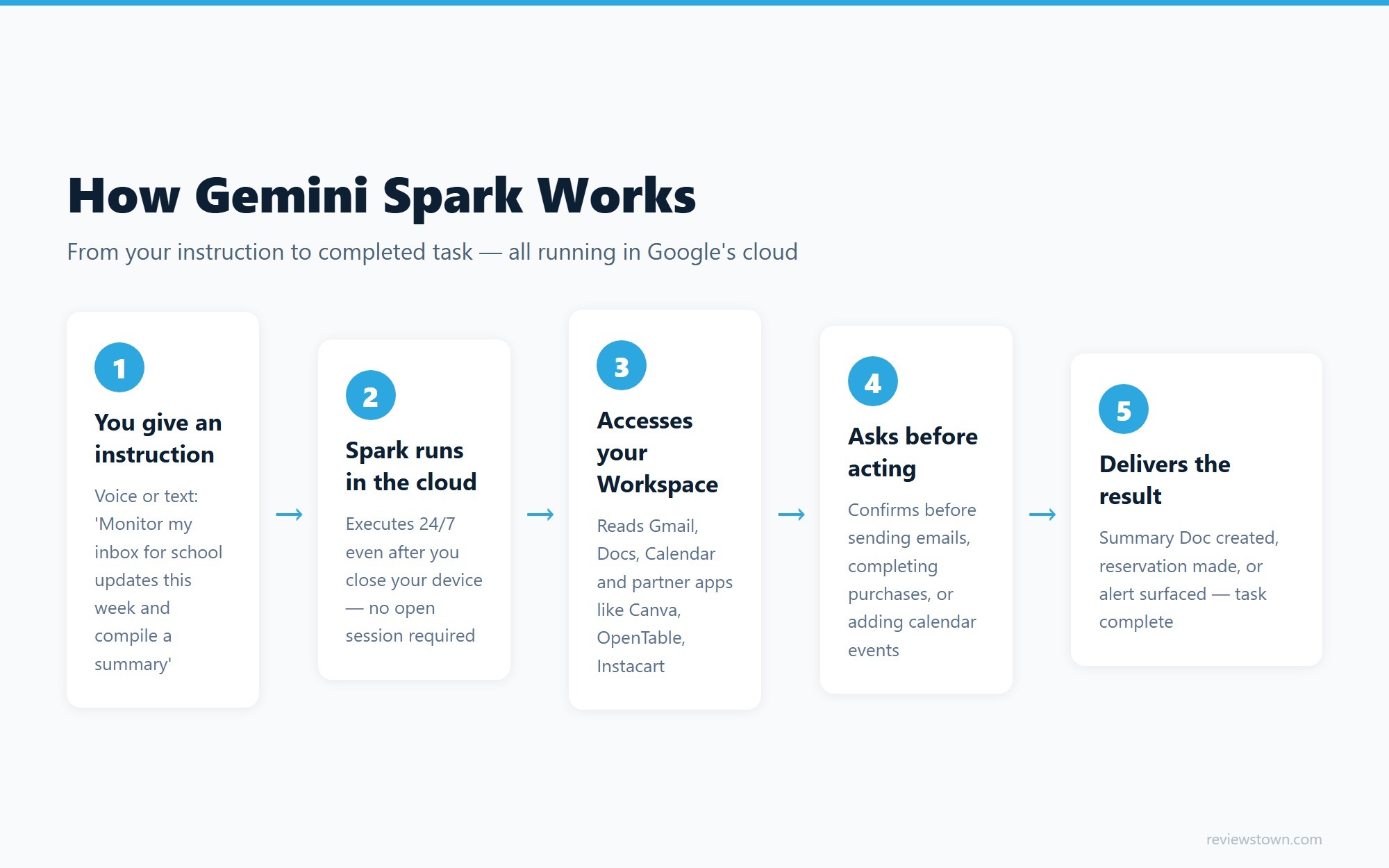
Gemini Spark is Google’s answer to a question that has been circling AI discussions for two years: what if your AI assistant kept working even after you closed your laptop? Unlike on-device assistants that pause the moment your screen goes dark, Spark runs entirely in Google’s cloud, executing multi-step tasks 24/7 without requiring your device to stay on.
At launch, Spark connects natively to Gmail, Google Docs, Calendar, and Sheets. This is not screen-scraping – it is direct API access, which means Spark can read your inbox, identify action items, draft responses, update your calendar, and compile scattered project notes into a new Doc, all without you touching a keyboard. According to Engadget’s hands-on coverage, Spark can monitor credit card statements for hidden subscriptions, track school update emails, and synthesize notes from multiple threads into a single document.
Google is also opening Spark to partner apps – Canva, OpenTable, and Instacart are confirmed at launch – which means it will be able to make restaurant reservations or reorder household items on instruction. Crucially, Spark asks for confirmation before taking irreversible actions like sending emails, completing purchases, or scheduling calendar events. This human-in-the-loop design makes it meaningfully safer than fully autonomous agent systems.
Rollout schedule:
– Trusted testers: Week of Google I/O 2026
– US Google AI Ultra subscribers: One week after I/O
– Chrome desktop app (local file access + desktop automation): Summer 2026
Real-world use cases for Gemini Spark’s personal agent capabilities include monitoring travel deals, tracking rental listings, auto-summarizing weekly newsletter digests, and managing recurring task lists across Workspace. Spark is built on Gemini 3.5, giving it the reasoning capability to chain these tasks intelligently rather than just executing isolated commands.
Gemini 3.5 Flash: The Speed Engine Powering Agentic Coding Platforms
One data point dominated the Gemini 3.5 Flash announcement: 289 tokens per second, according to Artificial Analysis benchmarks (as of May 13, 2026). GPT-5.5 outputs 71 tokens/second. Claude Opus 4.7 manages 67 tokens/second. Gemini 3.5 Flash is more than four times faster than either.
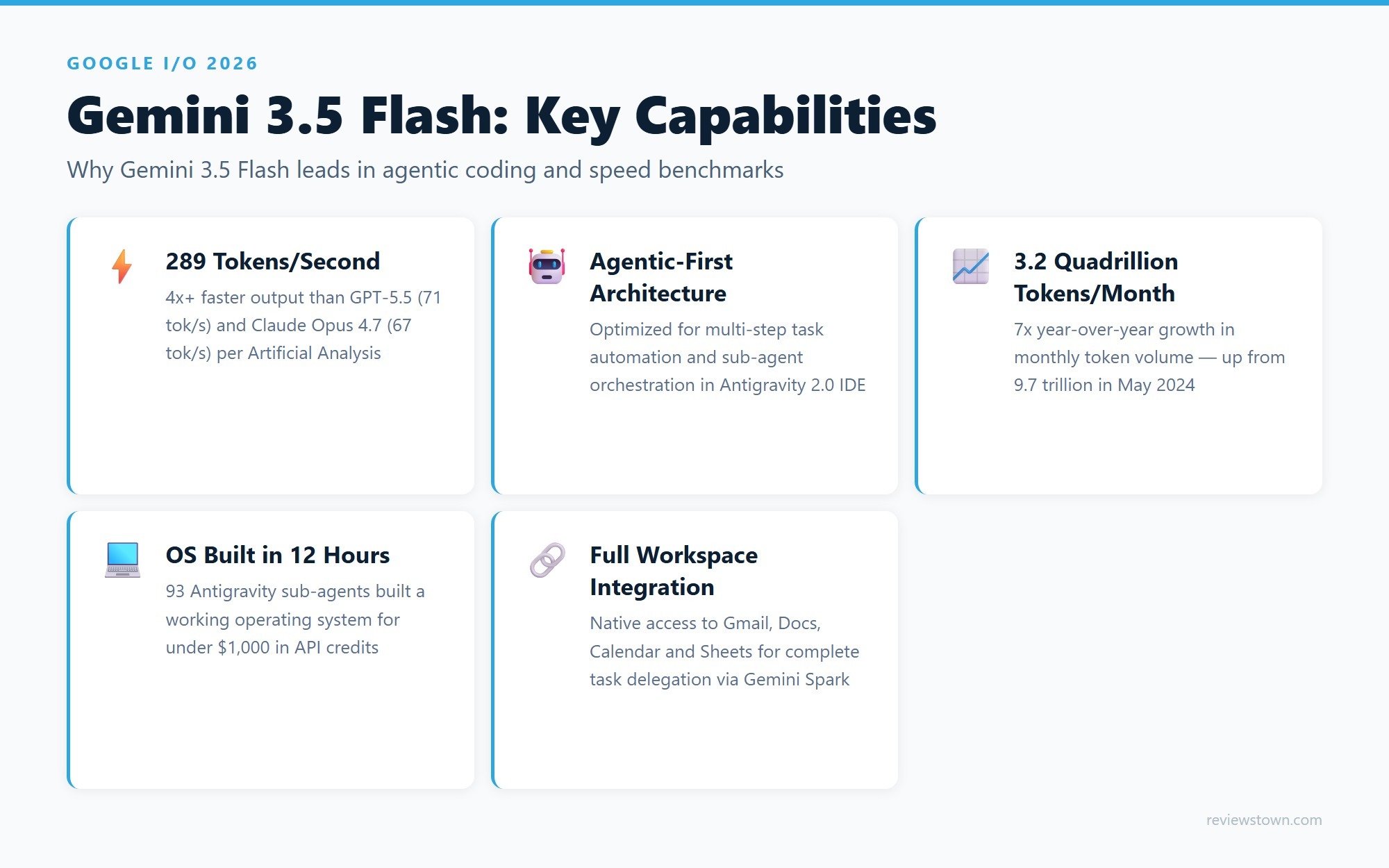
For agentic coding platforms, speed is not a vanity metric. When an AI coding tool iterates across dozens of sub-tasks – reading files, running tests, patching bugs, writing documentation – output speed compounds. A model that generates code four times faster doesn’t just feel snappier; it completes agent loops in a fraction of the time, reducing latency for every downstream step.
For scale context: Google’s internal token processing grew from 5 billion tokens per day in March 2026 to over 3 trillion tokens per day by the I/O keynote. Monthly token volume reached 3.2 quadrillion – a 7x year-over-year increase since May 2024. These are real throughput numbers, not theoretical limits.
For developers wondering which AI coding tools integrate with Gemini 3.5 Flash, the answer at launch includes Antigravity 2.0, Firebase, and Google AI Studio. Google has also confirmed third-party API access, meaning IDEs like Cursor and Windsurf can plug into Gemini Flash as a backend model. Gemini 3.5 Pro – targeting deeper reasoning tasks – is in internal testing and expected to reach public APIs next month.
Gemini Omni: Google’s World Model for Multimodal AI Video Generation
Gemini Omni is the most technically ambitious announcement in the keynote. Google describes it as a world model – a system that doesn’t process text, images, audio, and video in parallel pipelines, but reasons across all of them simultaneously while understanding physical laws governing the real world.
In practice: Gemini Omni takes a still image, a video clip, an audio track, and a text prompt together, then generates a cohesive output video. It understands gravity, kinetic energy, and fluid dynamics – so generated scenes don’t just look visually coherent, they behave physically plausibly. A falling object behaves with realistic momentum. Water reacts with accurate fluid behavior.
The editing workflow compounds this. Rather than regenerating from scratch with each revision, Omni lets users edit AI-generated videos through natural conversation, where each instruction builds on the previous output. Characters stay visually consistent across edits. Scenes retain context from earlier in the generation session.
All Omni-generated videos include SynthID watermarking – Google’s digital provenance system – embedding an invisible marker that confirms AI-generated origin. As Engadget reports, Omni represents a different architectural philosophy from competitors that bolt video generation onto existing text models: it is a single multimodal model that reasons across inputs at once, not a collection of separate systems stitched together.

Gemini Omni availability as of May 2026:
– Omni Flash: Live now in the Gemini app, Google Flow, and YouTube Shorts for Plus, Pro, and Ultra subscribers
– Omni API access: Coming soon
– Omni Pro: Launch timeline not yet announced
For a detailed look at what Gemini Omni can produce, see our Gemini Omni AI video generation review.
AI Mode Reaches 1 Billion Users – Is Traditional Search Over?
Google AI Mode reached one billion monthly active users before the I/O keynote. More significant than the number itself is the growth rate: AI Mode queries are doubling every quarter, meaning the adoption curve is still in its steep phase. This is not a plateau – it is an acceleration.
At I/O 2026, Google announced that AI Overviews and AI Mode are merging into a unified global experience. The familiar AI summary box at the top of search results will blend into a conversational format without requiring a separate mode toggle.
More substantively, Google introduced Search Agents – persistent monitors that track specific information categories over time without requiring repeated manual queries. Users can configure a Search Agent to watch stock price movements, rental listings in a target neighborhood, or new release dates for games, albums, or films. When something relevant changes, the agent surfaces it proactively.
Generative UI – powered by Antigravity – extends this further: complex queries can now render interactive visualizations rather than text-only answers. A mortgage rate comparison query might produce a live interactive calculator. A product comparison question might generate a real-time spec table.
On whether AI Mode replaces traditional search: it doesn’t eliminate links, but it changes what they are for. Informational queries increasingly resolve within AI Mode. Navigational queries – where users already know their destination – still route through standard links. As TechRadar observes, Gemini is now structurally embedded in every Google surface, making AI-off search increasingly impractical to opt out of.
The trade-off for publishers is real: zero-click resolutions reduce site traffic. The counter-argument – supported by early data – is that AI Overviews drive higher-intent clicks from users who want to go deeper after getting a quick answer. For more on Google’s ecosystem direction, see our Google I/O 2026 Android coverage.
Antigravity 2.0: Google’s Agentic Coding Platform Built on Gemini
Antigravity 2.0 is Google’s most concrete demonstration of what Gemini 3.5 Flash can accomplish under sustained multi-agent reasoning. The headline proof point: 93 specialized sub-agents collaborated to build a functional operating system in 12 hours, spending less than $1,000 in Gemini API credits.
Antigravity 2.0 ships as a desktop application with a CLI, SDK, and native speech interface. The platform allows developers to define specialized sub-agents that operate in parallel – one writing tests, one handling documentation, one managing dependencies, one performing code review – and hand off context between themselves. This is the AI agent operating system model in practical form: instead of a single AI doing everything sequentially, an orchestrated network of agents divides cognitive labor.
Confirmed integrations at launch include Android Studio, Firebase, and Google AI Studio. The entire system runs on Gemini 3.5 Flash as the backend, leveraging its 289 tokens/second throughput to keep sub-agent loops fast enough to be practically useful rather than theoretically impressive.
The OS-in-12-hours benchmark is deliberately provocative – it is designed to stress-test multi-agent coordination over an extended session, not to demonstrate a realistic development workflow. But it does establish something concrete: that agent orchestration at this scale can produce coherent, functional software with minimal human intervention.
Gemini Spark vs. ChatGPT Operator: Which Personal AI Agent Wins?
Two consumer-facing personal agent platforms now exist at meaningful scale: Google’s Gemini Spark and OpenAI’s ChatGPT Operator. They occupy the same category – AI that acts on your behalf – but differ in architecture, scope, and cost.
| Gemini Spark | ChatGPT Operator | |
|---|---|---|
| Task execution | 24/7 cloud-side | Session-based only |
| Platform integration | Chrome + Android | Browser tab only |
| Monthly price | $100 (AI Ultra) | $200 (ChatGPT Pro) |
| Coding IDE | Antigravity 2.0 | Not included |
| Model output speed | 289 tokens/sec | ~71 tokens/sec |
The decisive architectural difference is persistence. Spark runs in Google’s cloud after you close the app. Operator requires an active browser session. For overnight monitoring tasks – inbox triage, flight deal tracking, rental listing alerts – Spark’s cloud-side execution is a category-level advantage, not just a feature preference.
On price, Spark is bundled into Google AI Ultra at $100/month. ChatGPT Operator requires the $200/month ChatGPT Pro plan. Both tiers include substantially more than just the agent, but if personal agents are the primary use case, the price differential is significant.
The trade-off is ecosystem dependency. Spark’s deepest capabilities come from Workspace integration, which rewards users already operating within Google’s suite. Operator works across any browser, giving it a platform-neutrality advantage for mixed-environment users. If you are already embedded in Gmail, Docs, and Calendar, Spark’s integration depth is a genuine competitive edge. If you work across multiple platforms and don’t want Google controlling your agent layer, the calculus may shift.
Google AI Ultra and the New Subscription Tiers
Google restructured its entire AI subscription lineup at I/O 2026. The most consequential change: a new Google AI Ultra entry tier at $100/month, down from the previous Ultra price of $250. A revised higher Ultra tier at $200/month remains for power users requiring greater compute limits.
According to Engadget, the restructuring reflects Google’s effort to make advanced AI features accessible to a broader professional audience, not just enterprise customers.
| Tier | Price | Key Features |
|---|---|---|
| Free | $0 | Basic Gemini app, limited AI Mode |
| AI Plus | ~$20/month | Gemini Advanced, AI Overviews |
| AI Pro | ~$40/month | Gemini 3.1 Pro, Workspace integration |
| AI Ultra | $100/month | Gemini 3.5 Flash, Spark beta, Omni Flash, Antigravity access |
| AI Ultra (high) | $200/month | Higher compute limits, priority Gemini 3.5 Pro access |
For most professionals evaluating the $100/month tier: it is expensive relative to competitors’ base plans – OpenAI Plus costs $20/month – but it bundles capabilities that would otherwise require separate tools. Spark for task automation, Omni for video generation, Antigravity for coding, and the full Gemini 3.5 Flash API are features that individually could cost more than $100/month across competing platforms.
The honest question is whether you will actually use Spark, Omni, and Antigravity enough to offset the cost. If your workflow touches email management, creative content production, and coding automation regularly, the bundled Ultra tier has a realistic value case. If you primarily need AI for chat and basic writing, the free or Plus tiers remain more cost-efficient entry points.
- Gemini Spark runs in the cloud 24/7, executing tasks without keeping your device on
- Gemini 3.5 Flash delivers 289 tokens/second — over 4x faster than GPT-5.5 and Claude Opus 4.7
- Gemini Omni Flash is live now for Plus, Pro, and Ultra subscribers in the Gemini app and Google Flow
- AI Mode surpassed 1 billion monthly active users with quarterly query volume doubling
- Google AI Ultra entry price dropped from $250 to $100/month
- Gemini Spark beta is restricted to US Google AI Ultra subscribers at launch
- Full agentic features like email sending and browser control are rolling out in phases, not yet complete
- Gemini Omni Pro launch timeline has not been announced; only the Flash variant is available now
- Antigravity 2.0 agentic IDE is not yet widely available to independent developers outside the waitlist
Frequently Asked Questions
What is the new Google Gemini update from Google I/O 2026?
Google I/O 2026 introduced Gemini Spark (a 24/7 cloud-running personal AI agent), Gemini 3.5 Flash (289 tokens/second output speed), Gemini Omni (a physics-aware world model for multimodal video generation), Antigravity 2.0 (an agentic coding IDE), AI Mode reaching 1 billion monthly active users, and a redesigned subscription structure with Google AI Ultra starting at $100/month.
How does Gemini Spark compare to ChatGPT Operator?
Gemini Spark runs 24/7 in Google’s cloud — it keeps working after you close your device — while ChatGPT Operator requires an active browser session. Spark integrates natively with Gmail, Docs, Calendar, and Sheets, and comes bundled with Google AI Ultra at $100/month. ChatGPT Operator requires the $200/month ChatGPT Pro plan and operates at the browser level only, without cloud-side persistence.
Is Gemini Omni Flash free to use?
Gemini Omni Flash is available to Google AI Plus, Pro, and Ultra subscribers as of Google I/O 2026 — it is not available on the free Gemini tier. It’s accessible within the Gemini app, Google Flow, and YouTube Shorts. All videos generated via Omni include SynthID watermarking to indicate AI-generated origin. Gemini Omni Pro has not yet been given a release timeline.
What is the difference between Gemini 3.5 Flash and Gemini 3.5 Pro?
Gemini 3.5 Flash is optimized for speed and agentic throughput — it outputs 289 tokens per second, making it the fastest model in independent Artificial Analysis benchmarks as of May 2026. Gemini 3.5 Pro prioritizes deeper reasoning and is currently in internal testing, with a public API release expected next month. For most coding automation and agent workflows, Flash is the recommended starting point due to its speed advantage.
How much does Google AI Ultra cost, and what does it include?
Google restructured its AI subscriptions at I/O 2026. The new Google AI Ultra entry tier costs $100/month (down from $250) and includes Gemini 3.5 Flash access, early Gemini Spark beta access, Gemini Omni Flash, and priority features across Google’s AI surfaces. A higher Ultra tier at $200/month offers greater compute limits and priority access to Gemini 3.5 Pro once it launches publicly.