
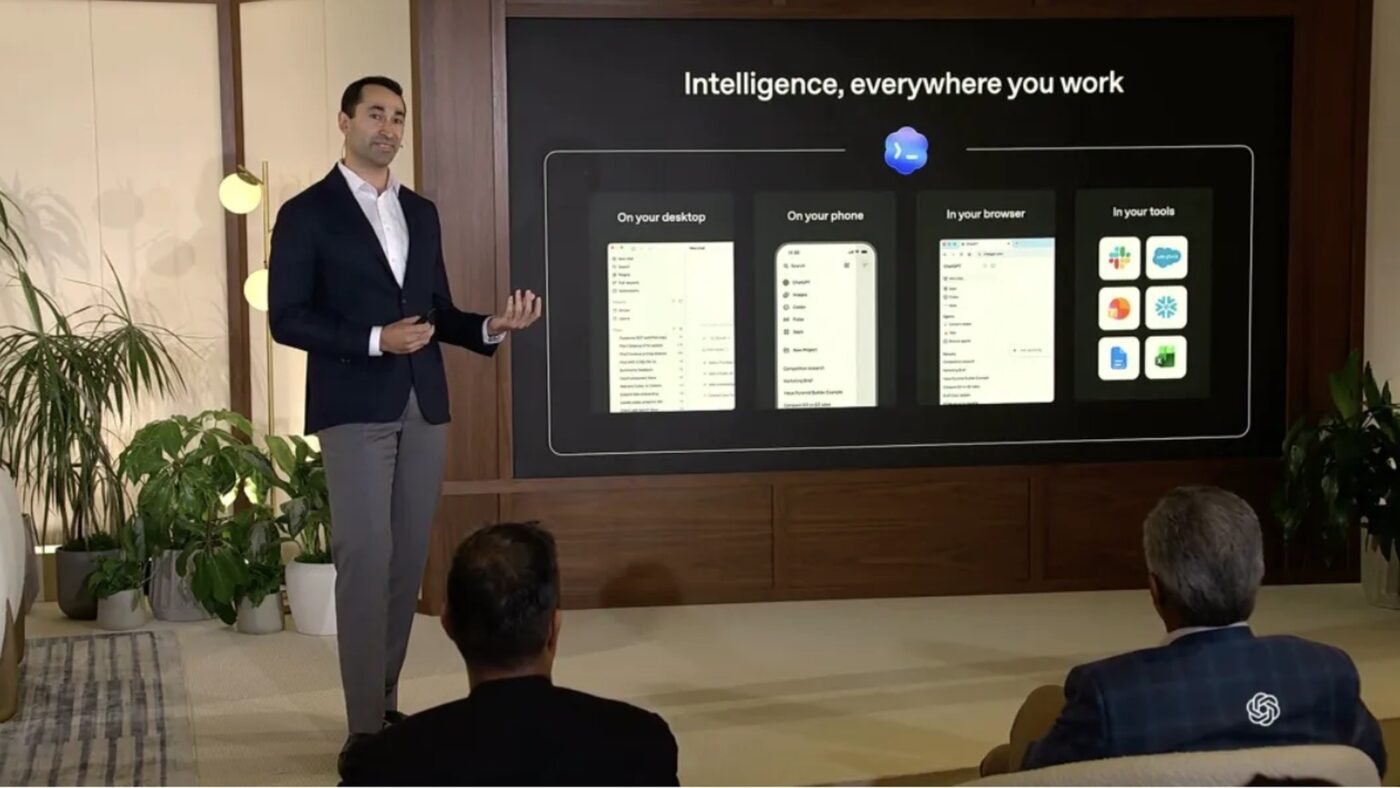
OpenAI Codex launched in May 2025 as something fundamentally different from a code completion tool. Where the original GitHub Copilot-era Codex API, deprecated in 2023, handled single-function generation, the current Codex is a full cloud-resident AI agent that runs multi-day engineering tasks without continuous user input. According to OpenAI, weekly active users surpassed 5 million by mid-2025, a 400% increase since the start of that year.
The timing was deliberate. Internal reporting confirmed that Anthropic’s Claude Code had outperformed OpenAI’s own models on certain benchmarks in late 2024, and that pressure accelerated the Codex team’s resourcing and roadmap. What emerged is a platform that spans software development, sales automation, financial analysis, and creative production under a single ChatGPT subscription.
This guide covers what Codex actually does today, how it differs from ChatGPT, where it beats Claude Code and where it falls short, and what enterprises like Cisco are doing with it in production.
What Is OpenAI Codex?
Codex is not a chatbot, and it is not a code autocomplete engine. It is an autonomous software agent hosted in ChatGPT’s cloud infrastructure that accepts a goal stated as a success condition and then executes the steps to reach it, over hours or days, while the user moves on to other work.
The goal command interface is the clearest illustration. Rather than prompting Codex with “write a function that does X,” an enterprise team submits a task like: “migrate this Java 8 codebase to Java 26 and pass all existing tests.” Codex reads the repository, plans an execution sequence, writes the changes, runs the test suite, and iterates until the success condition is met, or until it reaches a decision point that requires human input.
A critical architectural distinction separates Codex from inline tools like GitHub Copilot or Cursor: Codex operates on entire repositories inside isolated cloud containers, not on the file open in the editor. This is what enables tasks like full-codebase security scans. According to OpenAI’s enterprise demonstration, a security sweep of one customer codebase took 6.5 hours and generated a structured report covering threat models, attack vectors, and a ranked vulnerability list. That scope of analysis is not achievable with a file-by-file completion tool. In practice, this architectural difference is more significant than any model quality gap: the container approach means Codex can hold an entire 200,000-line codebase in context simultaneously, while Cursor or Copilot typically process one file at a time.
What is an AI coding agent, and how does Codex work?
An AI coding agent is software that reads a goal, plans the steps needed to reach it, executes those steps autonomously across files and tools, and iterates until the condition is met or it needs human input. Codex implements this pattern as a cloud-resident agent with full repository context, multi-app integration, and persistent task state across sessions.
How OpenAI Codex Differs from ChatGPT
The most common new-user question, “is Codex just a smarter version of ChatGPT?”, misses a fundamental architectural distinction.
ChatGPT is a conversational interface designed for back-and-forth exchanges. It responds to prompts, generates text and code, and has no persistent task state between messages unless you are using memory features. Codex maintains a task context across sessions, calls tools including code interpreter, file access, browser, and MCP-compatible app APIs, and continues running after you close the browser window. According to OpenAI’s published documentation, cloud tasks run continuously in isolated containers and users receive results without staying actively engaged in the session.
The integration layer marks the clearest practical difference. ChatGPT responds with text and inline code suggestions. Codex, through its annotations feature, can read content inside Figma documents, Google Slides, and Salesforce records, and then write changes back to those apps via OpenAI’s API layer, requiring only a final user confirmation before committing. A standard ChatGPT session cannot push changes into third-party production apps without a custom GPT Action or external API setup. This write-back capability is, however, a double-edged advantage: it delivers significant automation value but also raises governance questions around who can authorize agents to modify production systems, which ChatGPT’s conversation-only model avoids entirely.
For enterprise buyers evaluating both, the decision point is task duration and toolchain integration. ChatGPT handles short, interactive sessions well. Codex handles multi-hour autonomous jobs that touch multiple systems. Neither replaces the other for most organizations at this stage of adoption.
How the Codex agent platform actually executes a task
Six architectural pieces explain why Codex behaves differently from inline tools like Copilot or Cursor, and what it enables for enterprise workflows.
User states a success condition in plain language. The agent plans and executes the steps without further prompt input until the condition is met or a decision point requires a human.
Each task runs in a sandboxed environment preloaded with the connected GitHub repository, with no internet access during execution by default. This is the enterprise security baseline.
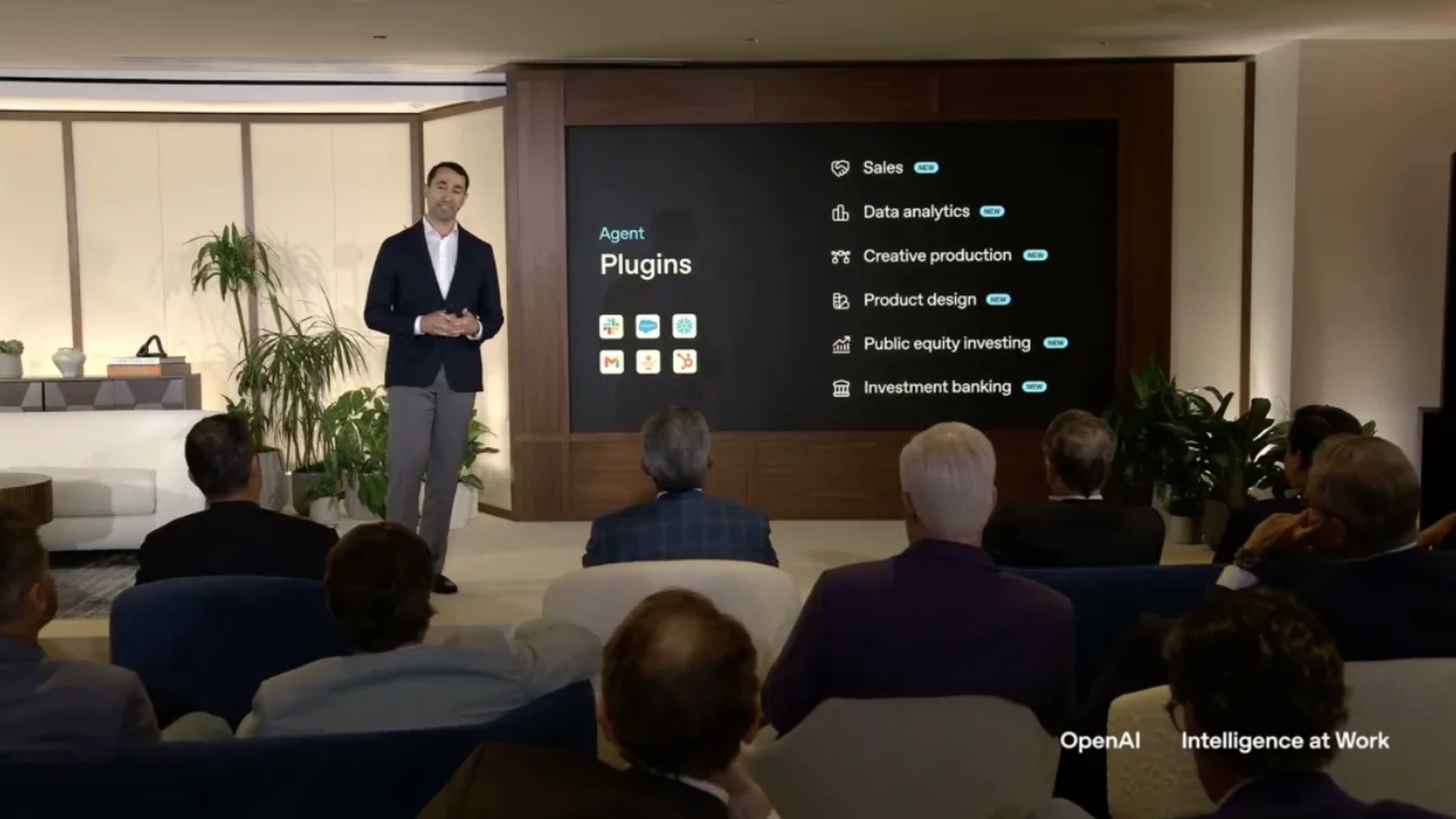
Pre-built integrations to Salesforce, Snowflake, Figma, HubSpot, Tableau, FactSet, and 56 more business tools, plus custom MCP plugins for internal systems.
GPT-5-Codex has been observed running independently for over 7 hours on complex tasks during OpenAI’s internal testing, iterating on implementation and fixing test failures.
Completed tasks produce reviewable pull requests with full diffs ready for engineering team approval, rather than dropping unreviewed changes into the codebase directly.
Deep codebase analysis covering threat models, attack vectors, and ranked vulnerability findings. The 6.5-hour Cisco demo scan represents the full enterprise scope.
The Six Business Agent Plugins: 62 Apps, 110 Skills
OpenAI’s May 2025 enterprise event introduced six specialist plugin categories, each pairing the Codex agent with purpose-built integrations across business applications. The breadth, 62 connected apps supporting 110 distinct skills, represents the clearest signal that OpenAI is repositioning Codex from a developer tool into a general enterprise automation platform.
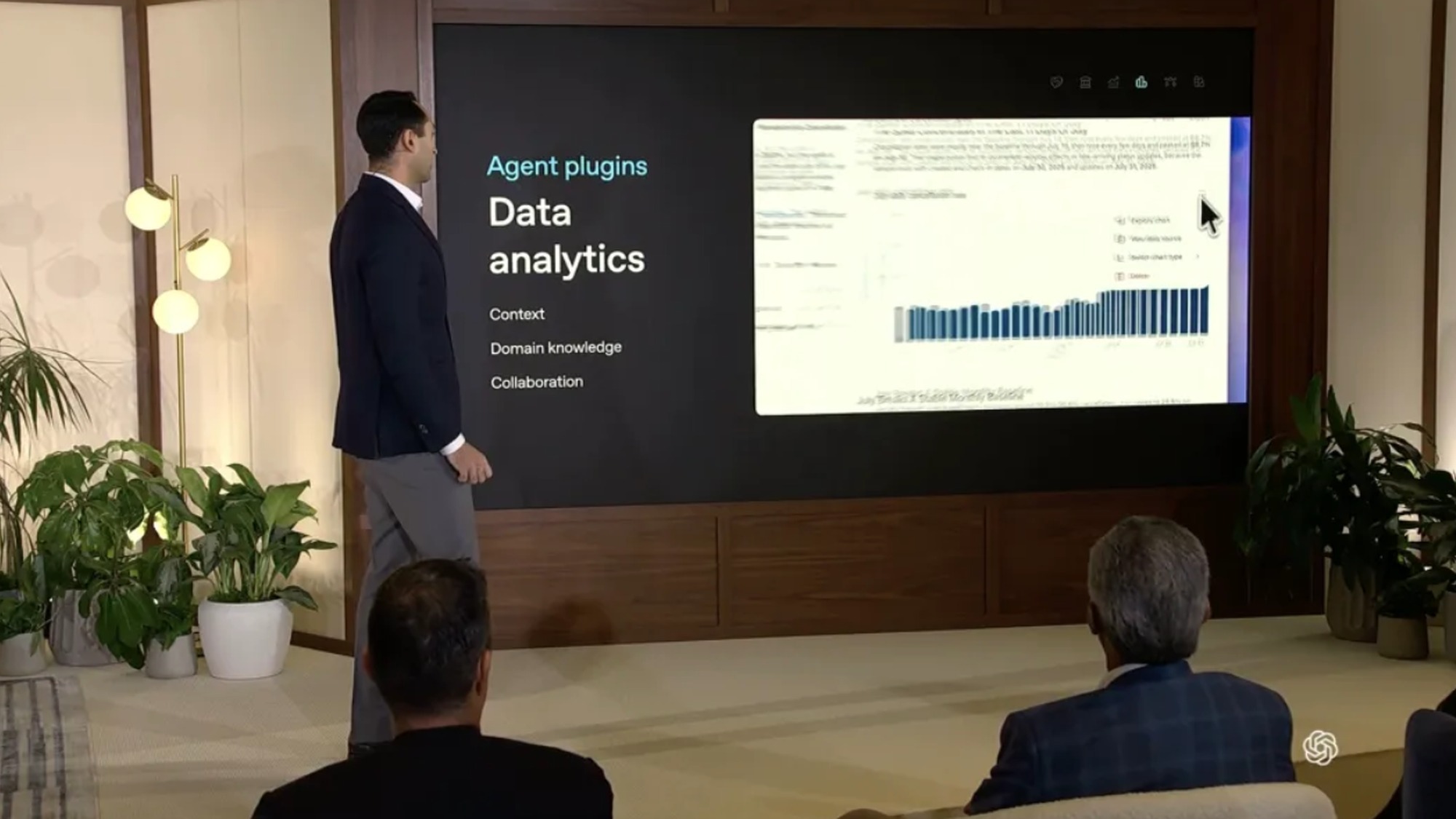
Data analytics connects to Snowflake and Tableau for production database queries, automated report generation, and anomaly flagging without requiring SQL expertise. The demos showed Codex formulating multi-step Snowflake queries and rendering results directly into Tableau dashboard refreshes, a task that previously required a data analyst’s manual involvement.
Creative production bridges to Figma and Canva, converting a written creative brief into design asset proposals. Codex reads brand guideline documents from connected storage, then generates Figma frame variants aligned to the existing component library for the designer to iterate on.
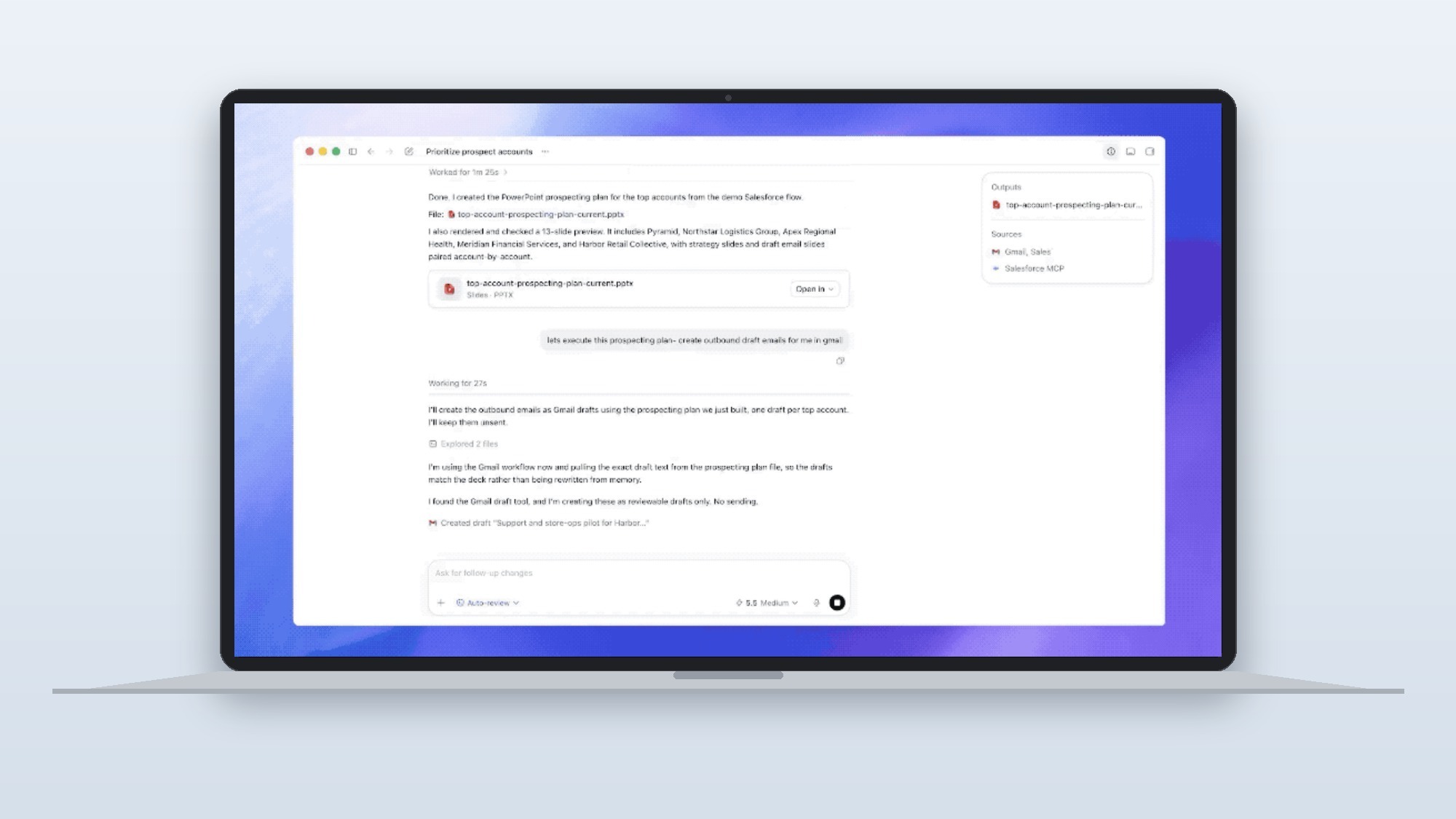
Sales links to Salesforce and HubSpot to prepare per-account meeting briefs, draft follow-up emails, and update CRM fields after calls. Enterprise sales teams report this as the highest-immediate-value integration, cutting pre-call research time from 45 minutes to under five across their representative population.
Product design pulls from Figma and Canva to produce interactive prototypes from user story tickets. The agent reads the Jira or Linear ticket, then generates a clickable Figma prototype aligned to existing design system components.
Investment research connects to FactSet and Moody’s for financial report ingestion, earnings call summarization, and competitive comparison tables. This category directly targets equity research analysts who currently spend three to four hours building initial company models before conducting any original analysis.
Investment banking covers pitch deck generation from multiple proprietary data sources, targeting junior bankers who spend significant time reformatting internal data into deliverable decks.
The plugin architecture uses OpenAI’s Model Context Protocol (MCP), meaning organizations can also configure private plugin bundles connecting internal tools not covered by the six standard categories.
Real Enterprise Use Cases: Cisco, Temporal, and Hudson Bank
The most widely cited enterprise deployment is Cisco. According to OpenAI, Cisco has rolled out Codex across its entire organization, starting with the software development lifecycle and expanding into internal process automation beyond engineering. That expansion pattern is worth noting: Cisco did not attempt organization-wide rollout on day one, and that approach outperforms the alternative. Enterprises that deploy Codex to all functions simultaneously before establishing governance typically see lower utilization and higher remediation overhead, based on comparable SaaS rollout data from Salesforce and Slack adoption studies.
Temporal, a workflow orchestration company, uses Codex to accelerate feature development, debug production issues, write and execute test suites, and refactor large sections of their codebase. Kodiak, working on autonomous vehicle technology, uses Codex to write debugging tools, improve test coverage, and handle code refactors in safety-critical software where comprehensive test suites are mandatory before any change ships.
Hudson River Bank demonstrated a different pattern: executive-level knowledge work automation. The live demo showed Codex generating a CEO daily briefing from connected financial systems and preparing client meeting materials automatically from CRM data each morning, using the goal command interface to define the briefing format once and run it on a schedule.
OpenAI also confirmed that its own internal AI products are built and maintained using Codex agents, making the company its own largest enterprise customer by headcount.
OpenAI Codex vs Claude Code for Enterprise Teams
Claude Code and OpenAI Codex are the two leading agentic coding environments as of mid-2025, and peer-to-peer comparisons from engineering communities reveal a clearer split than the marketing materials suggest.
Claude Code launched from Anthropic as a terminal-native agent, excelling at deep codebase reasoning where long context retention determines output quality. It ships as a CLI tool installable via npm, integrates natively with VS Code and JetBrains, and runs tasks within developer-controlled environments rather than exclusively in the cloud. Claude’s Opus model line is the primary driver for complex architectural work.
Codex runs entirely in the browser or via the ChatGPT desktop app, which reduces adoption friction for non-developer teams significantly. Its plugin layer connects to 62 business apps out of the box, something Claude Code does not offer natively. For organizations extending AI automation beyond the development team, Codex’s breadth wins on deployment speed.
For pure code quality on complex new development, Reddit users comparing both tools in mid-2025 reported that attempting the same three debugging scenarios showed Claude Opus using more session context but producing architecturally cleaner solutions. Codex 5.3 was described as “more consistent and way cheaper” for high-volume routine tasks: test generation, documentation updates, and dependency migrations.
| Dimension | OpenAI Codex | Claude Code |
|---|---|---|
| Interface | Browser and ChatGPT app | Terminal and IDE plugin |
| Long tasks | Cloud-resident, runs overnight | Session-bound, resumes via CLI |
| App integrations | 62 apps via plugins | None native; custom MCP setup |
| Ideal for | Cross-team automation | Deep engineering refactors |
| Pricing entry | ChatGPT Plus ($20/month) | Claude Pro ($20/month) |
| Enterprise security | SCIM, EKM, role-based access | SOC 2, GDPR, enterprise API |
Most enterprise teams with both engineering and non-engineering use cases will run both tools in parallel, using Codex for breadth and Claude Code for depth.
OpenAI Codex Pricing: What Business and Enterprise Users Pay
Codex is included in every ChatGPT tier, but available capacity scales significantly across plans. According to OpenAI’s published pricing information, ChatGPT Plus at $20 per user per month provides access to Codex using the GPT-5.3-Codex model, with a quota of 10 to 60 cloud tasks per 5-hour rolling window.
ChatGPT Business at $25 per user per month (billed annually, or $30 month-to-month) adds team administration, workspace credits for additional usage beyond the base quota, and a firm data privacy guarantee: OpenAI does not train on workspace data. This is the practical minimum tier for SMB deployments handling confidential information.
Enterprise pricing requires a direct sales engagement with OpenAI, and no published per-seat baseline exists. The enterprise tier adds SCIM-based user provisioning for identity management integration, encryption key management (EKM) for customers that need control over their encryption keys, role-based access controls for plugin and task permission management, and a dedicated support SLA. According to enterprise deployment reports, larger customers like Cisco negotiate credits-based contracts with volume pricing tied to token consumption rather than seat count.
For developer-only teams, the Plus tier is the practical starting point. For organizations deploying Codex across sales, finance, and operations functions, the Business or Enterprise tier is necessary to unlock the workspace credit pool needed for high-volume plugin usage. OpenAI also confirmed that additional credits can be purchased a la carte on Plus and Pro plans without requiring a tier upgrade.
How to Deploy OpenAI Codex for Your Business Workflow
Organizations that extract the most measurable value from Codex consistently follow a phased adoption path rather than an immediate organization-wide rollout.
Phase 1: Developer adoption. Start with the engineering team using Codex for test generation, code review, and documentation. Set concrete success metrics before the pilot begins: number of PRs processed autonomously per week, reduction in code review cycle time, or volume of test coverage added. The Codex CLI tool available on GitHub enables terminal-native workflows for teams that prefer local tooling integration over the browser interface.
Phase 2: Plugin activation. Once the development team is comfortable with the agent model, activate relevant business plugins for your existing tech stack. Assign two or three early adopters from the sales or data team as internal champions and document their workflows before rolling out more broadly. The AGENTS.md configuration file inside connected repositories gives the agent specific instructions about how to handle your codebase, which commands to run for testing, and what project conventions to follow.
Phase 3: Goal command automation. Move from interactive sessions to scheduled autonomous workflows using defined success conditions. The Hudson Bank briefing scenario illustrates this: the agent runs a fixed process each morning without anyone initiating it.
For security-sensitive deployments, Codex Security provides deep static analysis of connected repositories, generating structured vulnerability reports. The basic version is available on standard plans, and the GPT-5.5 cyber model provides deeper threat intelligence modeling for organizations with complex security requirements.
What Real Users Actually Report
Community feedback from Reddit’s r/ChatGPTCoding and r/ClaudeAI, alongside YouTube comment sections from the Codex launch videos, surfaces a pattern that marketing materials do not capture: strong approval for Codex on code review and high-volume routine tasks, combined with skepticism about architectural judgment on complex new development.
One r/ChatGPTCoding user summed up the initial reaction: “It can actually write, debug, test, and even understand entire codebases. It looks wild.” That enthusiasm reflects genuine capability for well-scoped tasks. However, users with complex greenfield projects report that Codex 5.3 “is oddly bad at writing good” new code compared to its code review capabilities, suggesting the agent’s strength is pattern recognition and test-driven correction rather than creative architectural design.
The pricing community has formed its own consensus: “4.6 is better at problem solving but 5.3 Codex is more consistent and way cheaper.” This signal points toward the optimal enterprise deployment pattern: route high-frequency, lower-complexity automation through Codex on standard plans, and reserve more expensive model tiers for architectural decision sessions.
The non-developer growth story is the most significant community signal. Multiple users in different threads described product managers and analysts independently discovering Codex through the ChatGPT interface and beginning to use it for data queries and report generation before any formal IT rollout. OpenAI’s own figure, that non-developer users are growing three times faster than developer users, aligns with this bottom-up adoption pattern. Enterprise IT teams should expect organic Codex adoption outside the engineering organization and plan governance accordingly.
The Future of AI Agents in Enterprise Software
OpenAI’s Sites feature, announced alongside the Codex enterprise rollout, points toward where enterprise AI agent output is heading. Rather than generating a PDF or PowerPoint, Codex can now produce a hosted, interactive web deliverable that clients can navigate directly. For consulting firms, banks, and research houses whose deliverables are currently static decks, this is a significant shift in how knowledge work gets packaged and delivered.
The longer arc treats Codex as infrastructure for AI employees rather than AI tools. The computer use capability, where the agent reads app interfaces visually and operates them directly through the same interactions a human would make, points toward tasks that currently require human judgment being routed to Codex agents as the model’s reliability improves. OpenAI’s internal reporting of 5% daily user growth at the time of the enterprise launch, if sustained, places Codex among the fastest-growing enterprise software platforms measured by active usage rate.
For enterprise buyers, the platform bet decision is not about whether AI agents will reshape knowledge work. That is already in progress. The question is which infrastructure positions your organization best for the integrations that will matter in 18 to 24 months. For a broader view of how competing AI agent platforms are shaping enterprise workflows, see our Google Gemini Spark AI Agent review. OpenAI’s head start on plugin breadth and non-developer accessibility is real. Anthropic’s advantage in deep code reasoning and developer trust is equally real. Most enterprise teams of meaningful scale will run both, segmented by task type rather than competing for a single vendor lock-in.
The reference architecture for enterprise AI in 2026 looks less like a single AI assistant and more like an AI staffing layer: specialized agents assigned to defined task categories, supervised by a shrinking pool of human coordinators who spend most of their time on judgment calls the agents cannot yet make reliably.
- Runs cloud-resident tasks continuously without user supervision, including overnight jobs
- 62 app integrations across sales, finance, creative, and data analytics via business plugins
- Available on ChatGPT Plus at $20 per month with no separate subscription required
- Goal command interface accepts plain-language success conditions, not step-by-step prompts
- Non-developer teams adopt it through the familiar ChatGPT interface, lowering rollout friction
- Cloud-only architecture means no local execution or air-gapped enterprise deployment
- Plugin breadth currently leads engineering depth: complex greenfield code quality trails Claude Code
- Enterprise pricing requires a sales conversation with no published per-seat baseline
- AGENTS.md configuration requires upfront repository setup to unlock reliable autonomous behavior
- No native IDE plugin: terminal and local editor integration requires the CLI or ChatGPT desktop app
Frequently Asked Questions
Is OpenAI Codex free?
Codex is included in every ChatGPT plan, including the free tier, but meaningful usage requires a paid subscription. ChatGPT Plus at $20 per month provides 10 to 60 cloud tasks per 5-hour window using the GPT-5.3-Codex model. The Business tier at $25 per user per month (billed annually) unlocks workspace credits and data privacy guarantees needed for most organizational deployments. Enterprise pricing is negotiated directly with OpenAI.
What does OpenAI Codex do?
Codex is a cloud-resident AI agent that accepts a goal and executes it over hours or days without continuous user input. It can read and modify files across an entire repository, run tests and linters, generate pull requests, conduct security scans of codebases, and automate business workflows through integrations with tools like Salesforce, Snowflake, and Figma. It differs from a code completion tool because it plans and executes multi-step tasks autonomously.
How do I get OpenAI Codex?
Codex is accessible directly inside ChatGPT at chatgpt.com on Plus, Business, or Enterprise plans. The Codex desktop app provides a dedicated multi-threaded interface for managing parallel agent tasks. A CLI tool is also available via the GitHub repository at github.com/openai/codex for terminal-based workflows. No separate Codex account or API key is needed if you are already a ChatGPT subscriber.
OpenAI Codex vs Claude Code: which is better for enterprise teams?
The decision turns on use case. Claude Code excels at deep, sustained codebase refactoring where long context and architectural judgment matter. OpenAI Codex wins on cross-team deployment breadth: its 62-app plugin layer extends automation to sales, finance, and creative teams without requiring engineering involvement. Reddit users comparing both in mid-2025 found Codex 5.3 more consistent and cheaper for high-volume routine tasks, while Claude Opus produced cleaner solutions on complex new development scenarios.
Can OpenAI Codex replace software developers?
Not in 2025. Codex handles routine, well-scoped tasks, such as test generation, documentation, dependency migration, and bug fixing with clear reproduction steps, with high reliability. Complex greenfield development still produces lower-quality architectural decisions compared to experienced engineers. The more accurate framing, from community feedback and enterprise deployments, is that Codex removes the repetitive portion of engineering work, freeing developers for design and judgment-intensive tasks rather than replacing the role.
How does OpenAI Codex handle long-running autonomous tasks?
Codex runs tasks inside isolated cloud containers preloaded with connected GitHub repositories. Each task operates independently without internet access by default, ensuring the agent works only within the provided codebase. According to OpenAI’s published testing, GPT-5-Codex has been observed running independently for more than 7 hours on complex tasks, iterating on implementation and fixing test failures without human intervention. Progress is visible in real time through the ChatGPT interface, and users receive a summary and any generated pull requests when the task completes.