
- Longevity: Modern cells are engineered to outlast the car’s chassis, with many retaining 88% health at 200,000 miles.
- The Silent Killer: Frequent DC fast charging (over 100kW) is the #1 driver of accelerated battery decay.
- 2026 Market Data: Commercial EVs and certain hardware batches (Tesla Juniper, Hyundai ICCU) show higher failure risks.
- Used EV Strategy: Never trust the dashboard range: use OBD-II tools to verify actual State of Health (SOH).
The “Dead Battery” Anxiety is a Myth
Remember when we were all terrified that buying an electric vehicle meant sitting on a ticking time bomb? The fear was simple: you spend $50,000 on a car, and five years later, the battery bricks itself like an old smartphone.
We were wrong. After tracking millions of miles of real-world driving, the data is in. It turns out that modern EV batteries are remarkably resilient. In fact, they are tough enough that the chassis will likely rust apart before the battery cells give up the ghost.
But there is a catch. While the batteries are chemically sound, human behavior is ruining them. New reports suggest that while battery tech is getting better, our impatience is making degradation worse.
The Numbers Don’t Lie: 200,000 Mile Resilience
Tesla’s own internal reporting shows that after 200,000 miles, their Model S and X battery packs lose only about 12% of their original capacity. Think about that: 200,000 miles is effectively the end of life for most internal combustion engines. The EV battery is still running at 88% health.
Independent researchers back this up. Recurrent analyzed thousands of used EVs and found that the vast majority retained over 90% of their original range even after crossing the 100,000-mile mark. If you buy a used EV, the battery is likely fine. The paranoia about buying a lemon with a dead pack is largely unfounded: unless you are looking at very early, air-cooled cars from a decade ago.
Understanding the “Buffer” (Gross vs. Usable capacity) is key to longevity. Here is how the 2026 market leaders compare:
| Model | Warranty (70% SOH) | Buffer (Usable/Gross) |
|---|---|---|
| Tesla Model Y | 8 Years / 120k Miles | 75.0 / 82.0 kWh (8.5%) |
| Hyundai Ioniq 5 | 10 Years / 100k Miles | 80.0 / 84.0 kWh (4.8%) |
| BYD Atto 3 | 8 Years / 155k Miles | 60.5 / 62.0 kWh (2.5%) |
The Villain: Why Decay Rates Are Rising
Here is where it gets interesting. Data from Geotab, a telematics leader, has been tracking battery health for years. In 2019, average annual decay was 2.3%. By 2023, it improved to 1.8%. But in 2025/2026, it jumped back up to 2.3%.
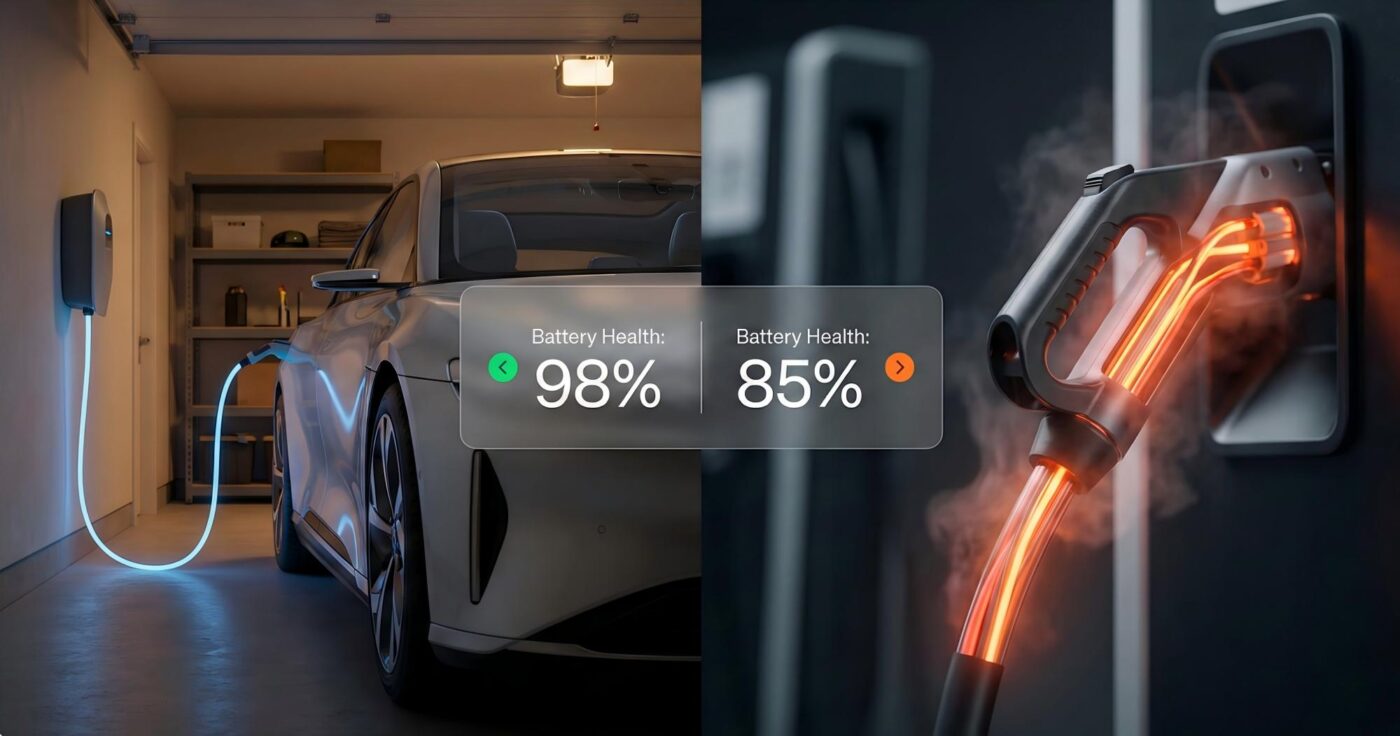
Why did we regress? The technology didn’t get worse: we did. The culprit is high-power DC fast charging. Five years ago, fast charging was a luxury. Today, users treat Superchargers like gas stations. Drivers who primarily charge at home (Level 2 AC) see about 1.5% degradation per year. Drivers who frequently use high-power DC chargers (over 100kW) see that number double to 3.0%.
Commercial Vehicles and Hardware Red Flags
The data revealed another trend: Commercial EVs, like delivery vans and heavy MPVs, are degrading at 2.7% annually compared to 2.0% for private sedans. This is because they prioritize energy density and are almost exclusively fast-charged between shifts.
- Tesla Model Y (Juniper): Watch for electrolyte leakage in certain 2025/26 batches. Check for “Performance-Related Recalls.”
- Hyundai/Kia (E-GMP): Some 2026 units still face ICCU burnout, which kills the 12V battery. Monitor 12V health via OBD-II.
- BYD Atto 3: High “vampire drain” reported in Firmware 8.8.1; ensure the car is updated to the latest 2026 stable build.
The “80/20 Rule” and Used EV Inspection
You have probably heard the internet wisdom: “Never charge to 100%.” The data confirms this is true, but context is required. The damage happens when the car sits at 100% (or 0%) for days on end. Charging to 100% because you are leaving for a road trip in an hour? Totally fine.
Temperature is another factor, though less critical than charging speed. Hot climates do accelerate decay by about 0.4% compared to cooler regions. If you are buying a used EV, don’t trust the dashboard range. Use the “Digital Deep Dive” method:
Pre-Purchase OBD-II Checklist
- Verify SOH (State of Health): Use apps like Car Scanner ELM OBD2 or Scan My Tesla. 90-100% is excellent; below 75% is a major warning.
- Check Cell Voltage Delta: The difference between cells should be under 20mV. Over 100mV indicates a failing cell dragging down the pack.
- Analyze Charging History: Look for the ratio of AC vs. DC charging sessions. High DC counts mean a more stressed battery.
Verdict: You Are The Variable
The battery inside your EV is an engineering marvel. It is designed to outlast the warranty and likely the car itself. Most manufacturers now offer an 8-year warranty because they know the hardware is solid. However, physics demands a trade-off for speed.
If you insist on blasting electrons into the pack at 250kW every single day, you are actively shaving years off your asset’s life. The takeaway is simple:
- Ignore the micromanagement for daily driving: just plug it in at home.
- Avoid extreme states of charge if the car is sitting idle for a week.
- Stop fast charging unless you actually need to for a long trip.
Your battery isn’t dying: you’re just killing it. With the right tools and habits, your EV will remain a high-performance asset for hundreds of thousands of miles.