
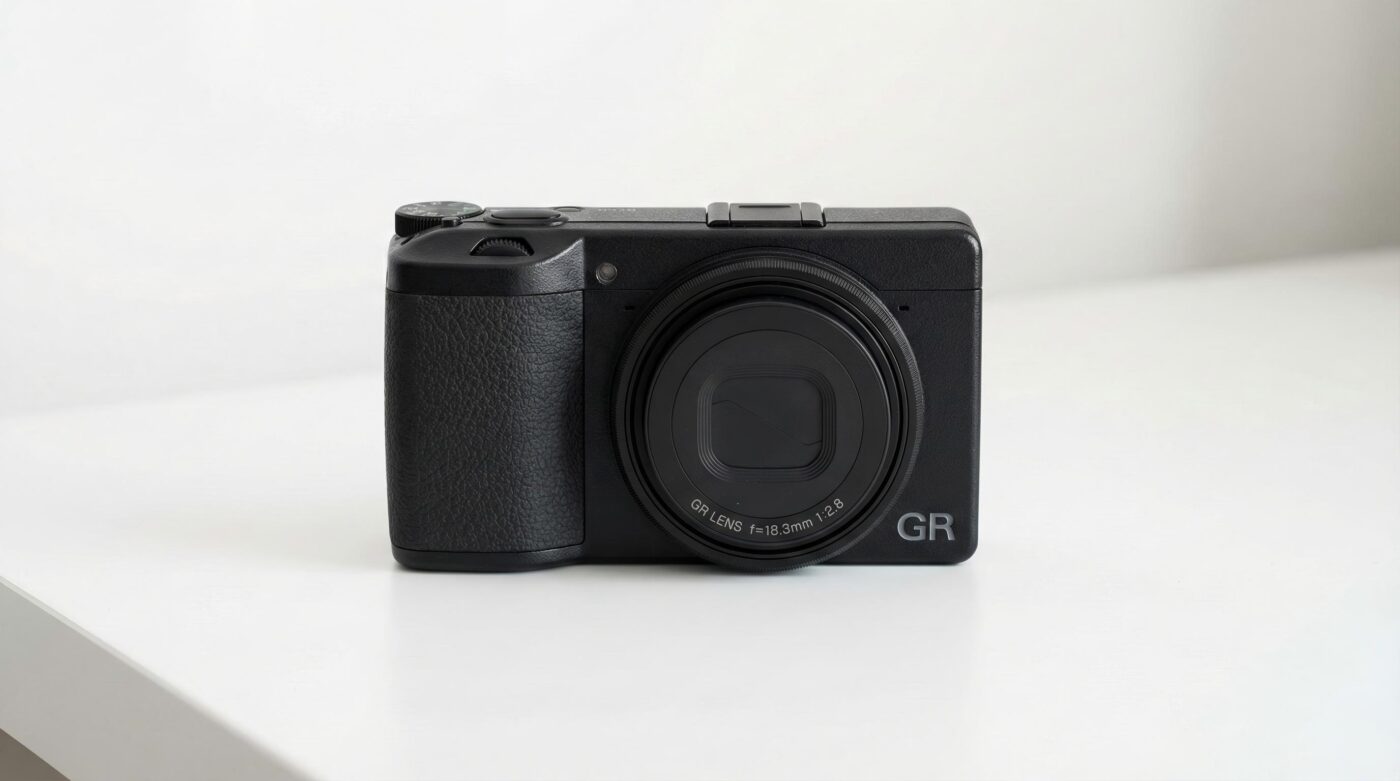
- The Big Upgrade: 5-Axis IBIS allows for 1-second handheld exposures.
- New Colors: “Cinema Yellow” and “Cinema Green” profiles offer distinct, moody aesthetics straight out of camera.
- Connectivity: The new GR WORLD app finally fixes the slow transfer speeds of previous models.
- The Dealbreaker: Video specs are outdated (1080p only) and autofocus is still slow compared to Sony/Canon.
The Cult of the Unobtainable
Try buying a Ricoh GR4 right now. You can’t. You either agree to a ridiculous bundle filled with accessories you don’t need, or you pay a scalper a premium that makes your wallet bleed.
In 2026, a year where professional cameras are spec-monsters and smartphones use AI to reconstruct the moon, it makes zero sense that a fixed-lens APS-C compact camera is the most coveted gadget on the planet.
Yet, after two months with the GR4, I get it. While Canon and Sony are fighting a nuclear war over megapixels and 8K video, Ricoh is sitting in the corner, quietly perfecting the only thing that actually matters: a camera you will actually carry.
It’s All About the JPEG (Again)
If you’re shooting RAW and spending hours in Lightroom, you’re missing the point of this camera. The GR series has always been about the “straight out of camera” look. The GR4 doubles down on this.
You still get the classic “Positive Film” (high contrast, punchy) and the polarizing “Negative Film” (muted, greenish-orange). But Ricoh added two new profiles that frankly steal the show:
- Cinema Yellow: This isn’t just a warm filter. It crushes highlights and retains shadow detail to look like a faded memory. It’s nostalgia in a button press.
- Cinema Green: This is the opposite. It’s cold, detached, and clinical. Use this for city nightscapes or overcast days. It gives everything a moody, arthouse aesthetic without looking like a cheap Instagram filter.
The One Upgrade That Actually Matters
Forget the colors for a second. The single biggest reason to upgrade from a GR III is the stabilization. Ricoh moved from a 3-axis system to a 5-axis in-body image stabilization (IBIS).
On paper, moving from 3-axis to 5-axis sounds like a minor spec bump. In hand, it’s ridiculous.
I stood perfectly still and managed a 1-second exposure handheld with a near 100% success rate. If I used two hands, I could push it to 2 seconds about half the time. This changes how you shoot at night. You can keep your ISO low and let the shutter drag, resulting in cleaner files than you have any right to expect from a sensor this size.
This stabilization also pairs perfectly with the built-in ND filter. Even in broad daylight, you can drag the shutter to create motion blur in crowds or water, all without a tripod.
What Didn’t Change (and What Should Have)
Ricoh is stubborn. The video specs on the GR4 are almost insulting. It tops out at 1080p 60fps. In an era of 4K/120, this is a statement: “Do not buy this for video.”
Autofocus is better, but let’s not get carried away. The tracking sticks more reliably than the previous generation, but compared to a modern Sony or Canon, it’s slow. In low light, the lens will still hunt back and forth like a confused moth. If you need to capture sprinting dogs or erratic toddlers, use your phone.
Finally, A Usable App
For years, the “Image Sync” app was a disaster. It was slow, buggy, and crashed if you looked at it wrong.
The new GR WORLD app is a massive correction. The move to 5GHz Wi-Fi means sending a RAW file to your phone takes seconds, not minutes. The “Shoot -> Transfer -> Post” workflow is finally frictionless.
The Verdict
The Ricoh GR4 sits in a bizarre ecological niche.
If you want better image quality, you have to buy a full-frame mirrorless camera, but you can’t put that in your jeans pocket. If you want something smaller, you have to use a smartphone, but the sensor physics just can’t compete with APS-C.
The GR4 wins because it has no competition. It is the golden mean between convenience and quality. It’s not a “content creator” tool; it’s a photographer’s notebook. That’s why the price is high, that’s why the stock is low, and that’s why, despite its flaws, it’s the only camera I’ve carried every single day for the last two months.
Buy it if: You want the best possible image quality that fits in a pocket.
Skip it if: You care about video or lightning-fast autofocus.