
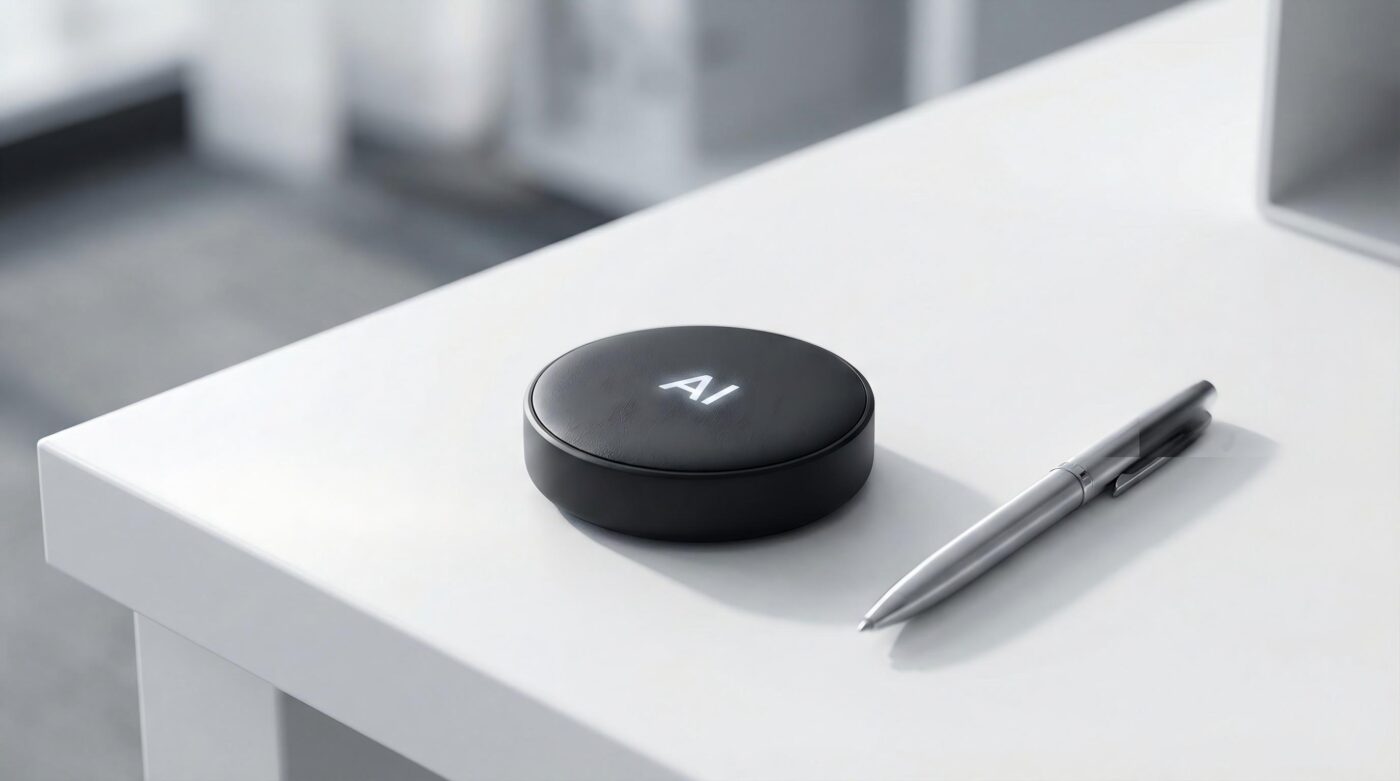
- Form Factor: Weighs only 10g; clips to clothing and becomes “invisible.”
- Core Feature: Converts chaotic meeting audio into structured “Logic Maps,” not just transcripts.
- Performance: Excellent handling of technical jargon and real-time translation.
- The Catch: Heavily reliant on the Feishu (Lark) software ecosystem to be useful.
The Anti-Gadget Verdict
We are tired. Tired of AI pins that overheat, rabbits that hallucinate, and “holographic girlfriends” that nobody asked for. The last year of AI hardware has been a parade of half-baked concepts trying to replace your smartphone. They failed.
Then Anker showed up with a button. It weighs 10 grams. It doesn’t have a screen. It doesn’t try to order your groceries. It just records audio.
Collaborating with Bytedance’s enterprise platform Feishu (known as Lark globally), Anker has built what might be the first AI wearable that respects your time. It is not a lifestyle revolution. It is a very specific tool for people who spend too much time in meetings. And that is exactly why it works.
Hardware: The “Invisible” Spec
The current trend in AI recorders is the “credit card” form factor. You are supposed to magnetize them to the back of your phone. In practice, they ruin the grip, the microphones get muffled by your palm, and they feel like a parasitic growth on your device.
This device ignores that trend. It is a 23.2mm disc. At 10 grams, it is lighter than a single AA battery. You don’t attach it to a phone. You wear it.
The device utilizes a magnetic clip system similar to a brooch or pendant. By isolating the microphone on your chest/collar:
- Audio Isolation: It separates the capture source from pocket friction or desk vibration.
- Always-Ready: No FaceID or unlocking required; a single physical press triggers recording.
- Dimensions: 23.2mm diameter, approx 10g weight.
After ten minutes, you forget it is there. This “invisibility” is the main hardware feature. There is no fumbling with screens. You press it, it records.
This physical separation from the phone is critical. It captures audio from your chest level, unobstructed, while your phone stays in your pocket or on the desk.

The Software: Chaos into Order
Hardware is easy. Anker can build batteries and plastic shells in their sleep. The reason this device exists is the software running on the backend: Feishu AI.
Most AI recorders work on a linear timeline. You record an hour of talking. You get a wall of text. Maybe a summary at the bottom. It is better than nothing, but it is still a chore to read.
We tested this device during a chaotic editorial brainstorming session. These meetings are usually a disaster of interrupted thoughts, tangents about the weather, and half-finished ideas. A standard transcriber would just give you a transcript of the mess.
The Logic Map Advantage
The Feishu integration did something different. It ignored the linear flow. Instead of a script, it generated a “Logic Map” (essentially a fishbone diagram) in real-time.
- The Fluff: It filtered out the complaints about the flu season.
- The Structure: It pulled three distinct article ideas out of the noise.
- The Action: It listed the execution steps for each idea, even though we discussed them out of order.
This is not just transcription. It is active listening. The AI acts like a project manager who takes notes while you ramble.
The Translation Test
To test the limits, we clipped the bean to a monitor and played a live OpenAI press conference. This is a stress test. You have technical jargon, fast speakers, and no pauses.
Standard translation tools often fail here. They give you “hard machine translation” where the words are right but the sentence makes no sense. The Anker bean handled the context surprisingly well. It recognized when Sam Altman stopped speaking and a colleague started, adjusting technical terms on the fly.
For journalists or workers sitting through foreign-language updates, this is a legitimate productivity boost. You get a structured English summary of a Chinese, Japanese, or French meeting while it is still happening.
The Ecosystem Trap
Here is the catch. The hardware is a gateway drug for the Feishu/Lark ecosystem.
If you use Slack, Teams, or Google Workspace, this device loses half its power. The killer feature is not the recording itself; it is where the data goes. The audio does not sit in a siloed app. It flows directly into the Feishu Knowledge Base.
This means you can query your entire history. You can ask the AI, “What did we decide about the browser project last month?” It will pull data from this recording, combine it with a document you wrote two weeks ago, and give you an answer.
It turns “dead data” (an MP3 file) into “live data” (searchable institutional knowledge). But again, this only works if you live in that walled garden.
🏁 Final Verdict
This little bean succeeds because it has low ambition. It doesn’t want to be your friend. It doesn’t want to replace your iPhone. It just wants to listen to your meetings so you don’t have to take notes.
If you are already in the Feishu/Lark ecosystem, this is a no-brainer. If you aren’t, it is a tempting reason to look over the fence. For 10 grams, it carries a lot of weight.