The Redmi KPad 2 is the most gaming-focused compact tablet Xiaomi has built, and it shows in every design decision. From a MediaTek Dimensity 9500 processor paired with an oversized vapor chamber, to a 165Hz 3K display running 540Hz touch sampling, to bypass charging that lets you game on wall power without aging the battery – this is a tablet designed from the ground up for serious mobile gaming in a pocketable form factor.
Launched in May 2026, the KPad 2 starts at ¥3,399 (~$470) for the 8GB+256GB configuration. That’s directly comparable to the iPad Mini 7’s entry price, which sets up one of the most interesting small-tablet debates in years. For full specs and availability, see the official Redmi KPad 2 page.
Design and Build: Metal Body Built Around Landscape Gaming
The KPad 2 uses a full-metal unibody chassis with a ceramic sand-blasted surface finish – a texture that adds grip without feeling industrial. Three color options are available: black, white, and a subtle purple that photographs closer to silver-gray in most lighting.
The rear camera module adopts a simplified “volcano crater” design compared to the previous generation’s busier layout. It’s a small change but adds to the overall cleanliness of the form factor.
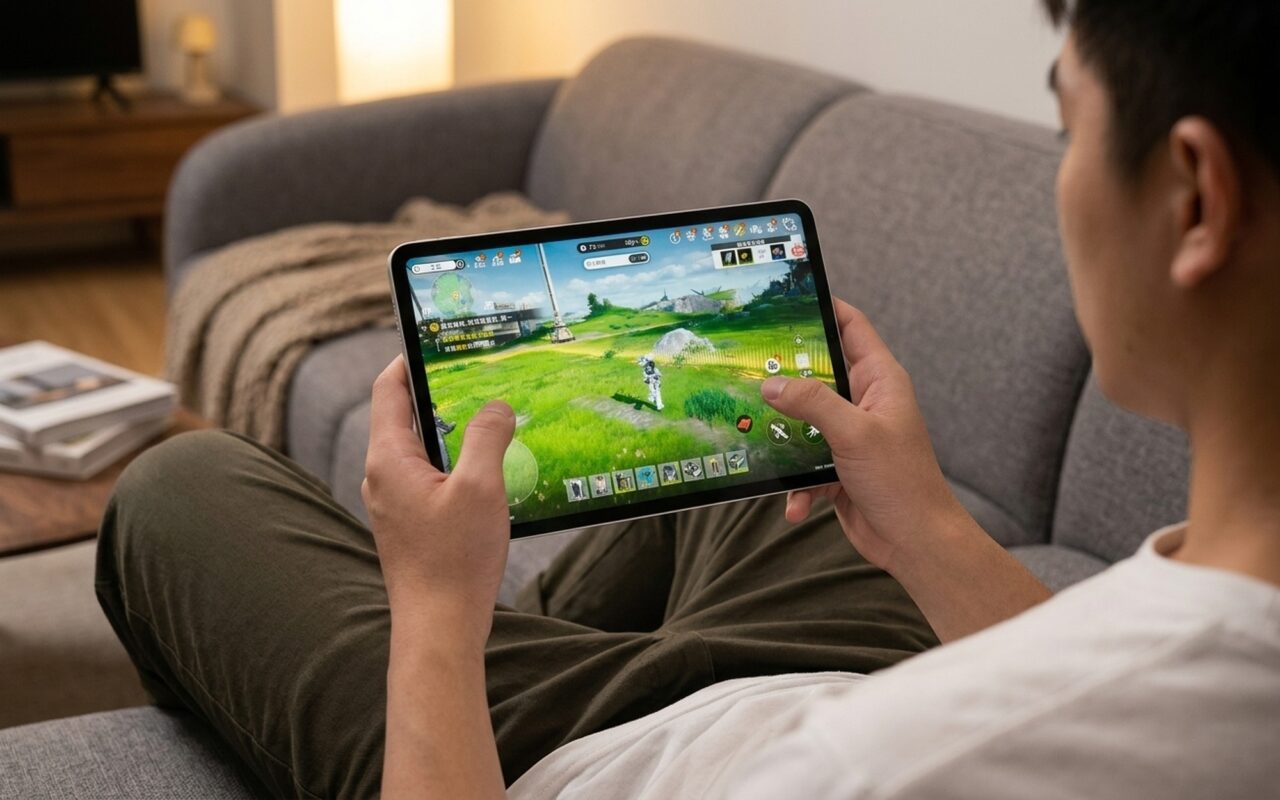
What separates the KPad 2 from generic Android tablets is the engineering that went into landscape use. The main logic board is center-mounted rather than offset to one side, which balances weight distribution evenly across both hands during horizontal gaming sessions – a detail you don’t notice consciously, but one that reduces wrist fatigue over extended play.
Dual speakers are positioned to avoid palm obstruction when you grip the long edges during landscape gaming. Most tablets route speakers to corners that your palms naturally cover; the KPad 2 moves them to positions where your thumbs sit on the screen, leaving the speakers clear.
A dedicated programmable button on the frame can be mapped to in-game functions – quick scope, grenades, switching weapons – without remapping your on-screen controls.
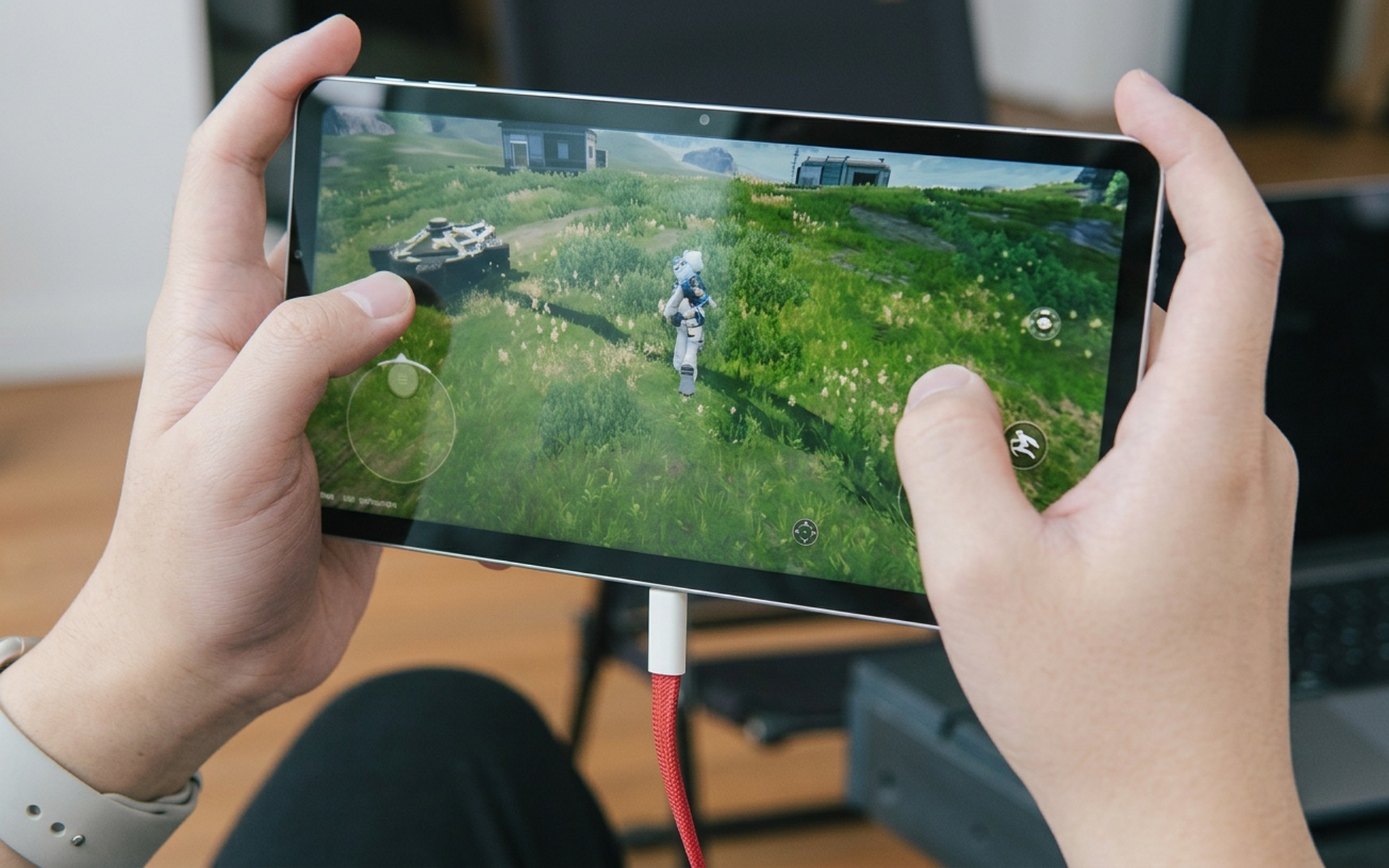
The USB-C 3.2 Gen1 port sits on the long edge of the tablet rather than the short edge. In landscape mode, this means the charging cable exits below the frame and hangs down naturally rather than pointing sideways out of your grip area.
Weight is up 19 grams and thickness up 0.2mm versus the original KPad. Both are meaningful but acceptable trade-offs for the thermal improvements they enable.
3K 165Hz Display with 540Hz Touch – What the Numbers Mean in Practice
The 3K LCD panel at 165Hz is the first thing you notice when powering on the KPad 2. Compared to the 60Hz display on the iPad Mini 7, the difference in motion clarity is immediately apparent – scrolling through menus, swiping between apps, and in-game camera movement all feel fundamentally smoother.
Peak brightness reaches 1,100 nits, up substantially from the 700 nits on the previous-generation KPad. Indoors this means vivid, saturated colors; outdoors it means the display remains readable in most natural lighting conditions where cheaper tablets wash out completely.
The 540Hz multi-touch polling rate is less obvious to explain but equally real in impact. Standard tablets sample finger positions 60 times per second; at 540Hz, the KPad 2 registers your input nine times more frequently. In fast-action games – FPS, fighting games, rhythm titles – rapid swipe gestures and quick taps feel noticeably crisper and more immediate. This is measurable, not marketing: input lag from touch to on-screen response drops significantly at higher polling rates.
For content consumption beyond gaming, the 3K resolution on an 8-inch panel produces pixel density high enough that individual pixels are invisible at normal viewing distance. Video, streaming, and reading all benefit.
Dimensity 9500 Performance: Real Benchmark Data
The MediaTek Dimensity 9500 is MediaTek’s 2026 flagship mobile chip. Placing it in a tablet rather than a smartphone gives it a meaningful advantage: tablets have more chassis volume for cooling, so the processor can run closer to its thermal ceiling for longer before throttling.
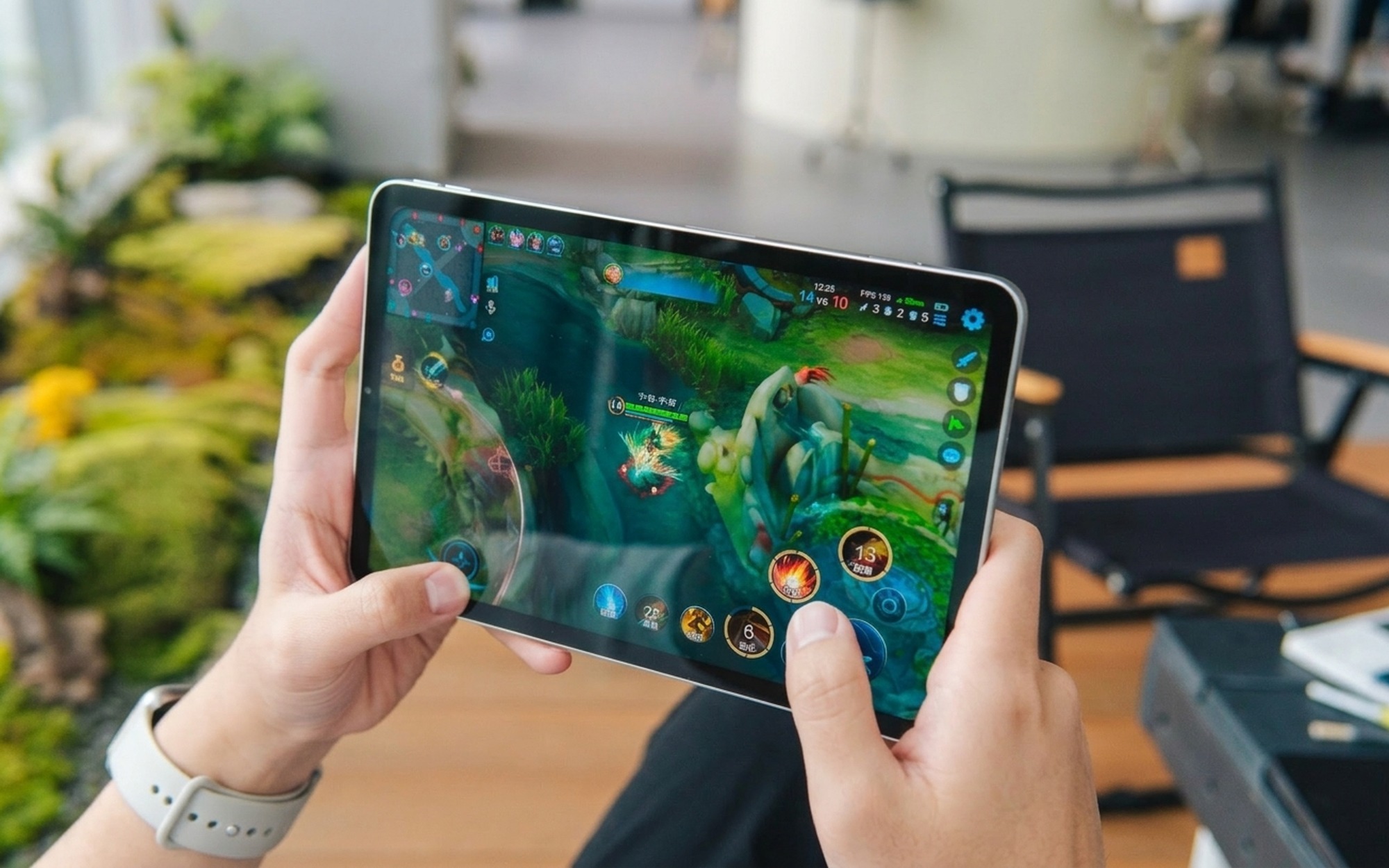
In real-world testing with Honkai: Star Rail’s “The Final Descent” chapter at maximum graphics settings, the KPad 2 averages 57fps sustained over a 30-minute session. Surface temperature stays below 40°C throughout – a threshold most reviewers consider the comfort limit for handheld gaming. Many competing tablets with the same chip in a smaller chassis will hit 57fps initially and then drop to 40-45fps as thermal throttling kicks in. The KPad 2 maintains the frame rate because the vapor chamber has enough area to dissipate heat continuously.
The 15,300mm² vapor chamber is the key enabler here. To put that in context, most gaming-focused tablets in the 10-11 inch range use vapor chambers in the 10,000-12,000mm² range. Getting 15,300mm² into an 8-inch chassis required the center-mounted board design mentioned above – there’s a direct engineering connection between the board placement and the vapor chamber size.
For context on how the Dimensity 9500 performs in Redmi’s smartphone lineup, our Redmi K90 Max Review covers the same chipset in a smartphone context – the KPad 2 demonstrates what additional thermal headroom unlocks.
Bypass Charging: Gaming Indefinitely Without Battery Penalty
Bypass charging solves a problem that every serious mobile gamer has: demanding games drain batteries fast, and gaming while charging simultaneously exposes the battery to heat and charge cycles simultaneously – accelerating degradation.
When the KPad 2 is plugged into power during gameplay, bypass mode activates. Electricity flows directly to the display and processor, and the battery sits at whatever charge level it’s at – neither gaining nor losing capacity. The battery temperature stays lower because it’s not being actively charged. Over a year of regular gaming sessions, this translates to meaningfully better long-term battery health compared to tablets without bypass charging.
The practical benefit is also simpler: you never need to stop playing because of battery level. Plug in, game as long as you want, unplug at your own pace.
The USB-C 3.2 Gen1 port on the long edge makes this comfortable in practice. In landscape orientation, the cable exits below the tablet and doesn’t interfere with your grip.
Audio: BOSE-Tuned Dual Speakers with Dolby Atmos
The KPad 2’s speaker setup is tuned by BOSE and certified for Dolby Atmos spatial audio. Both matter. BOSE’s acoustic tuning addresses the inherent challenge of small speakers – thin cabinets don’t produce bass naturally, and small drivers distort at high volume – through equalization and porting design. The result is louder, cleaner output than most tablets at this price produce.
Dolby Atmos certification means the audio pipeline supports spatial audio processing – positional sound that gives different audio sources distinct locations in three-dimensional space. In FPS games, this means gunshots to your left and right are distinguishable without headphones. In racing games, engine sounds have directionality. It’s not a substitute for good headphones, but it’s genuinely useful in casual gaming where you’re not wearing earbuds.
Speaker placement avoids palm obstruction in landscape mode, so volume doesn’t suddenly drop when you grip the device more firmly during intense moments.
Redmi KPad 2 vs iPad Mini 7: The Direct Comparison
This is the decision most buyers face, and it’s worth addressing directly rather than hedging.
Where Redmi KPad 2 wins for gaming:
– Display refresh rate: 165Hz vs 60Hz – a massive difference in motion clarity
– Touch polling: 540Hz vs 120Hz – faster input response in fast-action games
– Sustained gaming performance: Dimensity 9500 with 15,300mm² VC vs A17 Pro with smaller thermal envelope
– Bypass charging: present on KPad 2, absent on iPad Mini
– RAM: 8GB base vs 8GB base, but KPad 2’s 12GB and 16GB options offer more overhead for heavy games
– Storage: 256GB base on KPad 2 vs 128GB base on iPad Mini 7 at comparable price
Where iPad Mini 7 wins:
– iOS gaming library: deeper tablet-optimized game catalog, more iOS-first titles
– Cellular option: LTE and 5G variants available – KPad 2 is Wi-Fi only
– Apple Pencil 2 support: meaningful if you use the tablet for drawing, note-taking, or creative work
– App ecosystem maturity: tablet-optimized iPad interfaces in many apps that Android versions don’t match
– Resale value: Apple hardware holds value better in Western markets
Price reality: iPad Mini 7 Wi-Fi starts at $499 (128GB). Redmi KPad 2 starts at approximately $470 equivalent (¥3,399 for 8GB+256GB). At similar spend, the KPad 2 delivers twice the storage and meaningfully better gaming hardware. You’re trading ecosystem breadth for hardware performance.
If your primary use case is mobile gaming and you don’t need cellular or Apple Pencil, the KPad 2 makes a stronger case on the hardware merits. If you’re inside the Apple ecosystem or need cellular connectivity, iPad Mini remains the easier recommendation.
Specs, Price, and Availability
| Specification | Redmi KPad 2 |
|---|---|
| Display | 3K LCD, 165Hz, 1,100 nits peak |
| Touch | 540Hz multi-touch |
| Processor | MediaTek Dimensity 9500 |
| Configurations | 8GB+256GB / 12GB+256GB / 16GB+512GB |
| Vapor Chamber | 15,300mm² |
| USB-C | 3.2 Gen1 (long edge) |
| Bypass Charging | Yes |
| Audio | BOSE-tuned dual speakers, Dolby Atmos |
| Colors | Black, White, Purple |
| Price (CNY) | ¥3,399 / ¥3,799 / ¥4,799 |
| Cellular | Not available |
The Redmi KPad 2 is currently sold through the official Xiaomi store in China. No global version or cellular variant has been announced as of May 2026.
For buyers outside China, the tablet can be sourced through Xiaomi’s authorized resellers in Hong Kong and Singapore, or through international forwarding services – though warranty coverage and support may vary.
Verdict
The Redmi KPad 2 sets a new standard for what a compact Android gaming tablet can deliver. The Dimensity 9500, the 15,300mm² vapor chamber, the 165Hz 540Hz-touch display, and bypass charging are not marketing checkboxes – they are hardware choices that produce measurably better gaming experiences than any comparable 8-inch tablet currently available.
The trade-offs are real: no cellular option, modest weight increase, and China-first availability limit its audience. But for anyone who wants the best-performing small tablet for mobile gaming without paying flagship iPad prices, the Redmi KPad 2 is the clearest recommendation in 2026.
- 165Hz 3K display with 540Hz touch polling — dramatically smoother than iPad Mini’s 60Hz
- MediaTek Dimensity 9500 delivers sustained 57fps in demanding games without thermal throttling
- Bypass charging lets you game indefinitely on wall power without draining or aging the battery
- 15,300mm² vapor chamber keeps temps below 40°C during 30-minute max-graphics sessions
- BOSE-tuned dual speakers with Dolby Atmos — best audio on any small Android tablet
- USB-C 3.2 Gen1 on the long edge exits the cable below the frame in landscape — stays out of your grip
- No cellular or 5G option — Wi-Fi only, unlike iPad Mini which offers LTE and 5G variants
- 19g heavier and 0.2mm thicker than the previous KPad — noticeable over long sessions
- China-market product with no confirmed global availability as of May 2026
- Android gaming library still smaller than iOS for tablet-optimized titles
Frequently Asked Questions
Is the Redmi KPad 2 good for gaming?
Yes — it’s one of the best gaming tablets you can buy under $500. The Dimensity 9500 processor sustains 57fps in demanding titles like Honkai: Star Rail at maximum settings for 30 minutes, while the 15,300mm² vapor chamber keeps the chassis below 40°C. The 165Hz display and 540Hz touch response add genuine competitive advantages over standard 60Hz tablets.
How does the Redmi KPad 2 compare to iPad Mini for gaming?
On raw gaming hardware, the Redmi KPad 2 wins: 165Hz vs 60Hz display, 540Hz vs 120Hz touch, bypass charging (iPad Mini has none), and a larger vapor chamber for better sustained performance. iPad Mini counters with Apple Pencil support, cellular options, iOS-exclusive gaming titles, and a more polished tablet app ecosystem. Choose Redmi KPad 2 for performance-first gaming; choose iPad Mini if you’re invested in the Apple ecosystem.
Does the Redmi KPad 2 support 5G or have a SIM card slot?
No. The Redmi KPad 2 is Wi-Fi only — there is no cellular or 5G variant. If connectivity without a hotspot is important to you, the iPad Mini 7’s cellular models or Android alternatives like the Xiaomi Pad 7 Pro 5G are worth considering instead.
What is bypass charging and why does it matter on the KPad 2?
Bypass charging routes wall power directly to the processor and display, bypassing the battery entirely. While the tablet is plugged in during gaming, the battery neither charges nor discharges — it just sits idle. This means you can game indefinitely without battery depletion, and your battery ages more slowly because it isn’t being heated and cycled repeatedly during demanding gaming sessions.
Is Redmi a good brand for gaming tablets?
Redmi (Xiaomi’s sub-brand) has built a strong track record for performance hardware at competitive prices. The KPad 2 uses the same Dimensity 9500 chipset found in Xiaomi’s flagship phones, with a thermal solution specifically tuned for the tablet’s larger chassis. Build quality on recent Redmi tablets has been solid, with full metal unibodies rather than the plastic backs common at this price range.