

Sony has a consistent record with the 1000X series: each generation takes what was already the benchmark and quietly makes it better. The WF-1000XM5 turned skeptics of true wireless ANC into believers. The WF-1000XM6 enters a sharper fight – Apple’s AirPods Pro 3 raised the bar for spatial audio and noise cancellation simultaneously, and Bose’s QuietComfort Ultra Earbuds 2 made comfort-first ANC feel more accessible.
Against that backdrop, Sony’s answer to “what comes after the best?” is an earbud that deserves close inspection. After extended listening sessions spanning commutes, open-plan offices, long-haul flights, and late-night LDAC sessions, here is our full assessment.
Design and Fit: Lighter, Tighter, More Refined
The most immediately noticeable change from the XM5 is weight. At 6.5 grams per earbud, the XM6 feels noticeably more settled in the ear than its predecessor – and that difference compounds over multi-hour sessions. The redesigned earcup geometry reduces pinch pressure at the ear canal entrance, which was a documented discomfort point for some XM5 users.
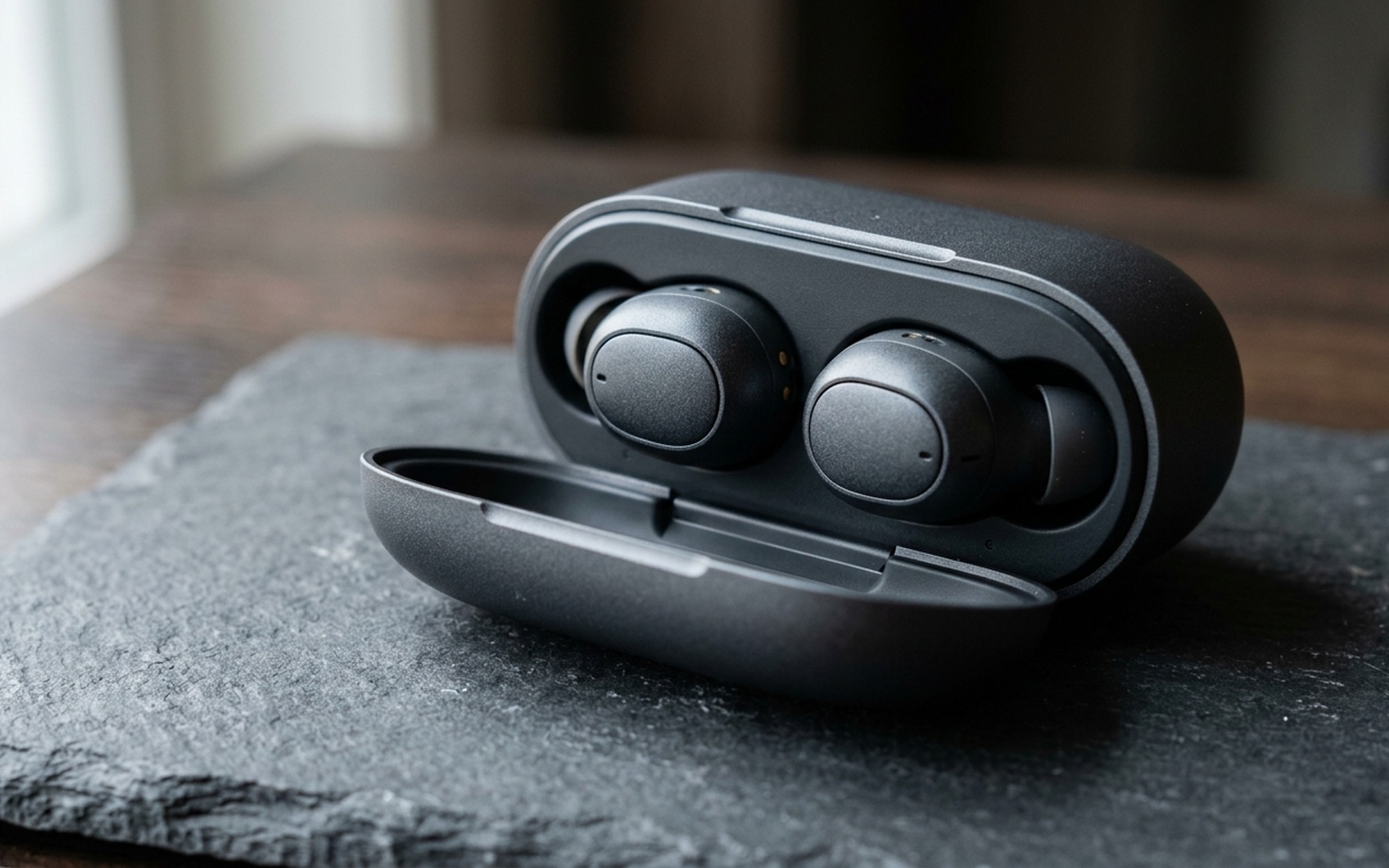
The full matte finish is a practical and aesthetic upgrade. It resists fingerprints more effectively than the XM5’s semi-gloss surface and conveys a premium, tool-like quality that makes handling feel deliberate. The single-piece touch panel on each bud is flush and responsive, with minimal false trigger rate during hair adjustments or hat removal.
IPX4 water resistance is maintained – the XM6 handles sweat and light rain without concern, though it is not submersible. The charging case is notably more precise in its build: lid movement and earbud seating both feel significantly tighter than the XM5 case. It is still larger than the AirPods Pro 3 case, but the engineering quality has caught up considerably.
One honest caveat: the XM6’s fit depends on ear canal geometry. Reviewers with standard or wider canals report excellent long-session comfort; extended wear of 5-plus hours is consistently described as fatigue-free. Those with narrow canals may experience pressure over time even with tip adjustments.
Sony WF-1000XM6 Specifications
| Specification | Detail |
|---|---|
| Driver | 8.4mm dynamic, layered groove-patterned diaphragm |
| Codecs | SBC, AAC, LDAC, LC3 |
| ANC Processor | QN3e + 32-bit V2 Integrated Processor |
| Microphones | 8 mics + bone conduction sensor |
| Weight | 6.5g per earbud |
| Water Resistance | IPX4 |
| Battery (ANC on) | 8 hours rated / ~6.5 hours real-world LDAC |
| Battery (ANC off) | 12 hours rated |
| Total with case | 24 hours (ANC on) |
| Quick Charge | 5 min → 1 hour playback |
| Equalizer | 10-band, ±6dB |
ANC Performance: QN3e Changes the Equation
The XM6’s noise cancellation story centers on its new QN3e processor, working in tandem with a 32-bit V2 integrated chip. The result is ANC performance that reviewers consistently place at the top of the true wireless category – and, crucially, noticeably ahead of the XM5 in both low-frequency depth and human voice suppression.
In the TDS ANC performance pyramid used by specialist audio reviewers, the XM6 earns a placement at the top tier for true wireless earbuds. In practical terms:
Low-to-mid frequency suppression attacks aircraft cabin drone, HVAC hum, and traffic noise more aggressively than the XM5. The improvement is immediately perceptible rather than marginal.
Human voice suppression approaches AirPods Pro 3 performance. Open-office conversation buzz, coffee shop background chatter, and commuter noise are pushed meaningfully into the background. The XM5 was already competitive here; the XM6 is better by a clear step.
Ear pressure sensation is lighter than expected for the depth of cancellation being delivered. Deep ANC typically produces a “plugged” sensation that fatigues listeners over long sessions. The XM6’s pressure balancing – particularly during altitude changes on flights – is among the least fatiguing of any flagship earbud currently available.
One area where the XM6 does not catch up fully: wind noise. In front-facing or rear-facing wind conditions, noise bleeds through both the ANC and transparency systems. The Bose QuietComfort Ultra Earbuds 2 handles directional wind more effectively. For cyclists and outdoor runners, this matters. For everyday commuters and office users, it rarely surfaces as an issue.
Sound Quality: Balanced and Built for LDAC
Sony’s tuning philosophy for the XM6 is a clear departure from the warmer, more colored sound of earlier 1000X generations. The XM6’s signature is best described as balanced with moderate warmth – a sound that favors accurate reproduction over editorial character.
Bass is firm and restrained. Extension is adequate without bloom, and mid-bass instruments sit at a neutral level rather than pushed forward. Listeners who prefer elevated bass will want to apply a custom curve via the Sony Headphones Connect app.
Midrange is the XM6’s strongest performance area. Both male and female vocals sit at a natural, neutral position. The minimal coloration compared to previous 1000X models means the XM6 performs well across genres – not just pop and hip-hop, but acoustic, classical, and jazz where midrange honesty matters most.
Treble maintains mid-level brightness with a smooth, non-fatiguing progression. Ultra-high extension is present but rolls off slightly faster than specialist TWS earbuds. Cymbal detail is accurate and non-abrasive over long sessions.
Soundstage is organized but not expansive. The XM6 images instruments in a slightly flattened presentation rather than a wide, open plane. It is better than average for closed TWS earbuds, but trails AirPods Pro 3’s adaptive spatial audio which uses head tracking to create a more three-dimensional experience.
Through Sony’s LDAC technology, the XM6 streams at up to 990kbps – approaching CD-quality resolution over Bluetooth. Combined with DSEE Extreme upscaling for compressed audio sources, the gap between lossless and streamed audio is meaningfully narrowed. LDAC stability in signal-priority mode tested to 7 meters through walls with minimal dropout, which is impressive for consumer TWS hardware.
The 10-band EQ with ±6dB adjustment range is among the most flexible in the category. For listeners who want to customize the XM6’s balanced starting point, the Sony Headphones Connect app gives sufficient range to build anything from reference-flat to a consumer-warm curve.
Call Quality: Eight Microphones, One Clear Voice
The XM6 features eight microphones combined with a bone conduction sensor – a hardware configuration that delivers Sony’s best call quality to date in the TWS lineup. AI beamforming isolates the speaker’s voice directionally, while DNN noise reduction attenuates background environments in real time.
In testing across loud environments – subway stations, street-level traffic, open-plan offices – call recipients reported consistent voice clarity. The bone conduction sensor provides a secondary voice pathway that remains effective even when external noise overwhelms the primary microphone array.
The main limitation is codec-related rather than hardware-related: at LDAC, audio is delayed by approximately half a word at normal speech cadence. For music listening, this is imperceptible. For video calls or synchronized video playback, it is noticeable. Switching to AAC eliminates most of the latency issue at the cost of LDAC’s audio resolution advantage.

Battery Life and Charging
Rated figures: 8 hours with ANC active, 12 hours without ANC, 24 hours total with the charging case (ANC on).
Real-world LDAC testing – with DSEE Extreme, adaptive sound features enabled, and volume at 50% – returned approximately 6.5 hours per charge. The gap between rated and real-world is typical for high-codec streaming. Switching to AAC or SBC extends battery life closer to the 8-hour rated figure.
Quick charge is a standout: five minutes delivers one hour of playback. Wireless Qi charging is supported, though standard wireless chargers deliver 2–2.6W to the XM6 case – a slower position than USB-C. For emergency top-ups, a cable charge will always be faster.
Sony WF-1000XM6 vs AirPods Pro 3
This is the comparison most buyers arrive with. Here is a direct breakdown:
| Category | Sony WF-1000XM6 | Apple AirPods Pro 3 |
|---|---|---|
| ANC Depth | Top-tier, approaches AirPods Pro 3 | Category-leading |
| Voice Suppression | Near-equivalent | Slight edge |
| Transparency Mode | Most natural in Sony TWS lineup | Industry-leading naturalness |
| Sound Signature | Balanced, LDAC-resolving | Clarity-tuned + spatial |
| Spatial Audio | Standard stereo | Adaptive, head-tracked |
| Codec Support | LDAC, LC3, AAC, SBC | AAC only (Apple ecosystem) |
| Call Quality | Excellent – 8 mics + bone conduction | Excellent |
| Android Compatibility | Full feature parity | Limited (no spatial audio) |
| Battery (ANC on) | 8 hrs rated / 6.5 hrs real-world | 6 hrs rated |
| Water Resistance | IPX4 | IP54 |
| Quick Charge | 5 min = 1 hr | 5 min = 1 hr |
The honest verdict: Apple AirPods Pro 3 holds a meaningful edge for iPhone users – deeper iOS integration, superior adaptive spatial audio, and a transparency mode that many reviewers consider the best in any earbud. The XM6 wins on codec diversity, and LDAC is a substantial advantage for Android users on any lossless-capable streaming service. On ANC depth, the gap between the two has narrowed to the point where most listeners will call it a draw in everyday conditions.
For Android users: the XM6 is the clear recommendation. For iPhone users: the decision turns on how much you value LDAC audio quality versus spatial audio and Apple ecosystem depth.
According to TechRadar’s best noise-cancelling earbuds guide, the cross-platform ANC category continues to be led by Sony – and the XM6 extends that lead through meaningfully improved noise cancellation and more honest sound tuning.
Who Should Buy the Sony WF-1000XM6?
Buy it if you:
– Use Android and want the best LDAC audio quality available in a true wireless earbud
– Prioritize ANC performance above all other features
– Need comfortable, sustainable wear over 5-plus hour sessions
– Make frequent calls and want the clearest TWS microphone system Sony has shipped
Look elsewhere if you:
– Are deep in the Apple ecosystem and value spatial audio with head tracking
– Regularly exercise outdoors where wind noise suppression is a priority
– Prefer a boosted, warm bass signature without EQ adjustment
– Are budget-constrained – the WF-1000XM5 remains excellent at a lower price
Verdict
The WF-1000XM6 does what Sony needed it to do: it takes a flagship lineup that was starting to feel its age relative to Apple’s AirPods Pro 3 and rebuilds it with a more powerful ANC processor, improved fit, and more honest tuning. The result is the most complete true wireless earbud Sony has shipped to date.
The ANC sits at the top of the TWS category. The sound is balanced and genuinely resolving through LDAC. The call quality is the clearest Sony has delivered in a TWS product. The fit, while not universally accommodating, is meaningfully better than the XM5 for most ear shapes.
Its limitations are real but narrow: wind noise suppression trails Bose, LDAC introduces latency for video use, and the soundstage stops short of what Apple’s spatial audio engine creates. None of these are dealbreakers in the context of what the XM6 gets right.
For LDAC-capable Android setups, commuters who rely on ANC to make their day survivable, and anyone upgrading from the XM5 who wanted “more of everything” – the Sony WF-1000XM6 delivers exactly that.
Rating: Excellent – 9/10
- Flagship-grade ANC powered by QN3e chip — rivals AirPods Pro 3 on voice suppression
- Balanced, neutral LDAC sound with excellent resolution and 10-band EQ flexibility
- Lightest XM series earbud at 6.5g — noticeably more comfortable than XM5 over long sessions
- 8 microphones + bone conduction sensor deliver Sony’s best TWS call quality to date
- Quick charge: 5 minutes gives 1 hour of playback; 24 hours total with the case
- LC3 codec support future-proofs the earbuds for Bluetooth LE Audio
- Most natural transparency mode in Sony’s TWS lineup
- Wind noise suppression lags behind Bose QuietComfort Ultra — noticeable for cyclists and runners
- LDAC introduces half-a-word audio latency, problematic for synced video watching
- Real-world LDAC battery at 6.5 hours falls below the 8-hour rated figure
- Narrow ear canals may experience pressure discomfort even with tip adjustments
- Soundstage is organized but not expansive — AirPods Pro 3 spatial audio feels wider
Frequently Asked Questions
Is the Sony WF-1000XM6 better than AirPods Pro 3?
It depends on your ecosystem. The Sony WF-1000XM6 is the better choice for Android users: it supports LDAC at up to 990kbps for near-lossless audio quality, offers ANC performance that approaches AirPods Pro 3 in voice suppression depth, and works with full feature parity on non-Apple devices. AirPods Pro 3 holds an edge for iPhone users through deeper iOS integration, superior adaptive spatial audio with head tracking, and a transparency mode that many reviewers rank as the best in any earbud. On pure ANC depth, the two are very close — both occupy the top tier of the TWS noise cancellation category.
How long does the Sony WF-1000XM6 battery last?
Sony rates the WF-1000XM6 at 8 hours with ANC active and 12 hours without ANC, with 24 hours total including the charging case (ANC on). In real-world LDAC testing at 50% volume with DSEE Extreme and adaptive sound features enabled, expect approximately 6.5 hours per charge. Switching to AAC or SBC brings battery life closer to the rated 8-hour figure. Quick charge delivers 1 hour of playback from a 5-minute charge via USB-C.
Does the Sony WF-1000XM6 support LDAC?
Yes. The Sony WF-1000XM6 supports LDAC at up to 990kbps — Sony’s proprietary high-resolution Bluetooth codec — alongside AAC, SBC, and the newer LC3 codec for Bluetooth LE Audio. LDAC in signal-priority mode remains stable at up to 7 meters through walls in testing. Quality-priority mode can stutter in signal-dense environments. For most users, signal-priority LDAC delivers excellent resolution with reliable connectivity.
Is the Sony WF-1000XM6 good for phone calls?
Yes — the XM6 features 8 microphones combined with a bone conduction sensor, AI beamforming, and DNN noise reduction. Call recipients consistently report clear voice quality even in loud environments like subway stations and busy streets. The bone conduction sensor provides a secondary voice pathway that holds up when external noise competes with the primary microphones. The main limitation is LDAC codec latency for video calls; switching to AAC resolves this.
What improved from the Sony WF-1000XM5 to the XM6?
The Sony WF-1000XM6 improves on the XM5 in four key areas: (1) ANC performance — the new QN3e processor delivers notably more aggressive low-to-mid frequency suppression and deeper human voice cancellation; (2) comfort — the XM6 weighs 6.5g per earbud with redesigned geometry that reduces ear canal pinch; (3) sound balance — the XM6 has a more neutral, less colored signature with better mid-range honesty; and (4) transparency mode naturalness. The case also has tighter build quality and improved lid precision.