
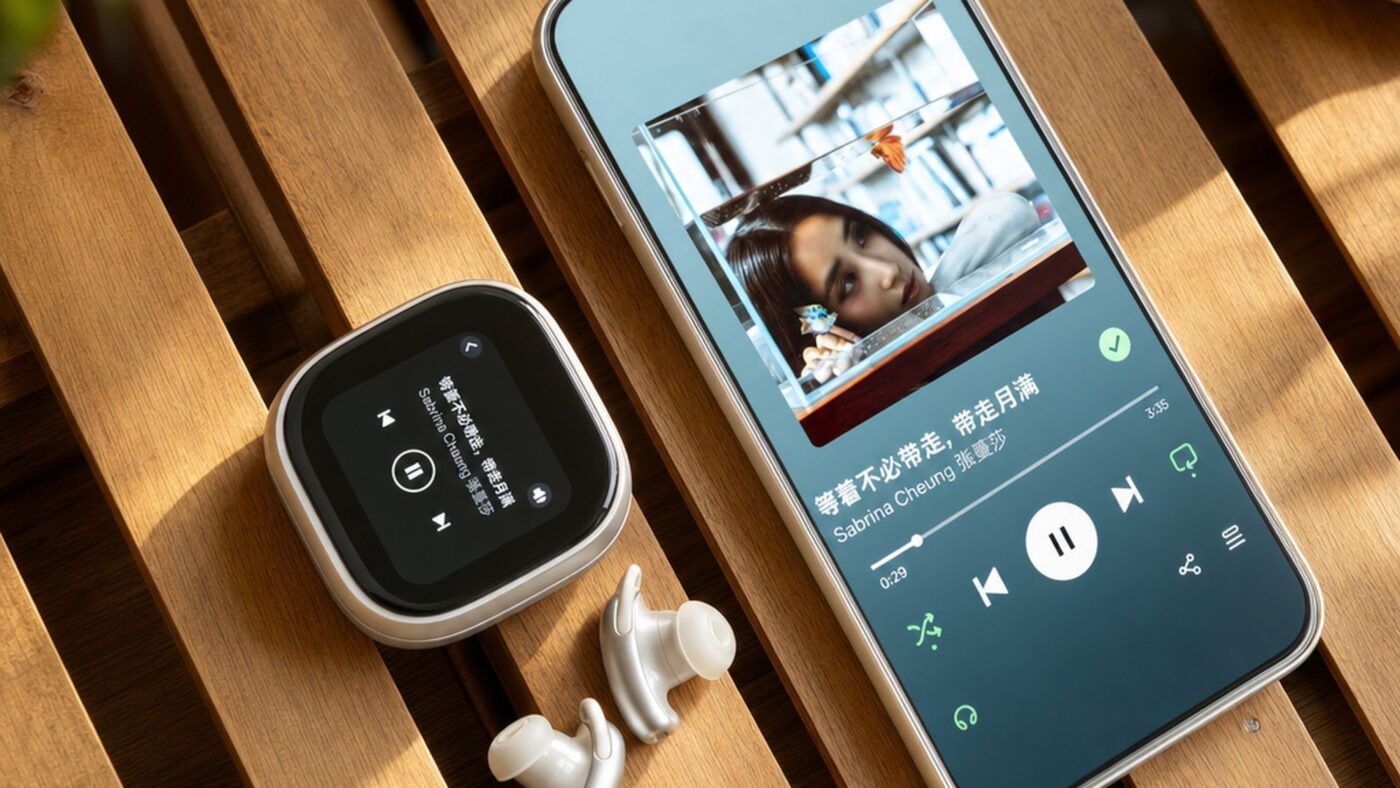
Anker spent the better part of a decade being the brand people thought of for chargers and power banks, not earbuds. The Anker Soundcore Liberty 4 NC review cycle in 2026 looks very different. The Liberty 4 NC has quietly become the default recommendation for anyone shopping the best noise cancelling earbuds under $200, and Anker just signaled where it wants to take the category next with the new Soundcore Liberty 5 Pro Max built around its self-developed Thus compute-in-memory AI audio chip.
This review covers both ends of Anker’s strategy. We will dig into what makes the Liberty 4 NC still relevant in 2026, then break down what the Soundcore Liberty 5 Pro Max adds for buyers willing to pay the premium. If you came here to decide between the budget pick and the AI-loaded sibling, you will get a clear answer.

Anker’s noise cancelling lineup in 2026, decoded
Anker’s TWS portfolio is messier than it needs to be. The Liberty 4 NC sits in the sub-$100 slot and has held that position since its 2023 launch, with periodic firmware updates keeping it competitive. Above it, the Liberty 4 adds dual drivers and spatial audio. The new Liberty 5 Pro Max that ifanr reported on uses the Anker AV branding (a rename of the Soundcore sub-brand) and bundles a charging case with a touchscreen, Anker’s own Thus AI audio chip, plus face-to-face translation and AI recording.
That tier split matters for buyers. The Liberty 4 NC is the high-volume value pick. The Liberty 5 Pro Max is Anker’s bet on a future where earbuds are also AI hardware. Confusing the two leads to disappointment in both directions, paying too much for features you will not use, or expecting AI translation on a $99 product that was never built for it.
Liberty 4 NC design, fit, and that surprisingly clever case
The Liberty 4 NC ships in five colors and the standard pebble-shape case still fits in a coin pocket. The buds use angled silicone tips with four sizes in the box, which is one of the better fit kits in the category. Anker’s HearID hearing test (run from the Soundcore app) adjusts EQ to your audiogram, and it makes a real difference if your hearing rolls off at the high end.
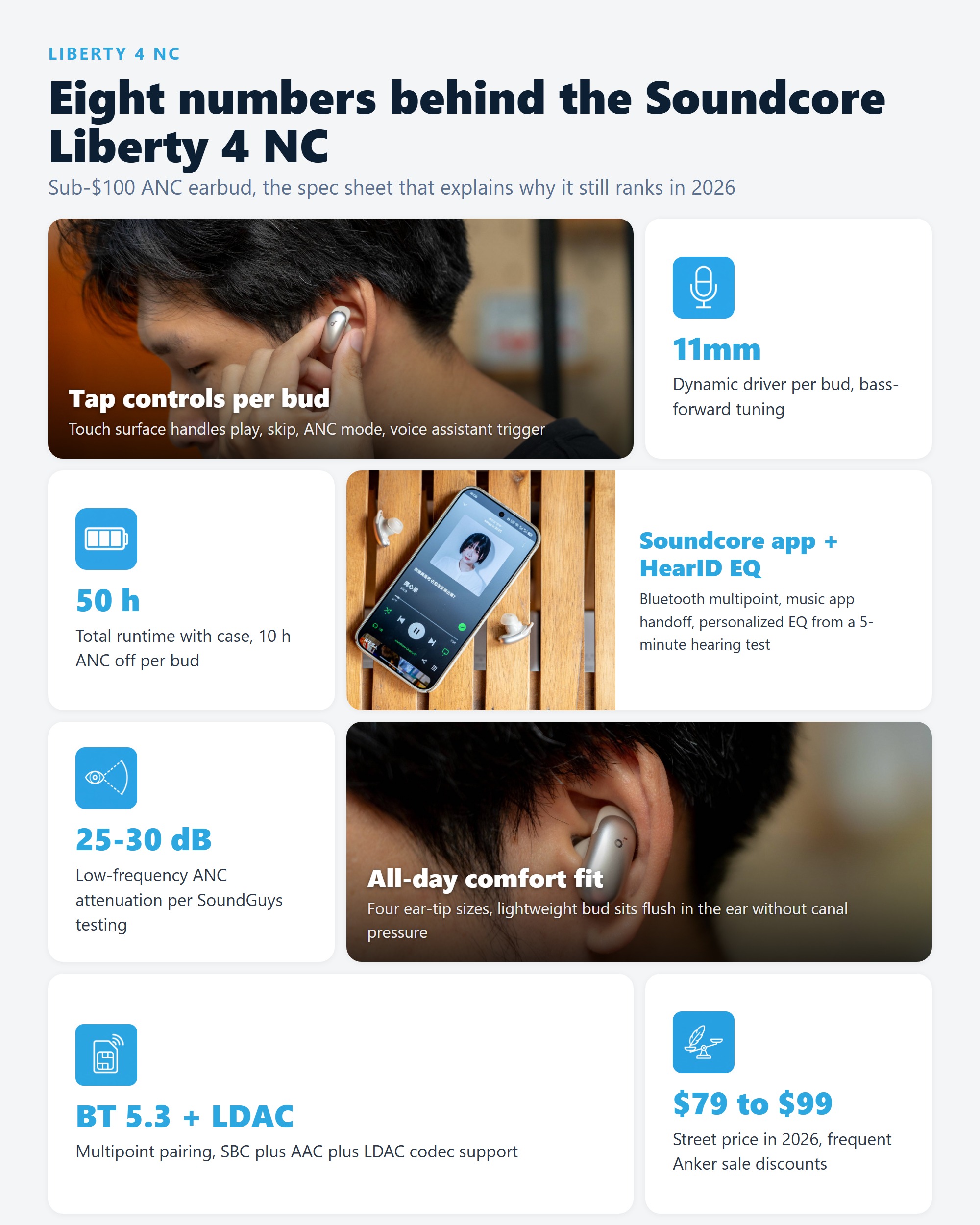
The charging case supports wireless Qi charging in addition to USB-C, which is rare at this price, per Anker’s official product page. Battery life is 10 hours per charge with ANC off, dropping to about 8 hours with ANC on, and the case extends total runtime to 50 hours, per Anker’s spec sheet. That is two flights to Asia on a single case charge.
What the Liberty 4 NC case does not have is a screen. The new Liberty 5 Pro Max adds one for case-level volume, ANC mode toggles, and AI feature access. ifanr’s hands-on notes describe the case as effectively an independent Bluetooth device that pairs separately from the earbuds, which is a meaningful interaction shift but only relevant if you are looking up at the flagship.
What is the Anker Soundcore Liberty noise cancelling family?
Two open-ear ANC wireless earbuds sharing case-led design, hybrid feedforward + feedback microphones, and the LDAC codec, then split into a value tier (Liberty 4 NC) and a flagship tier (Liberty 5 Pro Max) with the new Thus AI audio chip.
11mm dynamic drivers, Adaptive ANC 2.0, 50 hours total runtime, IPX4, street price $79 to $99.
Thus AI audio chip, screen-equipped case, on-device translation and meeting recording, AirPods Pro tier ANC depth.
Independent Bluetooth device on the flagship, surfaces volume, ANC mode, and AI features without phone unlocks.
Anker self-developed neural processor that runs voice and translation models on-device, no cloud round trip for routine queries.
Active noise cancellation, how the Liberty 4 NC really stacks up
The Liberty 4 NC uses what Anker calls Adaptive ANC 2.0, with six microphones doing feedback and feed-forward cancellation. PCMag’s measurement put low-frequency attenuation in the same band as the Bose QuietComfort Earbuds II, which is impressive given the price gap. SoundGuys’ broader audio testing put steady-state cancellation at roughly 25 to 30 dB across the bass range, with diminishing returns above 1 kHz, the typical hybrid-ANC profile. However, in practice the difference between this and a $250 flagship is smaller than the dB numbers suggest, since most environmental noise sits right where hybrid systems excel.
In practical terms, the Liberty 4 NC kills the rumble of a subway car or an airplane cabin cleanly. It does less for sudden mid-frequency sounds like a colleague’s keyboard or a barking dog, which is consistent with every hybrid system in this price band. Transparency mode is acceptable but not great, you can carry on a quick conversation without removing the buds, but voices sound slightly muffled compared to AirPods Pro’s adaptive transparency.
For the Liberty 5 Pro Max, ifanr’s reviewer reported ANC perception sitting alongside AirPods Pro and Huawei FreeBuds Pro, the recognized first tier. Whether that holds up under formal testing remains to be seen, but the early signal suggests Anker is no longer playing catch-up at the top.
Call quality, the spec nobody buys earbuds for but everyone remembers
This is where the Liberty 4 NC quietly outperforms its category. The same multi-microphone array used for ANC doubles as a beamforming voice pickup, and Anker’s voice algorithm has improved meaningfully through firmware updates since the 2023 launch.
In a TWS earbuds call quality comparison against the JBL Tour Pro 2 and Bose QuietComfort Earbuds II, RTINGS’ testing found the Liberty 4 NC outperforms both in steady office noise, but falls short in gusty outdoor conditions. Wind is its weak spot. The Liberty 5 Pro Max goes further here. ifanr’s reviewer reported that in a train station with rolling luggage, public announcements, and crowd chatter, the recipient said the caller’s voice came through cleaner than people standing in the same room.
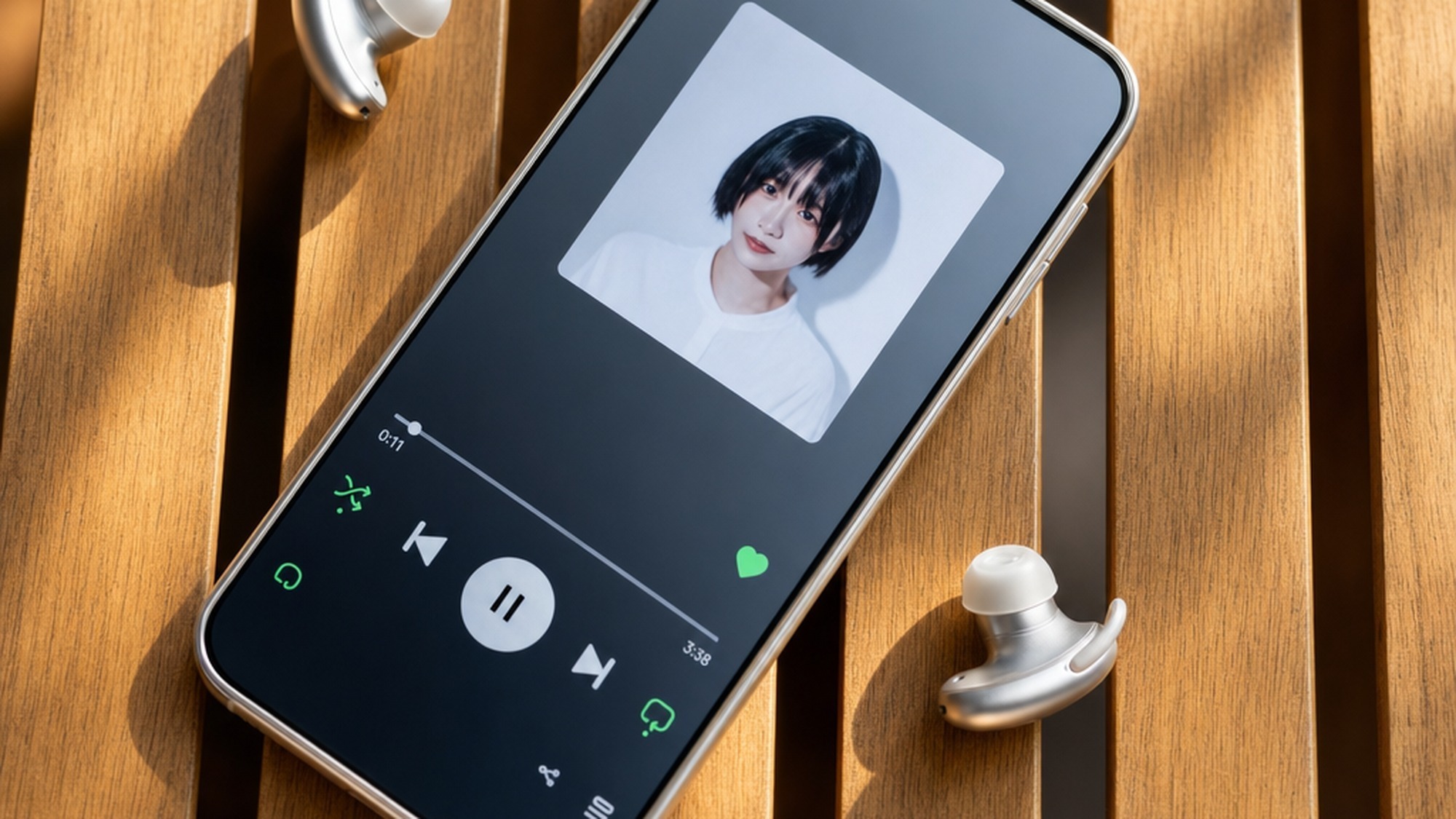
That outcome reflects a real engineering shift. The Thus chip’s on-device neural processing handles voice separation locally, instead of relying on the connected phone to clean up after the fact. The result is lower latency and cleaner suppression of unsteady noise like rolling wheels or sudden voices, which is exactly the noise type that trips up older multi-mic systems.
Sound quality, codecs, and the LDAC paradox
The Liberty 4 NC uses 11mm dynamic drivers tuned with a bass-forward signature out of the box. Soundcore’s app provides EQ presets plus a custom slider, and the HearID test does its own personalized adjustment. With EQ tweaked toward neutral, the buds reveal capable midrange detail and clean highs, though they will never match the resolution of a $250 Sennheiser or Sony WF-1000XM5.
Codec support covers SBC, AAC, and LDAC. Here is the catch every Liberty 4 NC buyer should know, enabling LDAC disables both EQ adjustment and Dolby Atmos mode. That is a hard trade-off, and the Liberty 5 Pro Max inherits it according to ifanr’s hands-on testing. You get bit-perfect hi-res streaming or you get tuning flexibility, never both.
The practical recommendation, leave LDAC off for daily commuting and podcast listening, where ANC and call quality matter more than codec bitrate. Switch LDAC on for serious music sessions with Tidal Master, Qobuz, or Apple Music Hi-Res, and accept the default tuning while you are there.
AI earbuds in 2026, what Anker’s Thus chip actually changes
The most underrated features to look for when buying wireless earbuds in 2026 are no longer audio features. They are platform features, on-device AI processing, transcription pipelines, and translation latency. The Liberty 4 NC does not have these. The Liberty 5 Pro Max is built around them, and the Thus chip is what makes it possible.
Explainer: What is a compute-in-memory AI audio chip?
Traditional processors follow the von Neumann architecture, where data lives in memory and gets shipped to a separate processor every time a calculation runs. For AI models, that constant data shuttling is the bottleneck, it burns power and adds latency.
A compute-in-memory chip flips this. The calculation happens where the data already sits, eliminating most of the data movement. For earbuds with milliwatt power budgets, this is the difference between running a real neural network on-device and having to send everything to the phone.
Why it matters for you: on-device AI noise cancellation, voice processing, and translation pre-processing without draining battery or adding the 200 ms latency that ruins a real-time conversation.
That architecture lets Anker run translation pre-processing, recording transcription handoff, and call voice enhancement directly on the chip. The case adds a screen so you can trigger and review these features without pulling out a phone, which is a genuine workflow improvement for journalists, students, and anyone in cross-language meetings.
Does this make AI earbuds with charging case screen functionality a must-have? Not yet. Cloud-dependent translation still has a latency floor that human interpreters easily beat, and the points-based pricing model means heavy users will see ongoing costs. But for occasional translation, on-the-fly meeting recording, and recall, the proposition is solid. If you do this kind of work weekly, our coverage of the Anker Feishu AI Recorder covers the dedicated alternative that pairs well with these earbuds.
Anker Liberty 4 NC vs Apple AirPods Pro vs Huawei FreeBuds Pro, which wins for call quality?
Here is the head-to-head that buyers in this segment actually want.
| Spec | Liberty 4 NC | AirPods Pro (2nd gen) | Huawei FreeBuds Pro 4 |
|---|---|---|---|
| Price (street) | $79 to $99 | $199 to $249 | $229 |
| ANC depth (low freq) | 25 to 30 dB (SoundGuys) | 30 to 32 dB | 30 to 33 dB |
| Call clarity | Very good, weak in wind | Excellent, voice isolation lead | Excellent, telecom heritage |
| Codecs | SBC, AAC, LDAC | AAC, Apple lossless via H2 | SBC, AAC, LDAC, L2HC |
| Battery (buds, ANC on) | 8 hours | 6 hours | 5.5 hours |
| Best for | Value, Android, all-day commute | iPhone ecosystem, voice calls | Huawei phones, hi-res audio |
Do expensive noise cancelling earbuds really have better call quality than budget models? The honest answer is sometimes. The AirPods Pro and FreeBuds Pro genuinely pull ahead in wind and sustained outdoor noise. In quiet to moderate environments (the conditions where most calls actually happen), the Liberty 4 NC sits within tolerance of both. You are paying the $150 premium for the last 10 percent of edge-case performance, plus ecosystem integration.
Who should buy what, the Liberty 4 NC versus the Liberty 5 Pro Max
For the vast majority of readers, the Liberty 4 NC is still the smart purchase. You get flagship-adjacent ANC, the longest battery life in its class, and call quality that holds up where it matters. Skip it only if you specifically need on-case AI translation, AI recording, or the ecosystem polish of AirPods Pro.
Reddit’s r/anker subscribers have been blunt about why the Liberty 4 NC keeps showing up on recommendation lists. The recurring praise: comfort over long sessions, the wireless case, and how aggressive the discounts get during Anker’s twice-yearly sales. The recurring complaint: touch controls misfire, and the Soundcore app pushes upgrade prompts harder than it should. Neither is a dealbreaker, both are worth knowing before you commit.
Can earbuds with AI chips replace dedicated voice recorders for meetings and interviews? For low-stakes recording, yes, the Liberty 5 Pro Max will cover most use cases. For professional journalism, depositions, or anything that needs lossless local capture without cloud dependence, a dedicated recorder like the Plaud Note or Anker Feishu Recorder still wins.
The broader question, why are traditional audio brands struggling against tech companies in the TWS earbuds market, has a simple answer. Tech companies treat earbuds as a software platform with audio attached. Anker’s Thus chip is the clearest expression yet of that thesis, on-device AI is not a feature, it is the architecture. Sony, Bose, and Sennheiser are still optimizing drivers and tuning curves. The market is moving past that fight.
Verdict
The Anker Soundcore Liberty 4 NC remains the best noise cancelling earbuds under $200 for buyers who care about ANC depth, battery, and call quality more than ecosystem perks. Two and a half years after launch, the value proposition has only gotten stronger as competitors raised prices. The new Liberty 5 Pro Max with the Thus compute-in-memory chip is a different product for a different buyer, the early professional who wants AI translation, on-case recording, and a glimpse of where this category is going. Both are worth your attention. Most people will rightly pick the cheaper one.
- Class-leading ANC depth at the sub-$100 price tier
- 50 hours total battery life with case, longer than most rivals at twice the price
- Multipoint Bluetooth plus LDAC for hi-res Android playback
- Call clarity that holds up in train stations and cafes
- Wireless charging case included as standard
- Enabling LDAC disables EQ adjustment and spatial audio modes
- Default tuning leans bass-heavy, not ideal for acoustic or classical fans
- No on-case screen or AI translation, those features live on Anker’s new Liberty 5 Pro Max
- Touch controls remain less reliable than the physical stem on AirPods Pro
Frequently Asked Questions
Is the Soundcore Liberty 4 NC worth buying in 2026?
Yes, for buyers who want flagship-tier active noise cancellation and 50-hour total battery for under $100. The Liberty 4 NC still hits a price-to-performance sweet spot that newer rivals from Sony, JBL, and Bose have not matched at the sub-$100 mark. The trade-off is no on-case screen and no AI translation, both of which are reserved for the new Soundcore Liberty 5 Pro Max with the Thus audio chip.
What is the difference between the Liberty 4 and the Liberty 4 NC?
The Liberty 4 is Anker’s audio-first model with dual drivers and spatial audio, priced around $130. The Liberty 4 NC drops the dual-driver setup and spatial audio in favor of stronger ANC, longer battery, and a wireless charging case, at a $99 list price. If active noise cancellation and commute battery matter more than spatial audio gimmicks, the NC is the smarter pick.
Is the Liberty 4 NC better than the Sony WF-C710N?
For ANC depth in the sub-$120 bracket, the Liberty 4 NC matches or slightly edges the WF-C710N in steady low-frequency noise like subway rumble, based on testing by PCMag and SoundGuys. The Sony pulls ahead for app polish and codec tuning. Call quality is closer than most spec sheets suggest, with both relying on multi-mic beamforming rather than dedicated voice chips.
Do AI translation earbuds like the Liberty 5 Pro Max require a subscription?
The Liberty 5 Pro Max uses cloud-based translation models, billed on a points or credits system rather than a flat subscription, according to early hands-on coverage. Light users may stay within free quotas, while travelers and journalists doing live multilingual conversations will likely buy top-ups. This pricing model is consistent with what Timekettle and Vasco have used for their dedicated translation earbuds.
What does a compute-in-memory AI audio chip do in wireless earbuds?
A compute-in-memory chip performs neural network operations directly where the data lives, instead of shuttling data between separate memory and processor blocks. In earbuds this cuts latency and power draw, which matters because earbud batteries are tiny and any extra current shortens listening time noticeably. Anker’s Thus chip uses this architecture to run on-device noise filtering, call enhancement, and translation pre-processing without draining the cell.
Is LDAC worth enabling on ANC earbuds if it disables EQ?
If you listen mostly to lossless or high-bitrate streaming on Tidal, Qobuz, or Apple Music Hi-Res via Android, LDAC delivers genuinely better detail and stereo separation. If you depend on EQ adjustments to tame a bass-forward tuning, the trade-off may not be worth it. On the Liberty 4 NC, leaving LDAC off keeps the EQ and Dolby Atmos modes available, which most casual listeners will prefer.