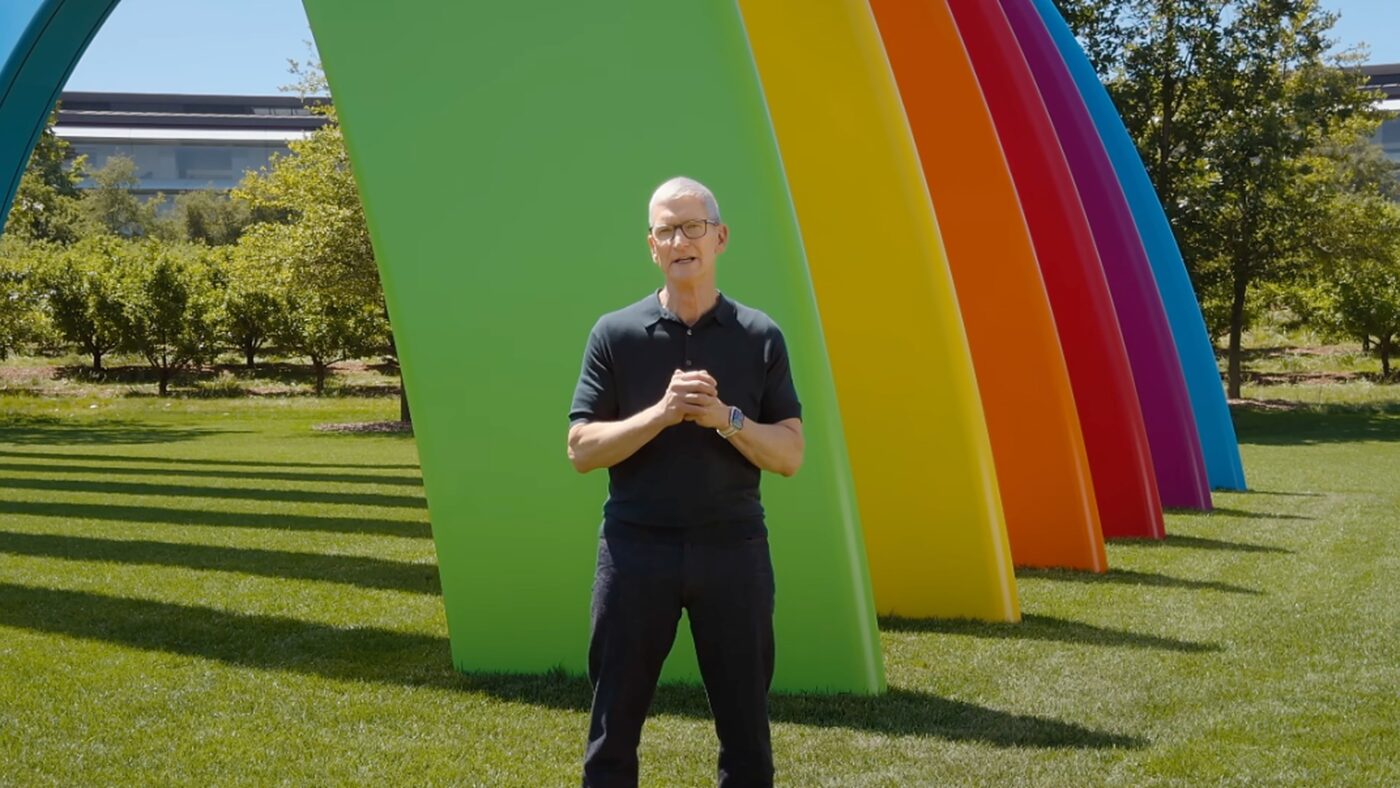
For two years, Apple Intelligence felt like a promise that kept slipping. The writing tools were useful, the notification summaries were hit or miss, and the genuinely smart Siri Apple teased in 2024 never quite arrived. At WWDC 2026, held at Apple Park on June 8 and framed as Tim Cook’s farewell keynote, that changed. Apple rebuilt its entire AI strategy around a new assistant it calls Siri AI, and it did so by licensing a custom Google Gemini model. This is the most significant overhaul of Apple Intelligence since the brand launched, and it answers the question everyone kept asking: when will Siri actually be good?
This guide walks through everything Apple announced, from the headline Apple Gemini AI partnership to the quieter architectural choices that decide where your data goes. We will cover how the new Siri works, what the system orchestrator does, the difference between the two on device models, how Private Cloud Compute protects your privacy, and how the whole package compares to using ChatGPT or Google Gemini directly.
What Is Apple Intelligence, and How Does It Work
Apple Intelligence is the umbrella name for Apple’s personal AI system. It is not a single chatbot. It is a layer woven through iOS, iPadOS, macOS, watchOS, and visionOS that powers writing tools, image generation, summaries, Visual Intelligence, and now a fully rebuilt Siri. The defining idea has not changed since 2024: handle as much as possible on the device, send only what is necessary to the cloud, and never build a profile of you to sell.
What changed in 2026 is the engine room. Apple Intelligence now runs on a hybrid stack of co developed Apple Foundation Models and a licensed Gemini model, coordinated by a new system orchestrator. According to Apple, the goal is to give you the capability of a frontier model without handing your life to an advertising company. Whether Apple fully delivers on that is a fair debate, and we get into the privacy mechanics below, but the architecture is genuinely different from a plain ChatGPT app.
What is Apple Intelligence in one sentence?
Apple Intelligence is Apple’s built in AI system that runs across its devices, doing simple work on device and routing harder work to private cloud servers and, when needed, a custom Gemini model.
Siri AI: The Biggest Siri Overhaul in 15 Years
The star of the keynote was Siri AI, described by Apple software chief Craig Federighi as a profoundly more intelligent, knowledgeable, and capable Siri. In practice it is a different assistant. The old Siri answered one question at a time and forgot everything between requests. Siri AI holds a conversation, follows up, and remembers what you just said.
Three capabilities define it. First, personal context: Siri AI can search across your messages, emails, photos, and files to surface the answer to a question like which restaurant a friend recommended last week. Second, onscreen awareness: it can see what is on your display and act on it, so you can ask it to add the event on screen to your calendar. Third, systemwide actions: it can draft and send an email, edit a photo, or share content across apps without you touching them. Add broad world knowledge from the Gemini model, and Siri stops being a glorified timer and starts being an assistant.

Apple also gave Siri AI a body of its own. A dedicated Siri app now lives on iPhone, iPad, and Mac, with your conversation history synced through iCloud so you can scroll back to a result from yesterday. On Apple Watch you can ask questions and get answers without the app. The assistant can now produce in depth answers, build multi step plans, and give longer, more considered feedback, a clear break from the one question, one answer rhythm of the past. You can even tune its voice for pace and expressivity. In our view, the synced history and the in depth answer mode are the two features that will change daily habits the most, more than any single party trick.
It is worth noting that developers feel this shift too. App Intents now replaces the older SiriKit framework, which means apps need to expose their actions in the new format for Siri AI to drive them. That migration clock started at WWDC, and according to Engadget’s WWDC 2026 coverage and other outlets covering the sessions, it is the kind of plumbing change that decides whether the assistant feels magical or empty a year from now.
The Apple Gemini AI Partnership Explained
Here is the part that surprised everyone. The new Siri does not run on an Apple built large language model. It runs on a custom 1.2 trillion parameter Google Gemini model, licensed under a multi year deal that analysts estimate costs Apple around one billion dollars per year. The arrangement was first reported in January 2026 and confirmed on stage at WWDC.
The scale matters. That custom model is roughly eight times larger than the cloud models Apple had been running, which sat near 150 billion parameters. Apple claims the new model is far stronger at summarization, planning, and natural language understanding, the exact areas where the old Siri stumbled. The model uses a mixture of experts design, which means it activates only a relevant subset of those 1.2 trillion parameters for any given query rather than firing the whole network every time. That keeps quality high without paying the full compute cost on every request.
Why outsource the brain? Because building and training a frontier model is brutally expensive and Apple was behind. In our view, the smarter read is that Apple decided the defensible moat is not the model itself but the harness around it: the device integration, the orchestrator, and the privacy layer. Apple rents the engine from Google and owns the car. Whether that holds up as Google improves its own assistant is the open question that will define the next few years.
Inside the System Orchestrator and Three Tier Routing
The glue holding all of this together is the system orchestrator, a new coordinator that sits in the middle of Apple Intelligence and decides where each request should go. It reads context, which app you are in, what you are doing, how complex the request is, and then routes the work to the cheapest place that can do it well.
That routing happens across three tiers. Simple requests stay on the device and run on Apple’s own model, so they are fast and never leave your iPhone. Moderately complex requests go to Apple’s Private Cloud Compute servers. The heaviest reasoning tasks, the ones that need the full 1.2 trillion parameter model, route out to Google Cloud, where they run on Nvidia Blackwell B200 GPUs. Apple found that running a model that large inside Private Cloud Compute was too slow to be usable at the scale Siri needs, which is why the top tier lives on Google infrastructure.
How the three tier routing works
Every Siri AI request passes through the orchestrator, which picks one of three destinations based on difficulty and context, balancing speed, capability, and privacy without asking you.
Simple tasks run on Apple’s own model and never leave your iPhone, the fastest and most private path.
Moderately complex requests run on Apple’s own servers inside hardware isolated enclaves.
The hardest reasoning routes to the full Gemini model on Nvidia Blackwell B200 GPUs.
Context such as the active app and task type tells the orchestrator which tier fits.
How Private Cloud Compute Protects Your Privacy
Private Cloud Compute is Apple’s answer to the obvious problem: some requests are too big for a phone, but sending personal data to a server is exactly what Apple spent a decade telling everyone not to do. Its design tries to extend on device privacy guarantees into the cloud.
When a request reaches Private Cloud Compute, it runs on Apple silicon servers inside hardware isolated enclaves. Apple says the system does not retain your data after the request is handled, and that not even Apple staff can access it. Independent security researchers can inspect the software images Apple publishes, which is a stronger transparency claim than any rival cloud assistant offers today.
The Gemini tier is where it gets more nuanced, and where you should pay attention. Because the heaviest queries run on Google Cloud, Apple adds a privacy buffer: according to Apple, each query is anonymized and tokenized so that neither Apple staff nor Google can link a request back to an individual user, and Google is contractually barred from using these query streams to train future models. That is a meaningful protection, although purists will still note that the raw text of a hard request does leave Apple controlled hardware. Compared to typing the same question into a standalone chatbot, the protections are stronger. Compared to a pure on device model, they are weaker. Both things are true.
The Two On Device Apple Intelligence Models
One detail that got less stage time but matters a lot: Apple Intelligence now ships two on device models, not one. Apple created a second version of its Apple Foundation Models that is multimodal, meaning it can understand speech and read both text and images, not just process plain text. This is what lets Siri AI react to what is on your screen and to what your camera sees.
On top of that, some devices receive a higher power version of the on device model with extra capabilities. According to Apple, that upgraded model delivers more natural sounding speech generation, more accurate dictation, and stronger handling of complex language and longer requests. The practical effect is that a newer iPhone does more locally before it ever needs the cloud, which means faster responses and fewer queries leaving the device. The difference between the standard and higher power model is the clearest reason the newest hardware feels quicker, even though both tiers share the same cloud brain.
If you want a sense of how an on device AI model changes the feel of an assistant, our look at the Marvis AI assistant covers the same on device versus cloud tradeoff from a different angle.
Every New Apple Intelligence Feature at WWDC 2026
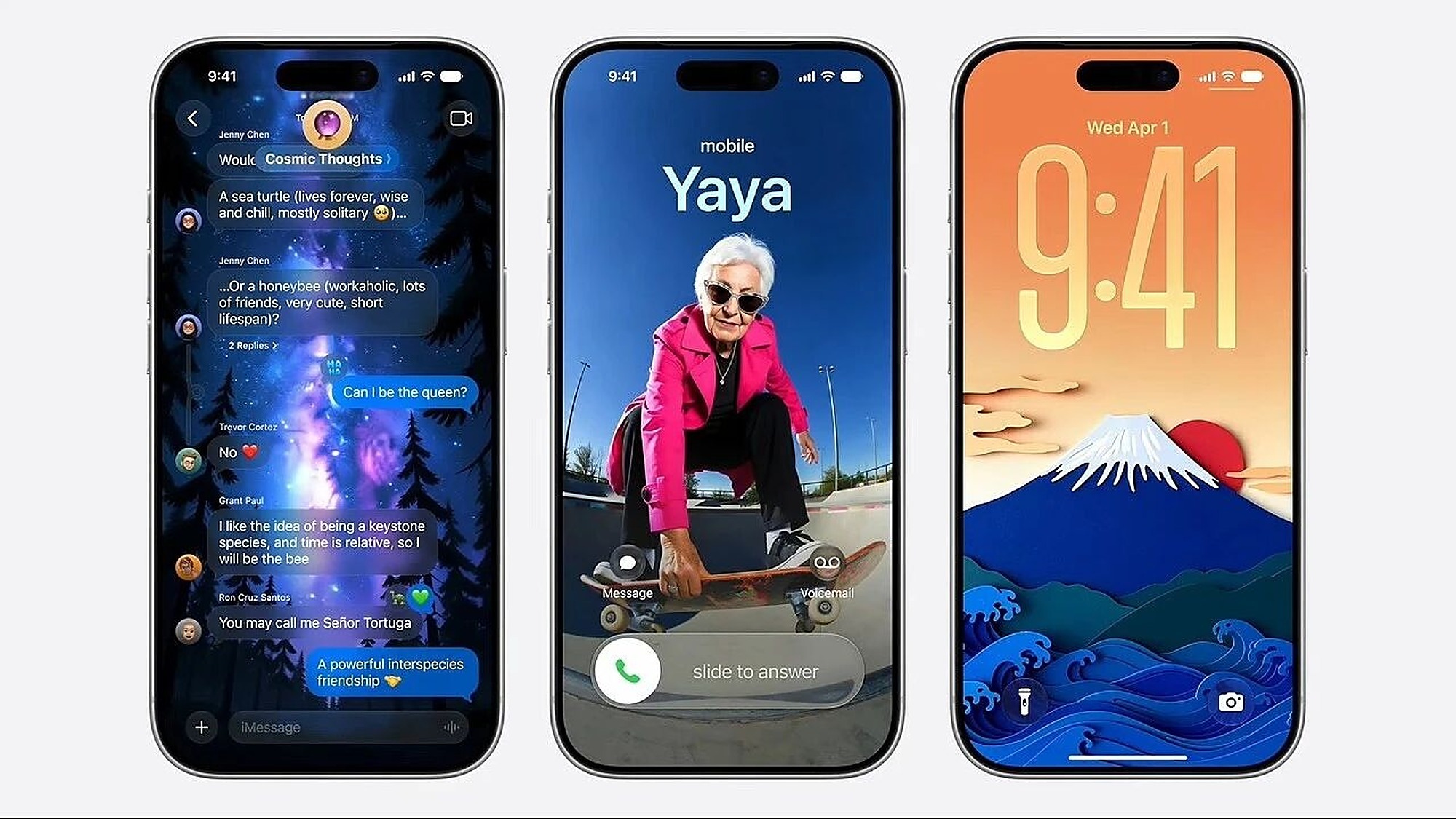
Siri AI grabbed the headlines, but Apple Intelligence picked up a long list of smaller upgrades that you will touch every day. The infographic below sums up the rebuild and the features riding on it.
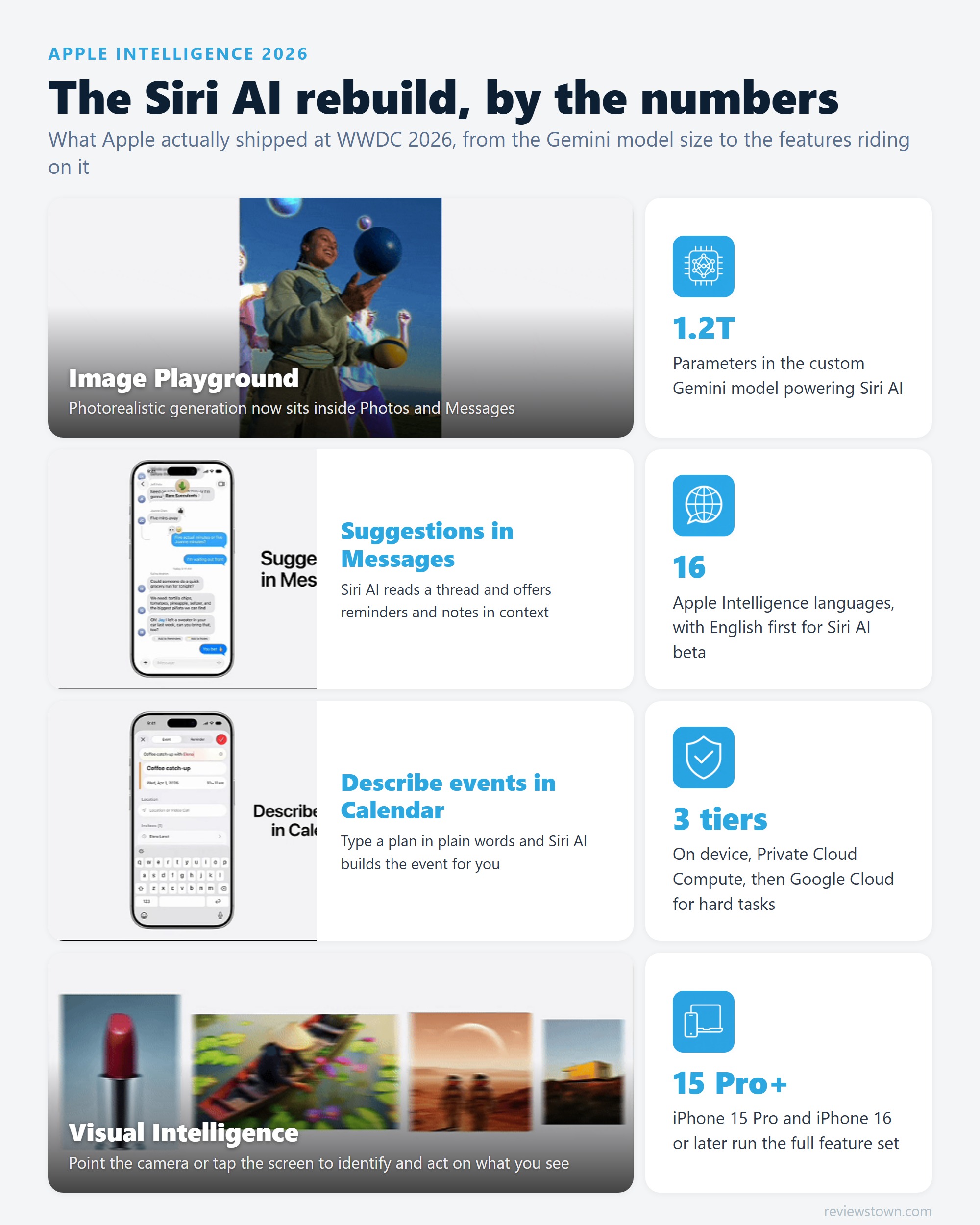
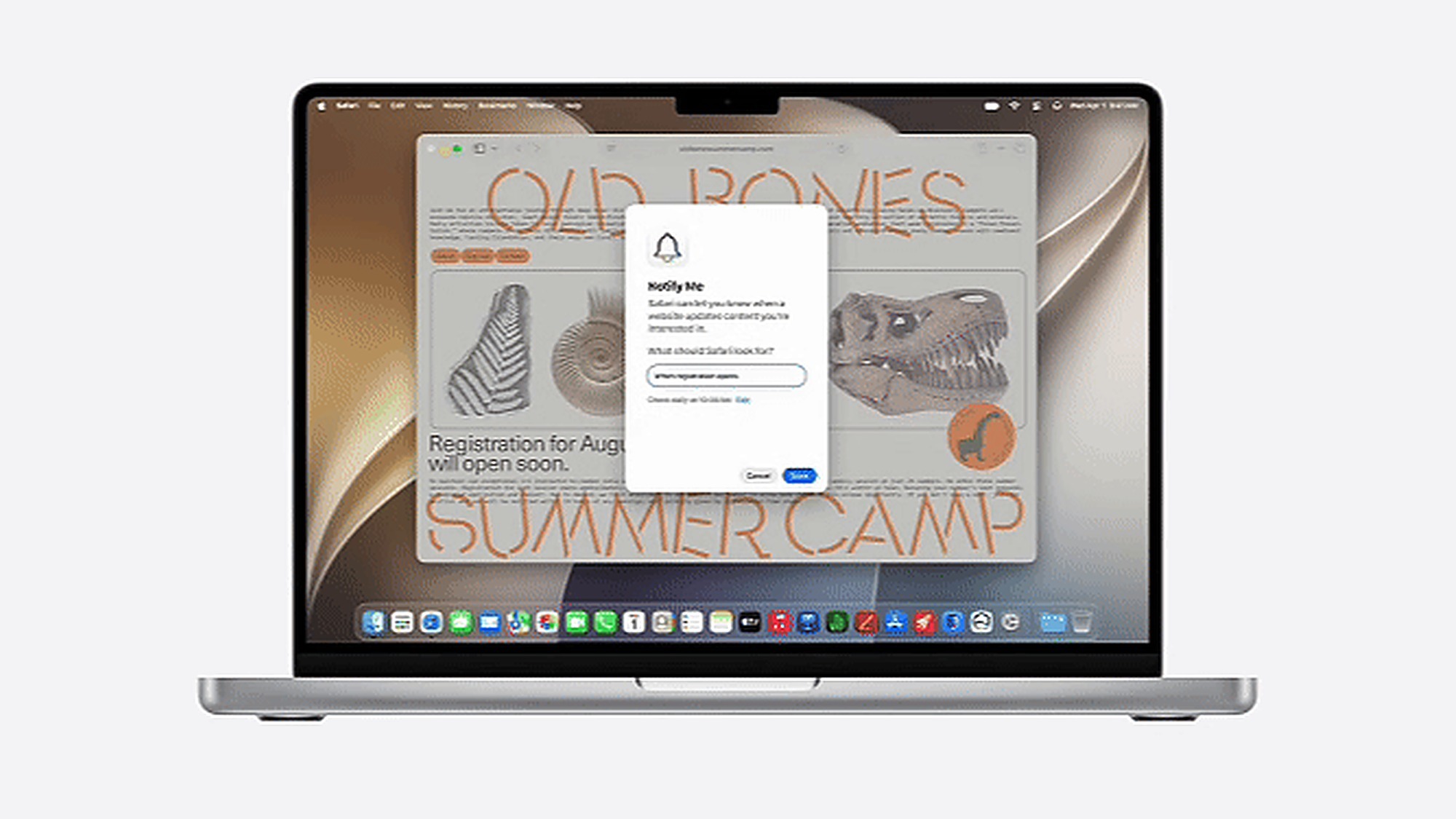
The standouts: Visual Intelligence now works across platforms, so you can point your camera at a dish and ask Siri to look up its nutrition, or tap something on screen to identify and act on it. Image Playground adds a genuinely photorealistic generation style and lives inside Photos and Messages. In Photos, a new Spatial Reframing tool improves the composition of a shot after you have taken it. Messages offers context based suggestions that turn a thread into a reminder or a note. Mail ships a redesigned search with much better Top Hits ranking. Safari gains Notify Me, which quietly watches a web page and pings you when the content you care about changes.
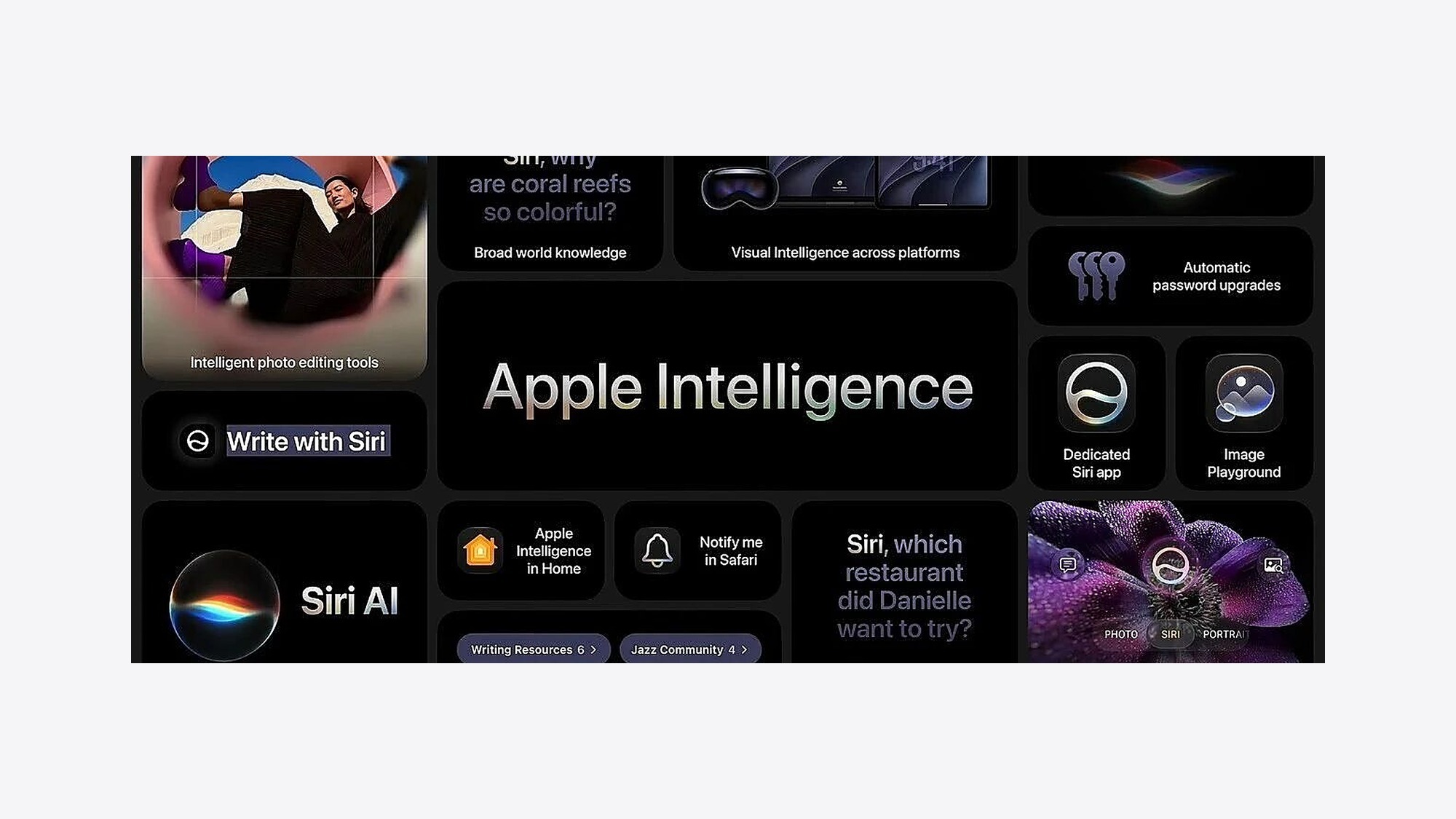
There are platform level wins too. Apple Intelligence now extends into the home through a previewed homeOS, automatic password upgrades harden weak logins, and iOS 27 adds Extensions that let you set a third party AI model as your default assistant if you prefer. The system also got faster across the board: Apple claims app launches are up to 30 percent faster, photo loading up to 70 percent faster, and AirDrop transfers up to 80 percent faster. The Safari Notify Me feature, shown below running on a Mac, is a good example of how these additions favor quiet usefulness over flashy demos.
Apple Intelligence vs ChatGPT and Google Gemini
The natural question is why use Siri AI at all when you can install ChatGPT or the Gemini app. The honest answer is that they solve overlapping but different problems. A standalone chatbot is a destination you open. Siri AI is a layer that already knows your apps, your screen, and your data, and can act on them.
| Capability | Apple Intelligence Siri AI | ChatGPT app | Google Gemini app |
|---|---|---|---|
| Core model | Custom 1.2T Gemini, plus Apple on device models | GPT class models | Gemini models |
| Runs on device | Yes, for simple tasks | No | Limited |
| Reads your screen and apps | Yes, systemwide | No | Partial on Android |
| Personal context (mail, photos, messages) | Yes, with on device search | Only what you paste | Only what you grant |
| Takes actions across apps | Yes, via App Intents | No | Some, on Android |
| Privacy model | Three tier, anonymized cloud | Account based cloud | Account based cloud |
| Best for | Hands free, integrated, private tasks | Open ended creative chat | Google ecosystem tasks |
The takeaway: if you want the deepest open ended conversation, a dedicated chatbot still wins, and Apple even lets you set one as your default through iOS 27 Extensions. But for the everyday work of running your phone by voice with your own data in the loop, the integration is the point. For a broader look at how frontier model providers are competing on capability, our breakdown of the OpenAI Codex enterprise agent platform shows how fast the underlying models are moving.
Supported Devices, Languages, and Regions in 2026
Apple confirmed that the new Apple Intelligence supports the same devices that already run it today, so there is no surprise hardware cutoff. The catch is regional, and it is significant.
| Detail | What Apple announced |
|---|---|
| iPhone | iPhone 16 or later, plus iPhone 15 Pro and 15 Pro Max |
| iPad and Mac | iPad with A17 Pro or M1 and later, Mac with M1 and later |
| Watch and Vision | Apple Watch Series 9, Ultra 2, SE 3 and later, and Apple Vision Pro |
| Languages | 16 total, including English, French, German, Spanish, Japanese, Korean, Simplified and Traditional Chinese |
| Siri AI rollout | English first, as a beta later in 2026, with more languages to follow |
| European Union | Siri AI not on iPhone or iPad at launch while Apple works on compliance |
| China | New Apple Intelligence features not initially available, pending regulatory approval |
If you are in the United States or another supported English region with a recent iPhone, you are first in line. If you are in the EU or China, you face a wait, and Apple has not committed to a firm date. According to Apple’s own support pages, the language list will keep expanding through the year as it did in previous Apple Intelligence rollouts.
What Users and Developers Are Actually Saying
The early reaction has been louder than any Apple AI launch so far, and it splits cleanly in two. The first reaction is relief. Across Reddit threads and the WWDC community, users who had written off Siri are cautiously impressed that the demos showed real personal context and onscreen actions rather than vague promises, the exact things the 2024 version failed to ship. The recurring sentiment is wait and see, because Apple has shown smart Siri demos before and pulled them.
The second reaction is sharper and comes from developers. The move from SiriKit to App Intents means real migration work, and what developers say in the WWDC sessions and on forums is that the assistant is only as good as the app actions exposed to it. Several note that the heaviest queries leaving Apple hardware for Google Cloud is a philosophical reversal for a company that built its brand on doing AI on the device. In our view that tension is the honest story of this launch: Apple shipped a genuinely better assistant by renting Google’s brain, and reasonable people disagree about whether that is pragmatism or compromise. What is not in dispute is that, in practice, Siri AI is the first version in years that people are arguing about because it might actually be good.
The Bottom Line
Apple Intelligence in 2026 is a different product than the one that launched in 2024. The system orchestrator, the two on device models, Private Cloud Compute, and a custom 1.2 trillion parameter Gemini model add up to the smart Siri Apple kept promising. The privacy architecture is more thoughtful than a plain chatbot, even if the top tier now runs on Google hardware. The biggest asterisks are the staged English first rollout and the EU and China delays. For everyone else with a supported iPhone, the long wait for a Siri worth talking to looks like it is finally ending.
- Siri AI finally delivers conversational, context aware answers across iPhone, iPad, Mac, Apple Watch, and Vision Pro
- A custom 1.2 trillion parameter Gemini model handles reasoning the old Siri could never touch
- Three tier routing keeps simple requests on device, so many everyday tasks never leave your iPhone
- Private Cloud Compute anonymizes and tokenizes queries, and Google is contractually barred from training on them
- Visual Intelligence, Image Playground, and writing tools now reach much deeper into everyday apps
- Siri AI ships in English first, with a staged rollout across the rest of 2026
- The European Union and China do not get the new Siri AI on iPhone at launch
- The heaviest queries still leave Apple hardware and run on Google Cloud, which will unsettle privacy purists
- The full feature set needs an iPhone 15 Pro or an iPhone 16 or later, leaving older models behind
Frequently Asked Questions
Is Apple Intelligence available in my country or region?
Apple Intelligence is available in most regions on compatible devices, and the new Siri AI begins as an English beta later in 2026. At launch, Siri AI is not available on iPhone or iPad in the European Union, where Apple says it is still working to meet regional rules, and it is not initially available in China while regulatory approvals continue. The wider Apple Intelligence feature set already supports 16 languages, including Simplified Chinese, Japanese, and Korean.
What devices support Apple Intelligence in 2026?
Apple Intelligence and Siri AI run on iPhone 16 models or later and the iPhone 15 Pro and 15 Pro Max, plus iPad models with A17 Pro or M1 and later, Macs with M1 and later, Apple Watch Series 9, Ultra 2, SE 3 and later, and Apple Vision Pro. Some newer devices receive a higher power on device model with more natural speech and stronger language handling.
How is Apple using Google Gemini models inside Apple Intelligence?
Apple licensed a custom 1.2 trillion parameter Gemini model that it runs as part of its own Apple Foundation Models stack. For most requests the model is reached through Apple’s Private Cloud Compute, and only the heaviest reasoning tasks route to Google Cloud. Apple says queries are anonymized and tokenized, and Google is contractually barred from using them to train future models.
Does Apple Intelligence store or share my personal data?
Apple’s stated design keeps simple requests on your device, so that data never leaves the iPhone. For cloud requests, Private Cloud Compute uses hardware isolated enclaves, does not retain your data, and is not accessible to Apple staff. When a query reaches Google Cloud, Apple says it is anonymized so neither Apple nor Google can tie it to you, and Google cannot train on it.
What can Siri AI do that the old Siri could not?
Siri AI holds a real conversation, remembers context from earlier in the chat, and can search your messages, emails, and photos to answer personal questions. It understands what is on your screen, takes actions across apps such as drafting an email or editing a photo, draws on broad world knowledge, and keeps a synced history in a dedicated Siri app on iPhone, iPad, and Mac.
What is the Apple Intelligence system orchestrator?
The system orchestrator is a central coordinator that decides which model or tool handles each request based on the app you are in and the task you are doing. Reading an email, editing a photo, and planning a trip each route differently. It chooses between the on device model, Private Cloud Compute, and the cloud Gemini model, balancing speed, capability, and privacy automatically.