
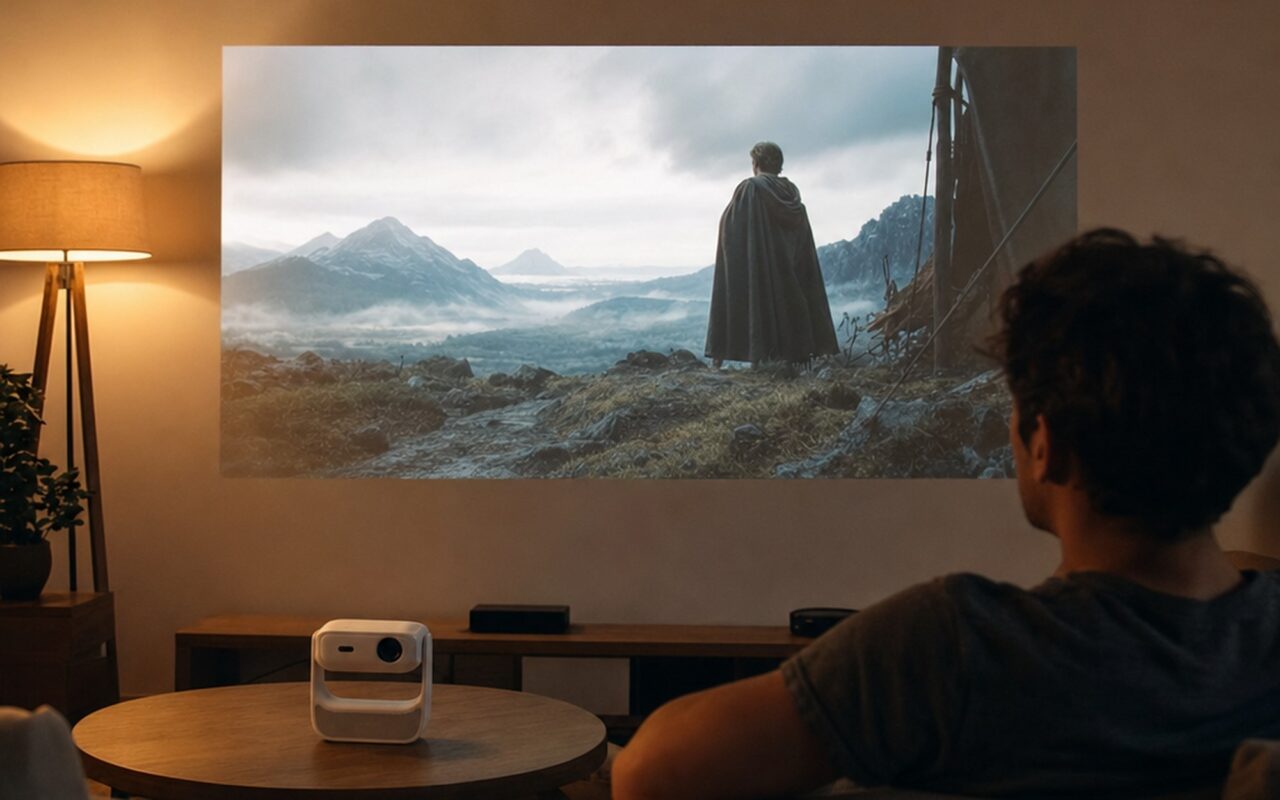
If you have ever searched for the best budget projector under 100 dollars and come away frustrated by spec sheets full of inflated numbers and blurry 480p output dressed up as ‘4K support,’ the Hakoo H3 Pro is a genuinely different animal. Launched at 809 CNY (roughly $112 USD), it is one of the first sub-$120 projectors to ship with a genuine native 1080p LCD panel, a sealed optical engine, and an AI-powered auto-calibration system that makes setup feel like the future.
This review is based on published technical testing data including measured brightness uniformity and real-world image comparisons. Here is everything you need to know before you buy.
What Is the Hakoo H3 Pro?
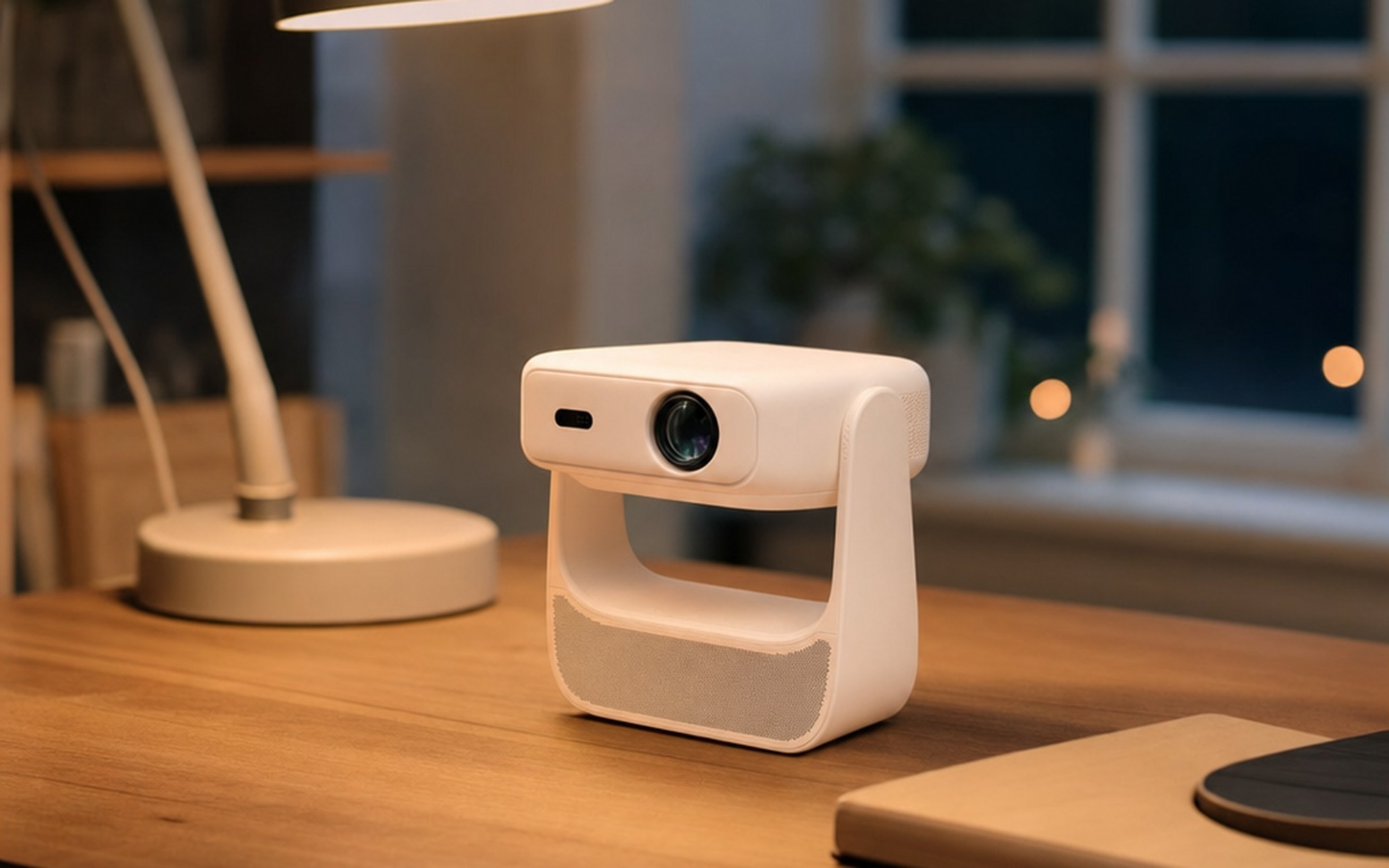
The Hakoo H3 Pro (model HQH3 Pro) is a 1080p LCD projector from Chinese audio-visual brand Hakoo (哈趣), known for making clean-OS smart projectors at aggressive price points. The H3 Pro sits above the standard H3 in the lineup, upgrading to the EngineX Pro Max sealed optical engine, a higher-output LED array rated at 400 CVIA lumens, and a Harman-tuned speaker system.
Physically it is a compact square unit – 221 × 216 × 194mm – weighing 1.8kg. The design integrates the projector head and speaker base into a single chassis with a looped carry handle, so it moves easily between rooms or trips without a dedicated case.
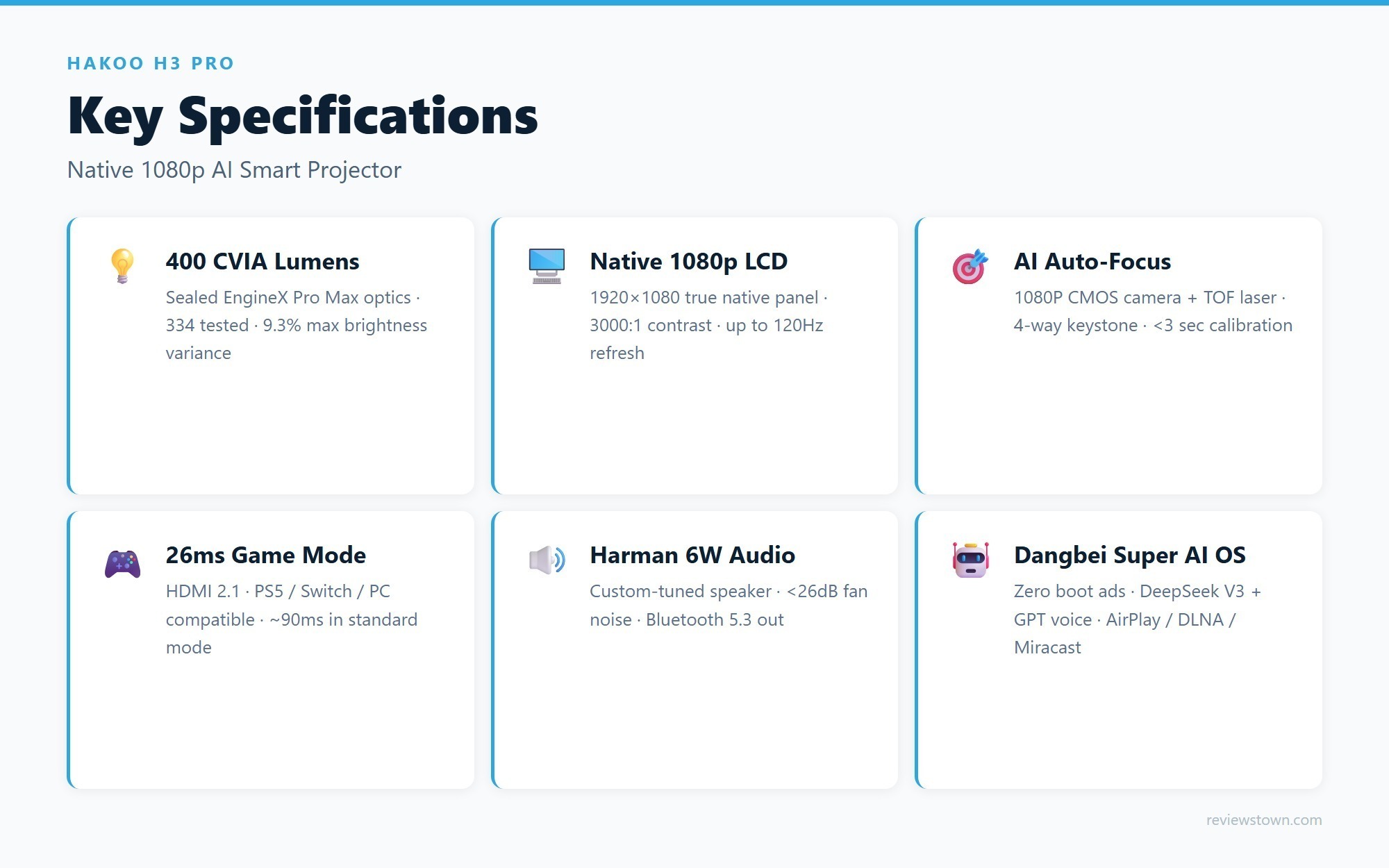
Key hardware at a glance:
| Spec | Detail |
|---|---|
| Native resolution | 1920 × 1080 (Full HD) |
| Brightness | 400 CVIA lumens (334 tested) |
| Display tech | LCD, LED light source |
| Contrast ratio | 3000:1 |
| Refresh rate | Up to 120Hz |
| Input lag (game mode) | 26ms |
| Throw ratio | 1:1.26 |
| Audio | Harman 6W custom speaker |
| OS | Dangbei Super AI OS |
| Connectivity | HDMI 2.1, USB 2.0, 3.5mm audio |
| Power draw | 70W |
| Dimensions | 221 × 216 × 194mm / 1.8kg |
Understanding the Brightness: CVIA vs ANSI Lumens
Before diving into performance, it is worth addressing the single most misleading metric in budget projector marketing: lumens.
Most sub-$100 projectors claim anywhere from 5,000 to 15,000 lumens – numbers that are physically impossible for the LED arrays inside these units. They are measured in a boosted single-color or white-flash mode that bears no relation to actual video playback. Tom’s Guide’s testing of budget projectors consistently shows that claimed lumens from no-name brands run 4–10x higher than real-world output.
CVIA lumens (China Video Industry Association standard) require the projector to reproduce a full white video signal at rated color volume. It cannot game the test with a momentary brightness spike. The Hakoo H3 Pro’s 400 CVIA rating is an honest number – independent testing measured 334 CVIA in actual use, a 16% gap that is normal for optical path efficiency losses.
As ZDNet found when testing compact projectors, real-world brightness consistency matters far more than peak spec numbers. The H3 Pro’s brightness uniformity test showed a maximum variance of only 9.3% and an average variance of just 4.0% across the image – that is exceptional for this price tier, meaning the corners are nearly as bright as the center.
EngineX Pro Max Optical Engine: What the Sealed Path Actually Means
The optical engine is the heart of any projector, and the H3 Pro uses Hakoo’s proprietary EngineX Pro Max design. The critical word here is sealed.
Cheap projectors use open optical paths – the LCD panels, color wheel or prism, and lens are exposed to ambient air. Dust accumulates on the LCD panels over months, creating permanent dark spots and reducing contrast. The H3 Pro’s sealed light path carries IP5X dustproof certification, meaning the optics are protected against dust infiltration at the same level as a quality outdoor watch.
Hakoo claims a 50–60% efficiency improvement over the previous generation optical engine. This tracks: a 70W power draw producing 334 tested CVIA lumens represents roughly 4.8 lumens-per-watt – meaningfully higher than the 2–3 lumens/watt you see in cheap open-path units.
The 3000:1 contrast ratio also benefits from the sealed path, as scattered ambient light inside an open chassis kills black levels. At 60 inches in a darkened bedroom, the H3 Pro’s blacks are dark enough to make dark thriller and horror content genuinely watchable – something most sub-$150 projectors cannot claim.
Auto Focus and Keystone: The AI That Actually Works
One of the most underrated frustrations with portable projectors is manual setup. Move the unit an inch, and you are fiddling with focus rings and keystone sliders again. The H3 Pro solves this with two sensors working together:
- 1080P CMOS camera: captures the projected image and detects geometry distortion
- TOF (Time-of-Flight) laser depth sensor: measures distance to the projection surface in real time
The system processes both inputs and executes full automatic 4-way keystone correction and auto-focus simultaneously – the company quotes sub-3-second calibration. In practice, reviewers report the system locks in reliably whether projecting straight-on or at up to 40° angle correction.
This matters for outdoor camping setup in particular. On an uneven surface with a portable screen that is not perfectly vertical, the H3 Pro self-corrects without user input. The TOF sensor also enables obstacle avoidance – if someone walks through the projection beam, the projector detects the interruption and auto-resumes focus after the obstruction clears.
Outdoor and Camping Use: What to Realistically Expect
The H3 Pro is marketed toward campers and renters as well as living room users. Here is an honest assessment:
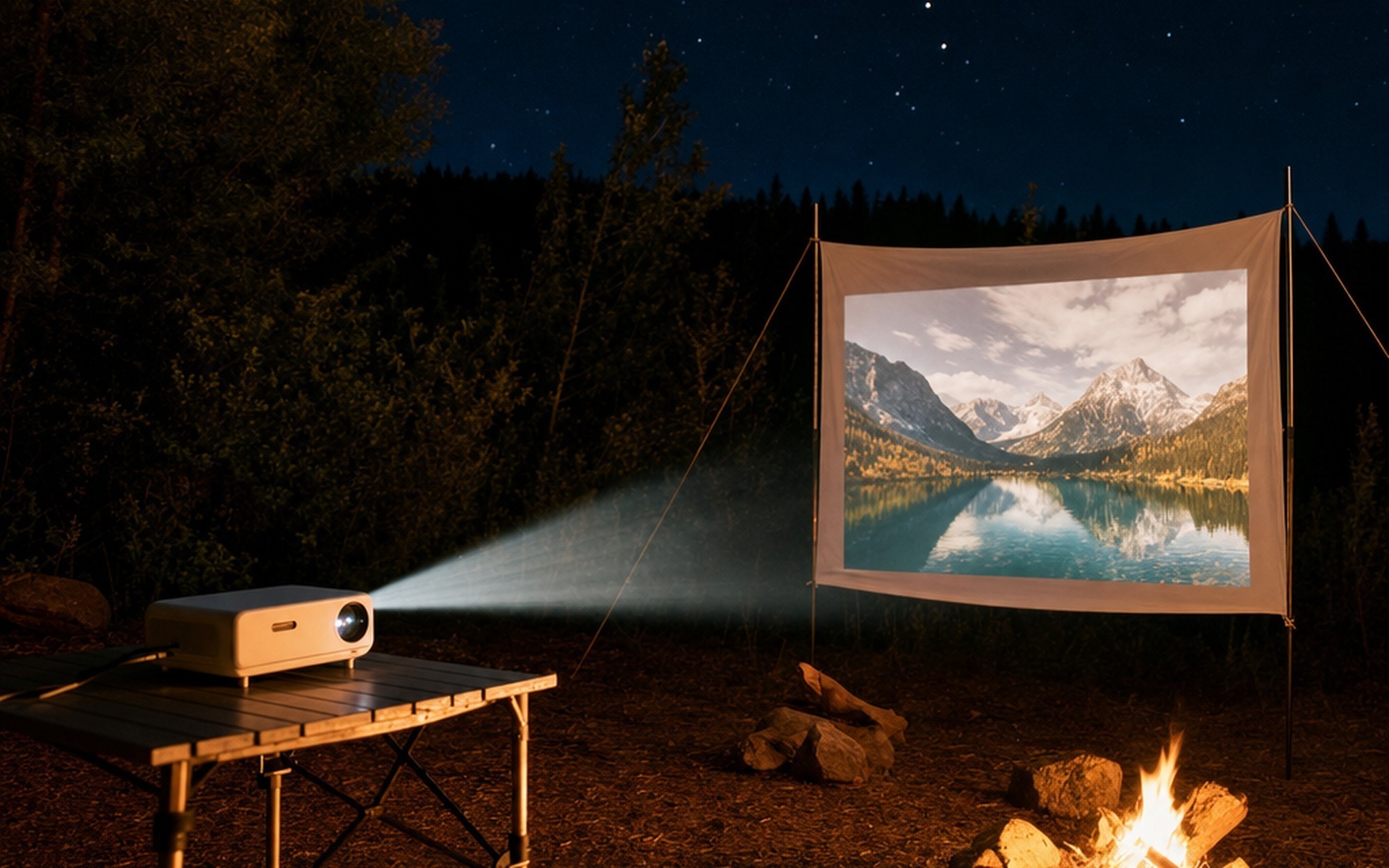
Strengths outdoors: The auto-setup system (focus + keystone in 3 seconds) is genuinely useful when you are setting up on uneven ground. The sealed dustproof optical path handles outdoor environments without degrading over time. At 60–80 inches after full dark, the 334 tested lumens produce a comfortable image for movie watching.
Limitations outdoors: The H3 Pro requires AC power – there is no built-in battery. You will need a power bank with AC output (at least 100W output capacity for the 70W draw) or a portable generator. At 1.8kg it is manageable in a backpack but not ultralight camping kit.
Best outdoor screen size: Keep projections to 60–80 inches outdoors. The throw ratio of 1:1.26 requires roughly 2.0m distance for a 65-inch image. Beyond 80 inches in a non-pitch-black environment, brightness starts to feel thin.
For a comparison with dedicated outdoor projectors, it is worth noting that purpose-built battery-powered units typically deliver less than 200 lumens in exchange for battery convenience. The H3 Pro’s 334 measured lumens with AC power is a better image in exchange for the power cable requirement.
Gaming Performance: 26ms Is Genuinely Usable
Projectors and gaming have historically been a poor combination due to high input lag. The H3 Pro’s 26ms measured latency in game mode changes this calculus for casual players.
To put that number in context:
– Competitive gaming monitors: 1–5ms
– Good gaming TVs: 10–15ms
– Average projector: 60–120ms
– H3 Pro game mode: 26ms
At 26ms you will not win a ranked match in a fast-paced shooter, but single-player games, RPGs, racing games, and couch co-op are entirely comfortable. TechRadar’s guide to the best portable projectors for gaming notes that anything below 50ms is the general threshold for comfortable casual play. The Switch, PS5, and modern PCs all connect via the HDMI 2.1 port, which supports 4K60 and 1080p120 signal input (the H3 Pro outputs at native 1080p regardless of input resolution).
Default (non-game) mode measures approximately 90ms – if you plan to game, enabling game mode in the settings is essential.
Dangbei Super AI OS: The Software Advantage
Hardware aside, one of the H3 Pro’s most meaningful differentiators is its operating system. Dangbei OS is often described as the ‘iOS of the smart projector world’ in the Chinese market – and the comparison holds up in several ways:
No boot advertisements: Most budget smart projectors from generic brands show 15–30 seconds of ad content every time you power on. The H3 Pro boots ad-free, directly to the home screen, in approximately 5 seconds.
AI voice assistant with DeepSeek integration: The built-in voice assistant runs DeepSeek V3 and GPT-based models, meaning you can ask natural language questions (‘Find me science fiction movies from the 1980s’), control playback, and adjust settings by voice. This is a meaningful UX step above the simple keyword-matching voice systems on cheaper units.
Streaming app compatibility: The OS supports standard casting protocols including AirPlay, DLNA, and Miracast. Most major streaming apps are accessible through the app store, though regional app availability varies – US users may need to sideload certain apps.
Audio: The Harman 6W Speaker
Projector audio is typically an afterthought – tiny 2W units that sound like a phone speaker from 2012. The H3 Pro integrates a Harman-tuned 6W speaker into the lower chassis, with the grille forming the bottom half of the square body design.
Harman’s involvement means the speaker has been acoustically tuned to the enclosure rather than just dropped in. The result is audio that is adequate for a bedroom environment at normal viewing distances (2–3 meters). Outdoor use or large living rooms will benefit from pairing a Bluetooth speaker via the 3.5mm output or Bluetooth 5.3.
Noise output from the projector fan is specified at under 26dB at 1 meter – quieter than most laptop fans at load, and not noticeable during normal content viewing.
H3 Pro vs. Competing Budget Projectors
The H3 Pro sits in a crowded market of $80–$150 mini projectors. Here is how it compares to the most common alternatives:
| Feature | Hakoo H3 Pro | Generic ‘Android’ Projectors | Dedicated DLP Budget Units |
|---|---|---|---|
| Native resolution | 1080p | Usually 480p–720p | 720p–1080p |
| Brightness | 400 CVIA / 334 tested | 150–300 claimed, ~50–80 real | 200–500 ANSI |
| Auto focus | AI (CMOS + TOF) | Manual only | Manual or basic |
| OS | Dangbei (no ads) | Android (ad-heavy) | Limited or none |
| Input lag | 26ms | 60–120ms | 30–80ms |
| Audio | Harman 6W | 2–3W generic | 2–5W generic |
| Connectivity | HDMI 2.1, BT 5.3, WiFi 6 | HDMI 1.4, basic WiFi | HDMI, USB only |
| Price | ~$112 | $40–90 | $80–150 |
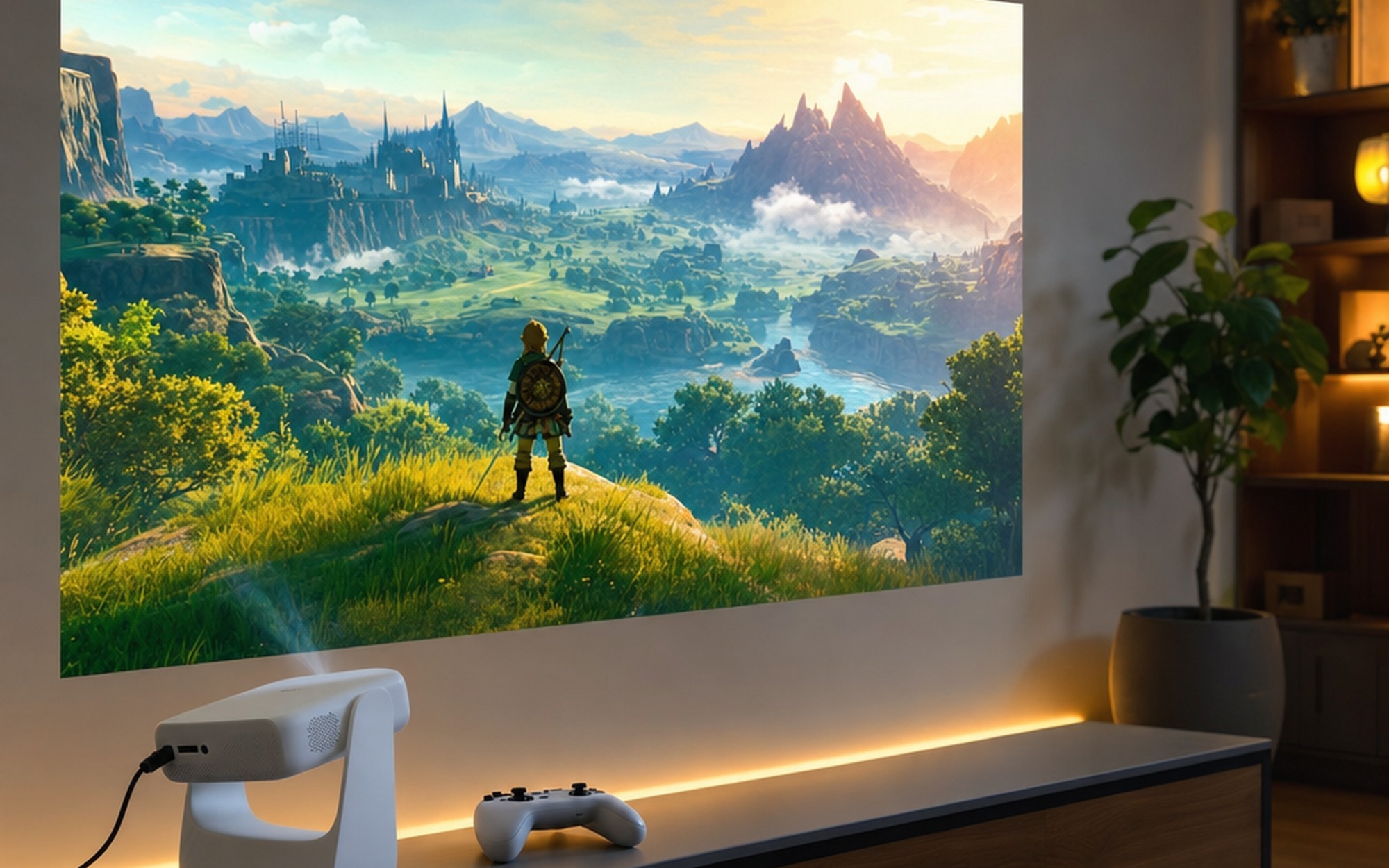
The H3 Pro is more expensive than the cheapest projectors on Amazon, but the brightness, auto-calibration system, and Dangbei OS represent a meaningful step up that cheaper units cannot match.
Who Should Buy the Hakoo H3 Pro?
The H3 Pro makes most sense for:
- Renters and apartment dwellers who want a large screen without wall-mounting a TV – the auto-keystone means perfect geometry every time even when projecting onto a slightly offset wall
- Students and dorm users who need portability between home and campus
- Casual gamers who want a big-screen console experience without investing in a large TV
- Campers and outdoor movie nights who have access to portable AC power
It is less suited for daytime living room use, bright conference rooms, or anyone who needs a truly untethered battery-powered unit.
Final Verdict
The Hakoo H3 Pro delivers on its core promise: a genuinely native 1080p image, honest brightness numbers backed by CVIA certification, and AI-powered setup that removes the manual friction that makes cheap projectors annoying in daily use. Tested brightness of 334 CVIA is below the 400 spec but still outperforms virtually every competitor at this price when measured honestly.
At $112 it is not truly ‘under $100,’ but it delivers enough performance improvement over that price band to justify the premium – particularly the sealed optics, 26ms game mode, and Harman audio that you simply do not get from $60 alternatives.
If you are looking for the best budget projector under $120 that provides real 1080p resolution and a smart OS worth living with, the Hakoo H3 Pro earns a strong recommendation for dark-room home and camping use. If you are building out a full tech setup alongside a projector, our Honor MagicBook Pro 16 2026 review covers a capable laptop that pairs well for casting and HDMI-out use.
Pricing reference: 809 CNY at launch (~$112 USD at current rates). International availability via major cross-border retailers.
- True native 1080p LCD panel — no interpolation or pixel-shifting tricks
- 400 CVIA lumens with certified EngineX Pro Max sealed optical engine
- AI auto-focus + 4-way keystone via 1080P CMOS camera and TOF laser in under 3 seconds
- 26ms response time in game mode — usable for casual console gaming
- Harman-tuned 6W speaker built into the stand — no external audio needed
- Dangbei Super AI OS with no boot ads and integrated DeepSeek AI voice assistant
- HDMI 2.1 port supports modern consoles and laptops at full bandwidth
- Tested brightness (334 CVIA) is 16% below the rated 400 CVIA spec
- At 1.8kg it is portable but not truly pocketable for hiking or travel
- Optimal image size is 60–80 inches — 100-inch projection noticeably dims in partial light
- No built-in battery — requires AC power outlet, limiting true off-grid use
- 1:1.26 throw ratio means you need roughly 2.5m distance for an 80-inch image
Frequently Asked Questions
What is the Hakoo H3 Pro and is it suitable for home use?
The Hakoo H3 Pro is a native 1080p LCD mini projector with 400 CVIA lumens, Dangbei Super AI OS, and a Harman 6W speaker. At roughly $112 USD it is well-suited for bedroom or living room use in dark or dimly lit environments, delivering image quality comparable to a 60-inch LCD TV at that screen size.
What is the difference between CVIA lumens and ANSI lumens?
CVIA (China Video Industry Association) lumens are measured under a standardised real-world display test — the projector must reproduce a full white video signal, so spec inflation is much harder. ANSI lumens use a simpler 9-point grid measurement that many manufacturers abuse with boosted color or brightness modes. As a rule of thumb, 400 CVIA lumens is roughly equivalent to 350–400 ANSI lumens measured honestly, making CVIA a more trustworthy spec.
How do you set up a mini projector for outdoor camping?
Place the Hakoo H3 Pro on a flat surface or small tripod, connect it to a power bank or camping generator via AC adapter, point it at a portable screen or light-colored tarp, and let the AI auto-focus and auto-keystone correction lock in the image in about 3 seconds. Pair it wirelessly to a Bluetooth speaker for louder outdoor audio. Best results come after full dark — its 400 CVIA output is comfortable at 60–80 inches outdoors once ambient light drops.
Is a budget mini projector better than a small TV for bedrooms?
For renters or anyone who moves frequently, a projector like the H3 Pro wins on flexibility — it projects 80–100 inches and packs into a bag. A same-price 43-inch TV delivers brighter, more consistent daytime images. The right choice depends on room lighting: if your bedroom is easily darkened, the projector offers a far more cinematic experience per dollar. If you watch in daylight, a TV wins.
Do cheap projectors actually deliver real 1080p resolution?
Many sub-$100 projectors advertise ‘1080p support’ but use a native 480p or 720p LCD panel and upscale the signal — you get soft, low-detail images. The Hakoo H3 Pro uses a genuine 1920×1080 LCD panel with no pixel-shifting, so every pixel is physically present. This is a meaningful distinction: at 60 inches the difference between native 720p and native 1080p is clearly visible.
What is the best screen size for a 400 lumen portable projector?
At 400 CVIA lumens (334 measured), the Hakoo H3 Pro delivers its best image at 60–80 inches in a darkened room. At 100 inches in full dark it remains watchable but noticeably dimmer. In partially lit rooms, keep it at 60 inches or under for comfortable viewing. The 1:1.26 throw ratio means you need about 1.9m of distance for a 60-inch image and 2.5m for 80 inches.
Can you use a low-cost projector for gaming with low input lag?
Yes — the Hakoo H3 Pro measures 26ms input latency in game mode, which is acceptable for casual gaming on Switch, PS5, or PC at 1080p. Competitive multiplayer at 60fps will feel slightly behind a dedicated gaming monitor (typically 1–5ms), but for single-player games, RPGs, and couch co-op the latency is imperceptible to most players.
How does LCD technology compare to DLP in affordable projectors?
LCD projectors use three separate panels for red, green, and blue light — this produces accurate, saturated colors and eliminates the ‘rainbow effect’ some viewers notice on single-chip DLP units. DLP projectors typically have better contrast ratios and are more compact, but at the sub-$150 price point, most DLP options use inferior optics that negate the contrast advantage. The Hakoo H3 Pro’s sealed LCD path with EngineX Pro Max delivers a 3000:1 contrast ratio that outperforms most budget DLP rivals.