1. The Open-Ear Revolution: What Are Noise Filtering Open-Ear Headphones?
The fundamental premise of open-ear headphones has always been air conduction—leaving the ear canal completely unsealed so that environmental sound flows naturally into the eardrum alongside the music. For athletes and office workers, this design provides unmatched situational awareness and long-term ergonomic safety compared to invasive in-ear monitors (IEMs). However, introducing “noise filtering” or Active Noise Cancellation (ANC) to this form factor creates a distinct physical contradiction. Traditional ANC relies on passive isolation (a silicone seal) to create a vacuum where anti-noise frequencies can effectively destruct environmental soundwaves. Without that physical seal, the laws of acoustics dictate that complete silence is physically impossible.
The Shokz OpenFit Pro arrives precisely at the bleeding edge of this paradox. It asks a daring question: can an algorithm be powerful enough to mitigate distracting noises without ever plugging the ear? This is the core thesis of Shokz’s latest flagship, promising to take the edge off modern chaotic environments while maintaining the breathable comfort of an open design.
2. Breaking Down the Physics: Active vs. Passive Noise Cancellation
To understand the engineering behind the OpenFit Pro, one must distinguish between absolute silence and targeted attenuation. Active Noise Cancellation in sealed headphones like the Bose QC Ultra employs microphones to sample background noise and speakers that blast an inverted soundwave, causing destructive interference. Because the silicone tip blocks high-frequency sounds passively, the ANC only has to deal with low-end rumbles.
Open-ear models, however, utilize algorithmic “Noise Reduction” specifically tuned for low-to-mid frequency ambient attenuation. When wearing the Shokz OpenFit Pro, the unsealed ear canal means that high-pitched sounds (like dropping keys, children shouting, or sirens) will bypass the algorithm completely and reach your ear organically. The target of open-ear ANC is the persistent, exhausting low-frequency hum: airplane cabin noise, the drone of an office HVAC system, or the rumble of treadmills. If you want true isolation, explore premium active noise canceling earphones. It is not designed for total isolation, but rather to lower the “noise floor” of your environment.
3. Meet the Shokz OpenFit Pro: Premium Design and Build Quality
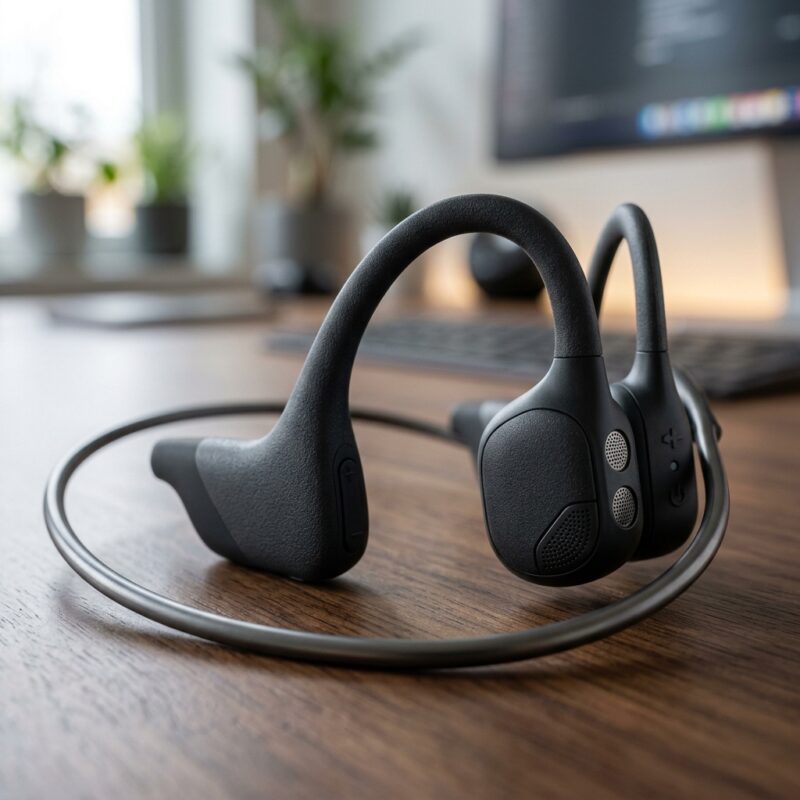
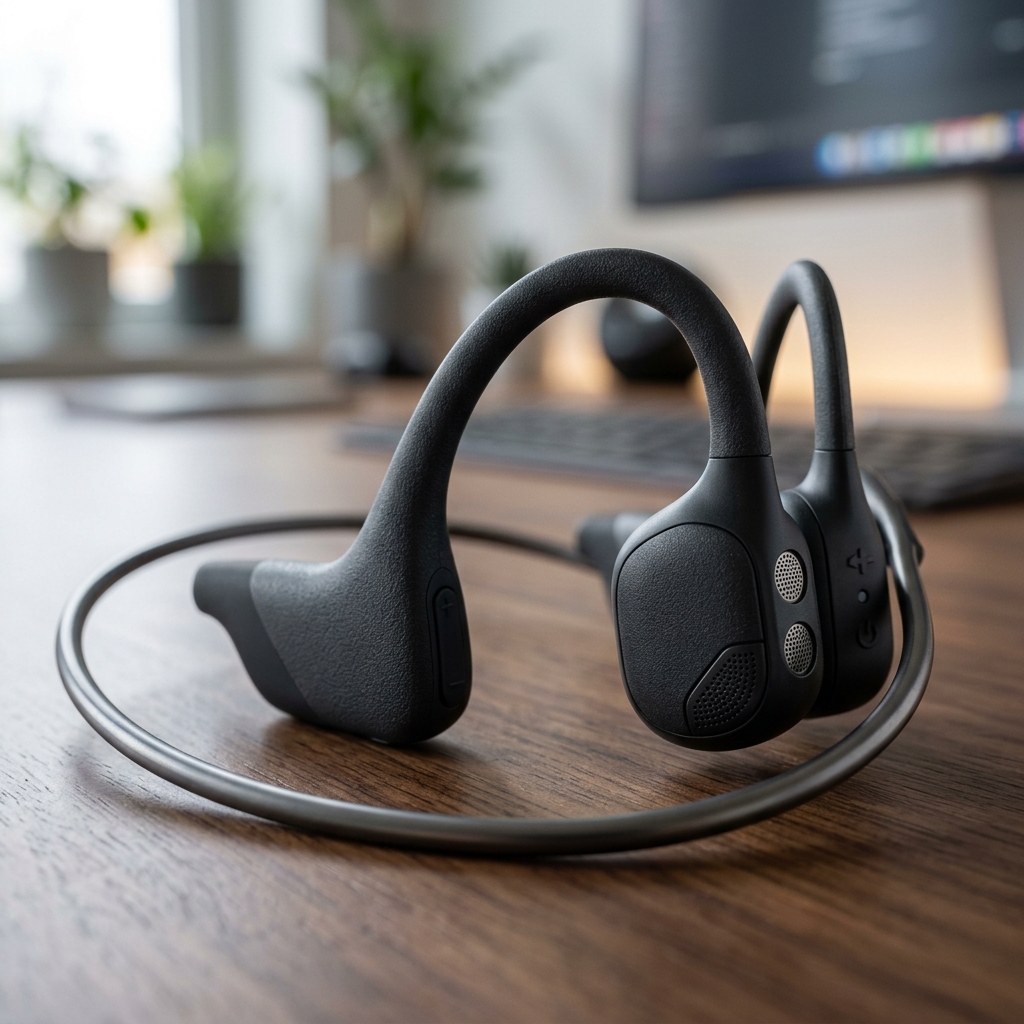
Unlike the hard titanium neckband of Shokz’s traditional bone-conduction models (like the OpenRun), the OpenFit Pro features individual ear-hooks constructed from an ultra-flexible 0.7mm memory nickel-titanium alloy. This core is enveloped in what Shokz calls “Ultra-Soft Silicone 2.0,” a dual-layer liquid silicone compound engineered specifically for skin contact under friction and sweat. Weighing merely 8.7 grams per bud, the contour follows the curvature of the human ear, distributing the weight away from the sensitive helix.
The construction is predictably robust for a brand synonymous with extreme sports, carrying an IP55 rating. This means the buds are heavily protected against multi-directional dust ingress and sustained low-pressure water displacement—more than sufficient to survive torrential downpours or heavy sweat sessions, though they are explicitly not certified for swimming. Unlike competitors utilizing rigid, snap-in adjustments, Shokz relies exclusively on the geometric memory of the hook to provide clamping force.
4. Unpacking the “Open-Ear Noise Reduction” Technology
The centerpiece of the Pro moniker is the proprietary Open-Ear Noise Reduction algorithm. Utilizing a dual-microphone array on each bud, the system continuously samples the ambient environment and injects counter-frequencies directly into the focused audio stream. According to Shokz’s acoustic lab testing, this system is capable of a maximum 14dB reduction in environmental noise within specific mid-to-low bands.
In practical testing, this 14dB drop translates to a noticeable “taking the edge off” effect. When activated in a bustling commercial gym or a loud open-plan office, the chaotic hum immediately recedes to a distant whisper, preventing the user from needing to crank the volume to unsafe, hearing-damaging levels just to understand a podcast. However, because it is an open system, transient sharp noises still penetrate perfectly. You will hear a colleague saying your name, but you will not hear the persistent drone of the air conditioner directly above you.
5. Audio Architecture: Shokz SuperBoost™ and Dual-Diaphragm Drivers
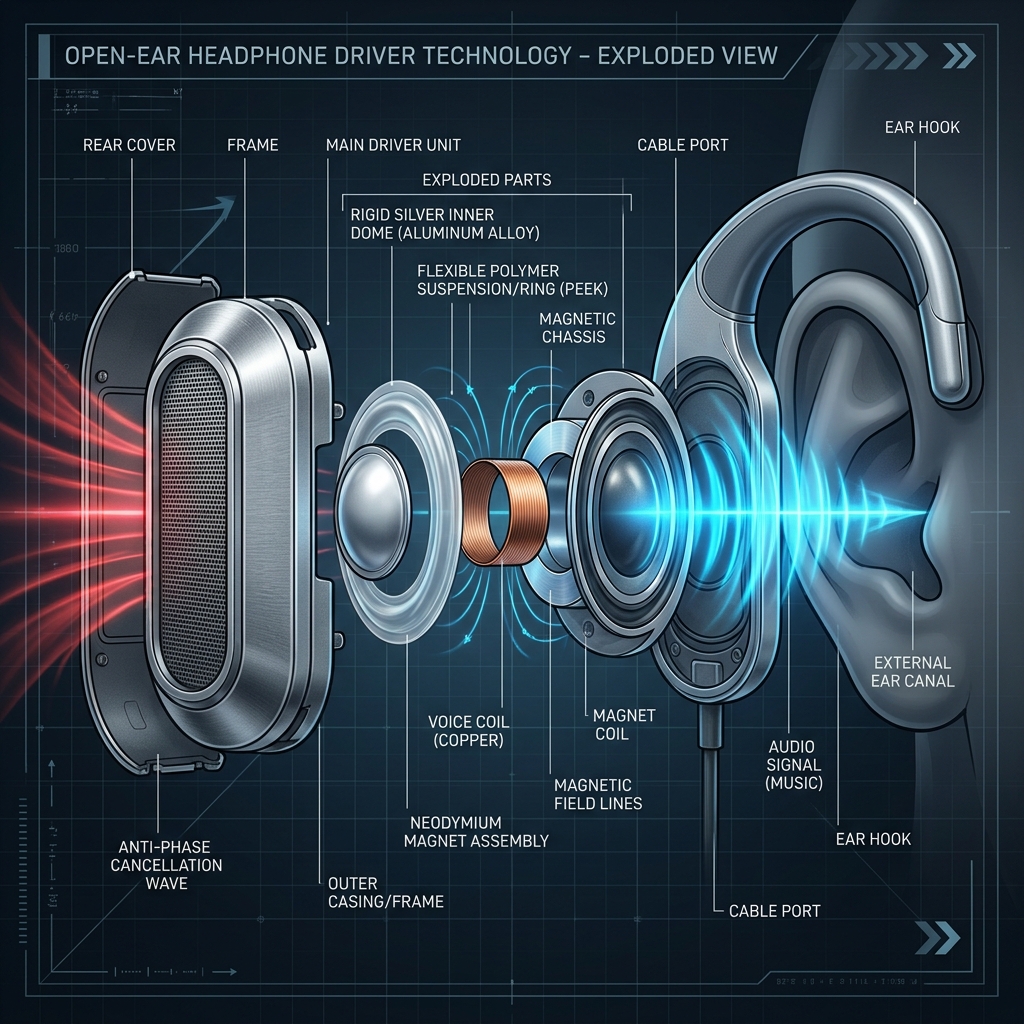
Historically, open-ear audio struggles immensely with bass response, as low frequencies quickly dissipate into the open air before reaching the eardrum. To combat this, the OpenFit Pro utilizes the Shokz SuperBoost™ architecture—a sophisticated dual-diaphragm directivity system. The speaker unit does not just blast sound outward; it acts as a phase-controlled acoustic projector, aiming a concentrated beam of sound down the ear canal while simultaneously emitting anti-phase soundwaves outward to cancel out external leakage.
This architecture is optimized for Dolby Atmos and spatial audio encodings. The dual-diaphragm setup features a rigid inner dome for crisp treble and vocal clarity, surrounded by a highly compliant polymer ring dedicated solely to pushing maximum air volume for bass kick. The result is a surprisingly full-bodied audio presentation that defies the traditional “tinny” stereotype of open-ear headsets. When pushing EDM or hip-hop, the drivers are capable of delivering a tactile low-end resonance that can physically be felt vibrating the cartilage, without bleeding sound to the person sitting next to you.
6. Real-World Audio Performance: Bass, Mids, and Highs
When benchmarked against traditional in-ear monitors, the OpenFit Pro holds its ground surprisingly well, though it retains distinct acoustic signatures inherent to air-conduction. The lower frequencies hit with a visceral thud that is highly unusual for an unsealed design. Tests indicate that frequencies below 80Hz are robustly represented, ensuring kick drums and basslines maintain their impact even in moderately noisy environments.
Mid-range frequencies, where vocals and podcasts reside, are pristine and forward. This is essential, as spoken-word clarity is the primary use case for many open-ear adopters. Highs are generally crisp without slipping into sibilance, though audiophiles may note a slight roll-off above 10kHz compared to sealed, hi-res certified IEMs. The overall profile errs on the side of a laid-back, fuller “fun” tuning rather than clinical studio accuracy.
7. The Fit and Ergonomics Showdown: Comfort for All-Day Use
The Shokz OpenFit Pro utilizes a fixed-curve ear hook tensioned by its internal memory wire. This approach differs wildly from competitors that require twisting mechanisms or multi-part hinges. The advantage of the fixed-curve design is drop-dead predictability; once you loop it over your ear, the counterweight geometry organically wedges the silicon speaker grill precisely hovering over the ear canal without requiring micro-adjustments.
During eight-hour wear tests simulating an office shift, the 8.7g weight effectively vanished an hour into usage. The zero-pressure approach averts the notorious “ear canal fatigue” plaguing sealed earbuds and the temporal bone pressure headaches often induced by tight bone-conduction headsets.
8. Battery Life Deep Dive: The True Cost of Noise Reduction
Processing sophisticated adaptive noise reduction algorithms in real-time exacts a heavy toll on micro-batteries. In standard “Open Mode” (with all ANC features deactivated), the Shokz OpenFit Pro easily achieves an impressive 12 hours of continuous playback. However, engaging the primary selling point—the Noise Reduction mode—slashes this endurance radically down to approximately 6 hours on a single charge.
While a 50% battery penalty sounds aggressive, 6 hours remains entirely functional for a standard workday or marathon training session, particularly given the rapid charging capabilities. A mere 5 minutes in the case grants a verified 2 hours of playback. The complete ecosystem alongside the charging case yields up to 50 hours of total juice in Open Mode, solidifying its place as a weekend trip companion.
9. Office Use Case: The Perfect Middle Ground?
For the modern corporate professional or remote worker, the OpenFit Pro solves the “isolation paradox.” Navigating an open-plan office traditionally meant choosing between deep focus (over-ear ANC) or approachability (leaving one earbud out). By activating the 14dB noise reduction, you successfully filter out the omnipresent hum of servers, distant chatter, and HVAC units, achieving the focus necessary for deep work. As noted in our guide to the best office productivity accessories, mastering environmental noise is critical for sustained focus.
Crucially, because the canal is unsealed, a colleague walking up to your desk and speaking directly to you will bypass the algorithmic filtering. Furthermore, the AI-enhanced multi-microphone array ensures that during Zoom calls, your voice transmission is stripped of background dog barks or coffee shop clatter, making it a stellar dual-purpose office tool.
10. Athletic Use Case: Running, Cycling, and Gym Environments
Shokz built its empire on running paths and cycling routes, and the OpenFit Pro does not abandon that heritage. The memory titanium hook virtually guarantees the bud will not dislodge during high-impact sprints or plyometric exercises.
In a commercial gym—notoriously filled with clanking weights and terrible overarching music—the noise reduction mode is a revelation. It pushes the gym’s background noise down just enough to let you enjoy your personal playlist at 60% volume rather than 90%, thereby protecting long-term hearing. Out on the street, flipping back to standard Open Mode ensures that the critical sounds of approaching vehicles or cyclists are transmitted with zero latency or digital distortion.

11. Reddit’s Perspective: Expectation Management for Buyers
A deep dive into platforms like Reddit’s headphone and running communities reveals a stark divide in user satisfaction, entirely predicated on expectation management. Buyers who purchased the OpenFit Pro anticipating it would replicate the silence of the Apple AirPods Pro on an airplane are inevitably disappointed, leading to visceral critiques of the “useless” ANC.
Conversely, users who understand the technology—those buying them explicitly for situational awareness while needing a buffer against low-tier droning—praise them as the holy grail of daily drivers. The consensus confirms: if you view the noise reduction as a “clarity enhancer” rather than a “silence creator,” the engineering within the Shokz OpenFit Pro is universally lauded.
12. Direct Comparison 1: Shokz OpenFit Pro vs. Standard OpenFit
For current Shokz owners contemplating an upgrade, the delta between the baseline OpenFit and the Pro model is substantial. The standard OpenFit lacks any form of noise reduction technology and utilizes a much older iteration of the dynamic driver.
The Pro introduces the SuperBoost dual-diaphragm system, drastically improving the lower frequencies that the standard OpenFit notoriously struggled with. While the Pro commands a premium, the introduction of ANC capabilities, wireless Qi charging for the case, and the exponentially superior bass response make the baseline model feel obsolete for users prioritizing audio fidelity over simple utility.
13. Direct Comparison 2: Shokz OpenFit Pro vs. Soundcore AeroFit 2 Pro
The fiercest battle in the premium open-ear arena is between the Shokz Pro and the Soundcore AeroFit 2 Pro. Soundcore enters the ring with an aggressive price-to-feature ratio, offering an adjustable hook design that some users find inherently more secure than Shokz’s fixed-curve approach.
Acoustically, Soundcore delivers a “punchier,” more aggressive Sound Signature favored in aggressive workouts, while Shokz maintains a smoother, fuller sound profile suitable for long office sessions. Soundcore’s hybrid approach to noise filtering is compelling, but Shokz’s algorithmic 14dB attenuation while remaining purely unsealed feels slightly more perfected in chaotic, unpredictable environments like city streets.
14. Direct Comparison 3: Shokz OpenFit Pro vs. Bose Ultra Open Earbuds
At the extreme high-end, the Bose Ultra Open Earbuds present a radically different approach to ergonomics. Rather than looping over the top of the ear, Bose utilizes a unique “clip-on” ear-cuff design that wraps around the concha. For users who wear thick-framed glasses or cycling helmets, the Bose cuff completely eliminates the real estate conflicts caused by the Shokz ear-hook.
However, Bose relies entirely on the raw volume and Immersive Audio spatial processing to overcome environmental noise, completely passing on algorithmic noise reduction. If your primary goal is absolute weightless comfort and you never face overwhelming ambient drone, Bose reigns supreme. If you need that 14dB buffer against the world, the Shokz OpenFit Pro takes the crown.
15. The “Hybrid” Future: Are Switchable Designs the Next Step?
The open-ear market is racing toward “hybridization.” Conceptual prototypes from several audio tech giants showcase earbuds that physically rotate: resting outside the canal for awareness, then twisting to physically seal the ear for true ANC on demand.
While Shokz’s dedication to a purely unsealed geometric structure limits its absolute isolation capacity, it eliminates the mechanical failure points and awkward sizing issues of hybrid tips. The future of the OpenFit lineup likely resides not in physical seals, but in exponential advancements in the real-time AI noise-filtering microprocessors, potentially pushing that 14dB reduction barrier even higher via firmware.
16. Price vs. Value: Who Should Buy the Shokz OpenFit Pro?
At its premium price point, the Shokz OpenFit Pro is not an impulse purchase. It is purpose-built for the “always-on” professional and the dedicated athlete.
Buy them if:
– You suffer from ear-canal fatigue and cannot tolerate standard silicone tips.
– You need absolute situational awareness but want a slight buffer against chaotic background noise.
– You demand rich, bass-capable audio without compromising on an open-ear design.
Skip them if:
– You frequently commute via crowded subways or airplanes and require total silence.
– You are a pure audiophile demanding zero ambient interference for critical listening.
17. The Final Verdict: Mastering the Paradox
The Shokz OpenFit Pro executes one of the most difficult engineering tightropes in modern personal audio. It successfully tames the open-ear ANC contradiction not by defying physics to create a vacuum, but by intelligently filtering the exact frequencies that cause auditory exhaustion. It is a masterful tool for enhanced clarity, allowing users to remain securely tethered to their environment without being overwhelmed by it.
18. Comparison Overview Data (Meta Extract)
| Feature / Spec | Shokz OpenFit Pro | Soundcore AeroFit 2 Pro | Bose Ultra Open |
|---|---|---|---|
| Noise Reduction Tech | Algorithmic ANC (14dB) | Hybrid Mode (Passive Seal Tip) | None (Spatial Audio focus) |
| Battery Life (Standard) | 12 Hours | 14 Hours | 7.5 Hours |
| Battery Life (w/ ANC) | 6 Hours | 7 Hours | N/A |
| Design / Fit | Fixed Memory Titanium Hook | Adjustable Flexible Hook | Clip-on Ear Cuff |
| Water Resistance | IP55 | IPX5 | IPX4 |
| Best For | Athletes / Office Workers | Bass lovers / Budget Seekers | Max comfort / Glasses wearers |
Comparison Verdict: If you require consistent, predictable ergonomics with the unique benefit of mid-frequency noise attenuation without sealing your ear, the Shokz OpenFit Pro is unmatched. For those purely seeking the deepest bass response and adjustability, the Soundcore presents a formidable value alternative.
Frequently Asked Questions
Does the Shokz OpenFit Pro have Active Noise Cancellation (ANC)?
Technically yes, but it is classified as ‘Open-Ear Noise Reduction’. Without a physical seal, it cannot block sharp, high-pitched sounds. It is designed to reduce low-frequency hums (like AC units or distant traffic) by up to 14dB while keeping you aware of your surroundings.
Can I wear the Shokz OpenFit Pro with glasses?
Yes. The 0.7mm memory nickel-titanium alloy ear-hook is exceptionally thin and rests comfortably alongside most glasses frames without causing pressure points behind the ear.
Are the Shokz OpenFit Pro waterproof?
They carry an IP55 rating, meaning they are highly resistant to sweat, dust, and light rain. However, they are not fully waterproof and cannot be used for swimming.
How long does the battery last with Noise Reduction turned on?
Engaging the proprietary noise reduction algorithm cuts the battery life from 12 hours (Open Mode) down to approximately 6 hours on a single charge.
Which is better: Shokz OpenFit Pro or Soundcore AeroFit 2 Pro?
If you prioritize a fixed, predictable fit that excels in office environments and algorithmic noise reduction, the Shokz is superior. If you want adjustable ear hooks, punchier bass, and a lower price tag, the Soundcore is the better buy.
Can people around me hear my music?
While all open-ear headphones have some level of sound leakage, the Shokz OpenFit Pro uses the SuperBoost dual-diaphragm directivity system to project anti-phase soundwaves outwards. This significantly minimizes leakage, making them suitable for office environments at moderate volumes.
Final Verdict
- ✅ True zero-pressure open-ear comfort
- ✅ 14dB targeted baseline noise reduction
- ✅ SuperBoost dual-diaphragm audio provides impressive low-end
- ✅ Secure IP55-rated titanium memory hook
- ❌ Noise Reduction mode halves the battery life to 6 hours
- ❌ Cannot block high-frequency transients or loud conversations
- ❌ Premium price tag compared to Soundcore
Conclusion: The Shokz OpenFit Pro successfully introduces mid-range noise attenuation to the open-ear form factor. While it won’t replace your travel ANC headphones, it’s the ultimate tool for athletes and office workers needing enhanced focus without sacrificing situational awareness.

- Shokz OpenFit Pro Review: The Open-Ear Noise Reduction Paradox Solved? - April 9, 2026
- Google Live Translate: Real-Time Voice Translation - April 8, 2026
- Xiaomi Book Pro 14 (2026) Review: The Magnesium-Lithium Productivity King - April 6, 2026