
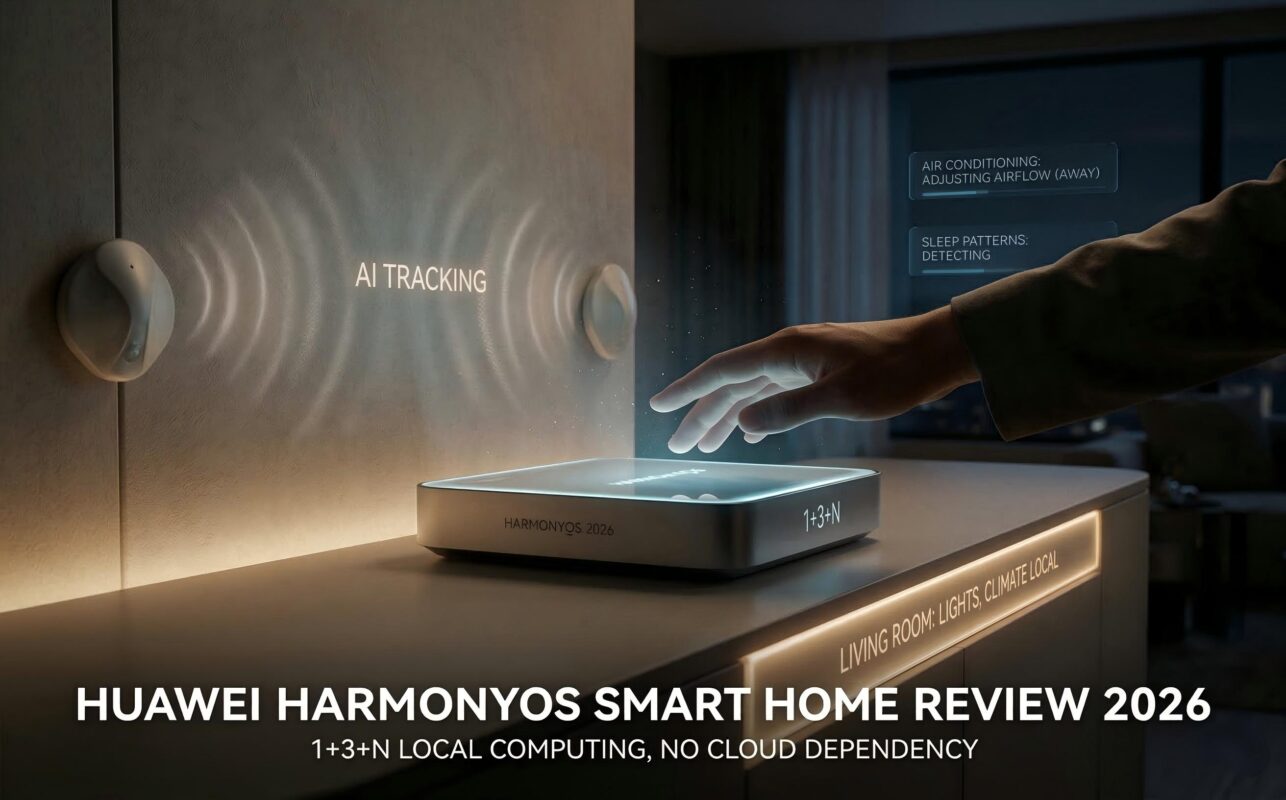
⏱️ 30-Second Verdict: Is the Huawei HarmonyOS Smart Home system worth it? The 2026 “1+3+N” upgrade introduces the X2 Pro local computing hub, advanced Wi-Fi 7+ routing, and seamless AI sensors for an integrated, low-latency experience. If you want a robust, non-cloud-dependent smart home, Huawei offers a compelling ecosystem.
The Core Problem: Cloud Dependency
Most modern smart homes suffer from a fundamental flaw. They rely heavily on cloud processing. When your internet connection drops, the system fails. High latency ruins the experience of seamless automation. The 2026 Huawei HarmonyOS Smart Home update addresses this directly by moving processing locally.
Instead of sending every voice command or sensor trigger to a distant server, Huawei focuses on the “1+3+N” architecture. This system shifts the heavy lifting to a central local hub, prioritizing speed and stability over cloud reliance.
The shift to local computing is exactly what the smart home industry needs. The X2 Pro hub ensures lighting and climate adjustments happen instantly, without the frustrating half-second delay common in competing systems.
The X2 Pro Smart Hub and Connectivity
The “1” in Huawei’s architecture stands for the primary hub. The new X2 Pro smart host uses a flagship-tier processor dedicated entirely to device management and local calculation. It coordinates the “3” interaction methods: touch, voice, and non-intrusive AI sensing.
This non-intrusive sensing is a major focus. Utilizing AI millimeter-wave sensors, the system tracks human presence and location within a room. It adjusts lighting automatically and directs air conditioning airflow away from people. In health applications, these sensors detect sleep patterns and recognize emergencies like falls.
| Feature | Details |
|---|---|
| Primary Hub | X2 Pro (Local Computing) |
| Interaction | Touch, Voice, AI Sensing |
| Ecosystem Scale | 3200+ Brands, 400+ Categories |
| Connectivity Focus | Wi-Fi 7+ (HiSilicon Lingxiao 760) |
To support this vast network, Huawei introduced Wi-Fi 7+ technology powered by its custom HiSilicon Lingxiao 760 chips. This includes dynamic narrow bandwidth, compressing 20MHz channels down to 5-10MHz when signals are weak to extend range. Testing data shows an 80% reduction in network latency in congested environments using true dual-band concurrency.
Vision Smart Screen 6 and Security
The entertainment and control center of the home remains the television. The new Vision Smart Screen 6 features an ultra-thin 4.9cm profile and sits nearly flush against the wall. It uses a “Black Crystal” anti-reflective display, reducing ambient light interference to just 0.5%.
Running on HarmonyOS 6, the system boasts a 15% increase in interface fluidity. It supports AI sports tracking and seamless 4K casting from mobile devices.
On the security front, Huawei expanded its smart lock family. The Smart Door Lock 2 Series includes a 3D ToF camera for facial recognition and palm vein scanning. These locks integrate tightly with the ecosystem, triggering specific lighting and climate profiles the moment a recognized family member opens the door.
Market Alternative Comparison
How does the HarmonyOS system compare to alternatives? Users upgrading their homes often consider Apple HomeKit or Google Home.
| Feature | Huawei HarmonyOS (2026) | Apple HomeKit | Google Home |
|---|---|---|---|
| Local Processing | Excellent (X2 Pro Hub) | Good (HomePod/Apple TV) | Poor (Cloud reliant) |
| Hardware Integration | Deep native integration | Strict but fragmented | Wide but inconsistent |
| Global Availability | Limited outside China | Worldwide | Worldwide |
The Real-World Trade-offs
While the hardware is exceptional, buyers face trade-offs. The ecosystem shines brightest in the Chinese domestic market. Users outside of China will find it difficult to source compatible localized appliances from the 3200 partner brands. You are investing in a system that performs flawlessly if you fully commit to Huawei devices, but connecting third-party global hardware natively can be challenging.
- Exceptional local processing speed
- Advanced AI detection replacing manual controls
- Robust Wi-Fi 7+ network stability
- Limited third-party appliance support globally
- High entry price for premium components like the X1 Lock
Final Verdict
The 2026 Huawei HarmonyOS Smart Home update is a masterclass in local ecosystem management. By prioritizing the X2 Pro computing hub and Wi-Fi 7+ infrastructure, Huawei has solved the latency and reliability issues plaguing older smart homes. It is a highly recommended solution for users willing to embrace the Huawei device ecosystem.
Frequently Asked Questions
Does the Huawei HarmonyOS Smart Home work without the internet?
Yes. The X2 Pro smart host handles logic and device communication locally, allowing core automation functions to run even during internet outages.
What is the benefit of Wi-Fi 7+ in this ecosystem?
Wi-Fi 7+ uses dynamic narrow bandwidth and true dual-band concurrency to reduce latency by up to 80%, ensuring smart devices respond instantly.
Can I install the system in an already built home?
While native wired integration is best done during construction, Huawei offers three tiers of retrofit packages for existing homes.

- Huawei HarmonyOS Smart Home Review 2026 - March 15, 2026
- iFLYBUDS Pro 2 Review 2026: The Ultimate AI Productivity Earbuds? - March 13, 2026
- What to expect from online dating in the coming years - February 27, 2026

