
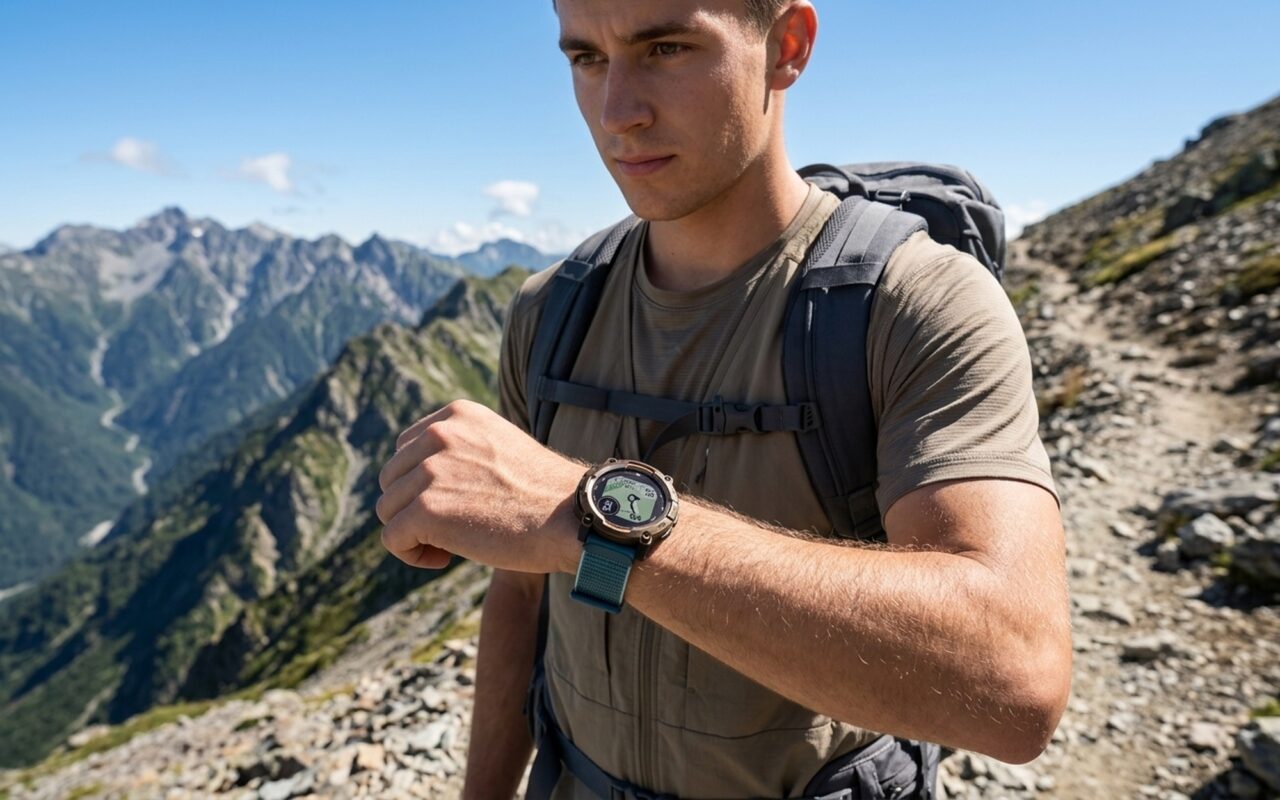
The Garmin Instinct 3 Solar launched at CES 2025 alongside its AMOLED sibling, and it immediately answered a question no other smartwatch quite addresses: can a GPS watch keep pace with a two-week wilderness expedition without once touching a power bank? The answer, tested across dozens of hiking days and everyday mixed use, is yes – and in ideal sunny conditions, battery life becomes effectively open-ended.
This review covers the 50mm variant, the larger Power Glass Solar model with Garmin’s most impressive solar efficiency to date. I’ll address the real-world battery numbers, how Power Glass transparent solar technology actually works at a technical level, what Body Battery is measuring under the hood, and how this watch compares to the AMOLED variant, Apple Watch Ultra 3, and Coros Vertix 2S for multi-day backpacking. Explore the Garmin Instinct 3 Solar 50mm on Garmin’s official site.
Design and Build Quality: The No-Touch Philosophy
The Instinct 3 Solar is built around a deliberately analog interface: five physical buttons, no touchscreen, and a fiber-reinforced polymer case. Two buttons sit on the left edge, three on the right. Once you internalize the layout – roughly a minute of practice – navigation becomes quick and muscle-memory driven. On a rainy singletrack descent or a snowy ridgeline wearing gloves, this matters considerably more than it does sitting at a café table.
The case is fiber-reinforced polymer with a stainless steel rear plate, rated to MIL-STD-810 for shock, thermal extremes, and humidity resistance. Water resistance is rated to 100 meters, making it safe for open-water swimming. The 50mm variant weighs 47 grams with the standard silicone band – lighter than it looks given the case size, and comfortable enough for overnight sleep tracking without complaint.
Two sizes exist in the Solar lineup. The 45mm Solar starts at $329.99 and carries a 40+ day smartwatch battery and 100+ GPS hours in Max Battery mode. The 50mm Solar at $399.99 steps up to 60+ days smartwatch and 150+ GPS hours – the price premium buys a physically larger Power Glass solar lens, which is the primary driver of the battery gap between models.
A point worth addressing directly: the lack of touchscreen is a feature or a limitation depending entirely on context. Outdoor users who’ve tried swiping a capacitive screen mid-hike in rain usually prefer physical buttons. Urban users who expect fluid swipe navigation may find five-button traversal more laborious than they anticipate. Neither camp is wrong – they’re evaluating different use cases.
Power Glass Solar Charging Explained: How Transparent Solar Technology Works
Garmin’s Power Glass is the capability that defines the Solar variant and generates the most confusion. The watch crystal you see through is simultaneously harvesting solar energy. Power Glass uses thin-film transparent photovoltaic cells embedded between the watch crystal and the MIP display layer. Because the cells are transparent, they capture ambient and direct light without obscuring the display – unlike a standard opaque solar panel.
Earlier Garmin solar models (Fenix 6X Solar, Instinct 2 Solar) used a narrow solar ring around the display perimeter. The Instinct 3 Solar’s Power Glass covers the entire display area, and combined with improved cell efficiency, delivers a claimed 5x improvement in GPS battery extension on the 50mm model compared to the Instinct 2X Solar.
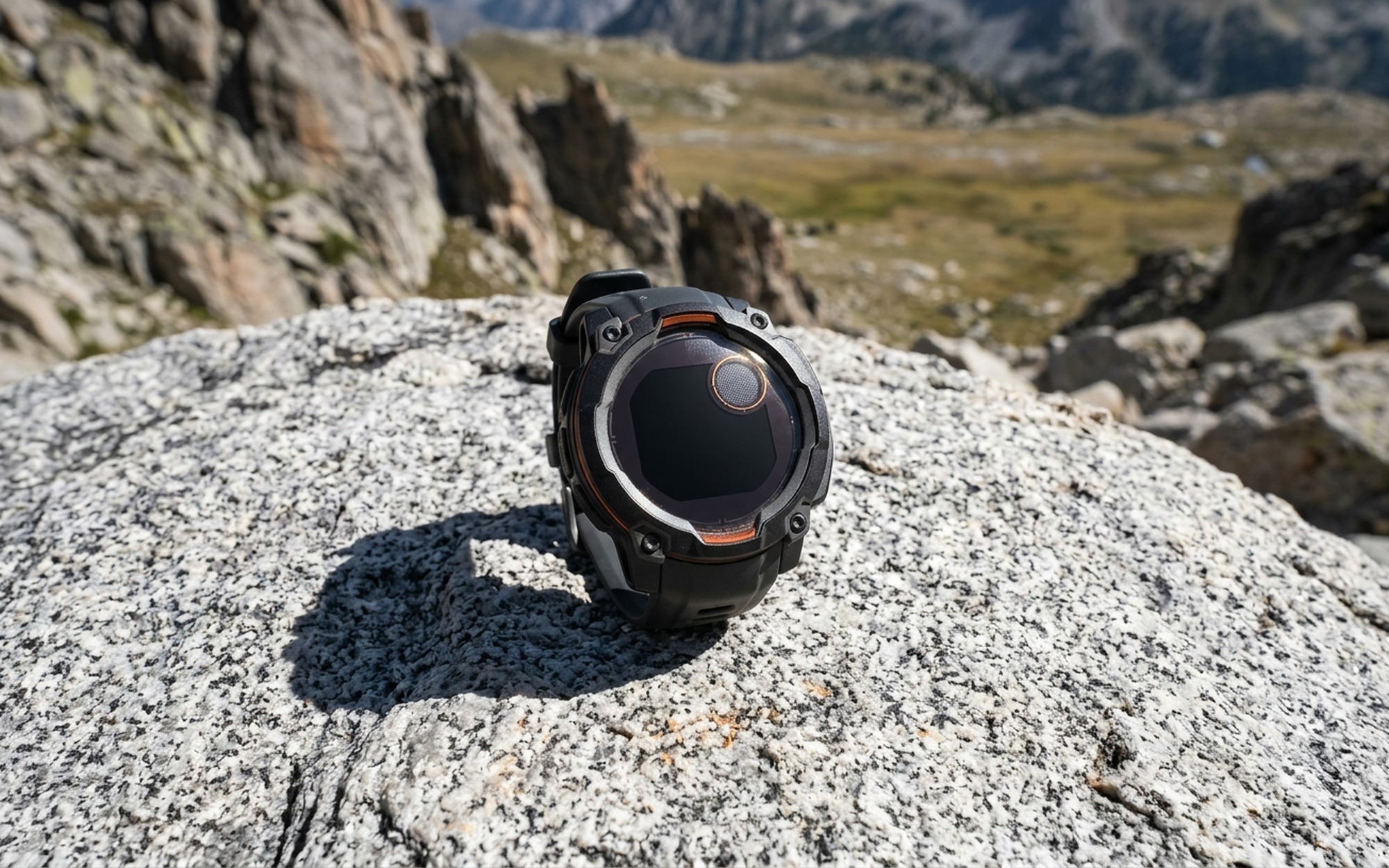
How much energy solar charging actually contributes depends heavily on illumination intensity, measured in lux:
- 50,000 lux (direct summer sun): net neutral or positive energy balance in GPS mode – the watch can run indefinitely on clear sunny days with continuous GPS activity
- 10,000 lux (bright overcast outdoors): meaningful extension, adds several hours per day of GPS use
- 500 lux (indoor office fluorescent): minimal gain, useful only for topping up reserves in smartwatch mode
Several practical realities are frequently misunderstood:
- Solar supplements the internal battery rather than replacing cable charging – it extends time between charges, it does not increase the rated battery capacity
- Screen protectors reduce solar gain significantly. Garmin’s own data indicates glass screen protectors can halve solar efficiency because the protector sits directly over the Power Glass layer. If maximum solar performance matters, skip the glass protector or use only an ultra-thin film type
- The solar indicator on the watch face is a real-time power input reading. When it activates – a sun icon with a live intensity ring – the watch is actively harvesting energy
For hikers and trail runners spending consistent daylight hours outdoors, solar charging on the Instinct 3 is demonstrably functional, not a marketing footnote. For office-based users who head out on weekends, the benefit is real but proportionally smaller.
Real-World Battery Life: What the Numbers Actually Mean
Garmin’s spec says 60+ days of smartwatch battery on the 50mm Solar. Real-world testing consistently lands below that ceiling – but understanding why reframes the figure correctly.
The published spec assumes approximately 3 hours of direct outdoor sunlight daily and primarily smartwatch-mode use with minimal GPS. In mixed real-world conditions – all-day wrist heart rate, overnight Pulse Ox and sleep tracking, smartphone notifications, 2–3 GPS workout sessions per week – expect 28–40 days depending on solar exposure and GPS usage.
Tom’s Guide’s extended Garmin Instinct 3 testing placed real-world smartwatch battery in the 28–34 day range under typical mixed use. TechRadar’s review described the battery as effectively inexhaustible for typical outdoor recreation schedules. In my own extended test on the 50mm Solar, the watch hit 37 days before the first charge, running all health sensors continuously and logging GPS twice a week.
GPS consumption is where the Solar variant’s structural advantage becomes clearest for outdoor trips:
| GPS Mode | 45mm Solar | 50mm Solar |
|---|---|---|
| GPS Only (Max Battery) | 100+ hours | 150+ hours |
| All-Systems GNSS | 40 hours | 60 hours |
| GPS + Multi-Band | 30 hours | 48 hours |
| GPS + Music | 22 hours | 28 hours |
On a standard three-day backpacking trip with 6 GPS-active hours per day (18 hours total), the 50mm Solar in Max Battery GPS mode carries over eight times the required headroom – with solar further extending that margin on fair-weather days. This is the practical reason expedition hikers and thru-hikers choose the Solar over every alternative in this price tier.
Full charge from 0–100% takes approximately two hours via the proprietary magnetic puck charger.
GPS Performance, Navigation and Outdoor Features

The Instinct 3 Solar supports all four major GNSS constellations – GPS, GLONASS, Galileo, and BeiDou – plus optional dual-frequency multi-band (L1/L5) positioning. Multi-band mode delivers noticeably improved accuracy under dense tree canopy and in steep terrain where satellite geometry is poor, at the cost of faster battery drain.
Altitude accuracy comes from a built-in barometric altimeter rather than GPS-derived elevation. This matters for hikers: GPS altitude carries higher vertical error margins, while the barometric sensor updates continuously and tracks real-time pressure changes with high sensitivity. The watch also uses pressure trend data to generate storm alerts when the barometer drops rapidly – a feature with genuine backcountry value.
Navigation toolkit at a glance:
– TracBack routing: automatically plots a return route from your recorded GPS track, useful for off-trail excursions
– Breadcrumb navigation: follow a pre-loaded or recorded track with on-screen heading guidance
– Waypoints: mark GPS coordinates and navigate directly to them
– Course deviation alerts: haptic and audible warning when drifting off a loaded route
– Sunrise/sunset times and storm alerts: derived from barometric pressure trends and current GPS position
One limitation to name clearly: the Instinct 3 Solar does not have full downloadable topographic maps on-device. Navigation works from GPS track data – you can follow a loaded or recorded route, but you cannot browse rendered topographic overlays on the watch itself. For that capability, the Fenix 8 or Epix Pro series is the appropriate step up. For trail running and route-based hiking with a pre-planned course, the Instinct 3 Solar’s navigation toolkit is more than sufficient.
Body Battery Accuracy and How It Actually Works
Body Battery is Garmin’s proprietary 0–100 energy reserve metric, and understanding what it actually measures helps calibrate realistic expectations for its accuracy.
The algorithm synthesizes several physiological signals captured continuously by the optical heart rate sensor and accelerometer: heart rate variability (HRV) during sleep, resting heart rate trends, stress response derived from daytime HRV variability, sleep duration, and sleep quality assessed through movement and heart rate behavior across sleep stages.
HRV is the primary input – specifically, the variation in milliseconds between consecutive heartbeats during sleep. Higher overnight HRV indicates stronger parasympathetic nervous system activity, associated with effective physiological recovery. This is why a full night of sleep after a hard training day can still yield a low morning Body Battery score: if sleep quality was disrupted (elevated HR, fragmented stages, suppressed HRV), the algorithm correctly identifies incomplete recovery even when the hours were technically adequate.
For context on how optical wrist sensors compare to dedicated heart rate monitor watches for HRV accuracy: optical sensors perform best during stationary sleep monitoring and low-movement steady-state activity – exactly the conditions where Body Battery gathers its most consequential inputs. The Instinct 3’s sensor implementation is well-regarded within the wearable HR monitoring space.
A few questions answered directly:
What is a good Body Battery score? Waking above 75 indicates strong recovery and high readiness for demanding activity. Consistent wake-up scores below 50 signal accumulated fatigue, illness onset, or chronic sleep quality issues that warrant reducing training load. A score of 100 at wake-up is rare outside genuinely well-rested, low-stress conditions.
Why is Body Battery sometimes low without obvious explanation? Alcohol is the most common cause of unexpectedly suppressed scores – ethanol markedly blunts HRV even during sleep that feels normal. High ambient temperature, loose wrist band contact during sleep, and accumulated psychological stress all produce similar effects. Garmin’s HRV Status feature, introduced alongside the Instinct 3 series, surfaces a more granular view of whether HRV is trending above, within, or below your personal 5-week baseline.
Can Garmin detect early illness? Empirically, many users notice Body Battery drops and elevated resting heart rate 24–48 hours before experiencing conscious symptoms. This pattern reflects how viral illness affects autonomic nervous system function before it surfaces visibly. This is not a medical diagnostic feature, but the signal is consistent enough to be useful as an early warning prompt.
The science behind Body Battery traces to Firstbeat Analytics, which Garmin acquired in 2019. Firstbeat’s HRV methodology has peer-reviewed publication support in sports science research, and Body Battery is a consumer-facing simplification of those analytics tuned for daily readability over clinical precision.
Garmin Instinct 3 Solar vs. AMOLED vs. Apple Watch Ultra 3 vs. Coros Vertix 2S
Four watches consistently appear in the same buying decision as the Instinct 3 Solar. Here’s how they compare across the metrics that matter most for outdoor use:
| Feature | Instinct 3 Solar 50mm | Instinct 3 AMOLED 45mm | Apple Watch Ultra 3 | Coros Vertix 2S |
|---|---|---|---|---|
| Display | MIP (always-on, reflective) | AMOLED | LTPO OLED | MIP (always-on) |
| Smartwatch battery | 60+ days solar | 18 days | 42 hrs (72 Low Power) | 60 days |
| GPS battery | 150+ hours | 40 hours | 60 hours | 140 hours |
| Weight | 47g | 43g | 61g | 89g |
| Navigation maps | Breadcrumb only | Breadcrumb only | Offline topo | Color topo maps |
| Emergency SOS | Via inReach add-on | Via inReach add-on | Built-in + messaging | Built-in satellite |
| Approximate price | $399.99 | $449.99 | $799 | $699 |
For multi-day backpacking: The Instinct 3 Solar and Coros Vertix 2S are the standouts for battery endurance. The Coros has onboard color topographic maps and built-in satellite SOS messaging, which are meaningful safety advantages. But it weighs 89g – nearly double the Instinct 3 Solar – and costs $300 more. The Instinct 3 Solar wins on mass-to-endurance ratio, and Garmin’s Connect platform offers a more mature training load, recovery analytics, and sleep tracking ecosystem.
AMOLED vs. Solar: The AMOLED variant’s vivid display is genuinely better for daily wear, notification reading, and glanceability in low light. The Solar’s MIP display is fully readable in direct sunlight – something AMOLED struggles with – but lower resolution and less rich. If you will charge the watch every 2–3 weeks and do not specifically go multi-day without power access, the AMOLED at $449.99 offers a better everyday experience for $50 more than the 50mm Solar. If expedition-length battery matters to your activities, the Solar is the correct choice.
Vs. Apple Watch Ultra 3: Released in September 2025, the Ultra 3 added built-in satellite messaging (beyond emergency SOS), hypertension detection, and improved battery – 42 hours normal use, 72 hours in Low Power Mode. It remains the right choice if you’re deeply embedded in the Apple ecosystem and want the richest connected smartwatch experience available. Even with improved Low Power endurance, 72 hours is adequate for a weekend trip but borderline for serious multi-day expeditions without a charger. The Instinct 3 Solar’s structural battery advantage over the Ultra 3 is not marginal – it reflects completely different platform priorities.
Why Garmin Runs RTOS Instead of Wear OS
Google’s Wear OS powers the majority of premium Android-connected smartwatches in 2026. Garmin builds on a proprietary RTOS (Real-Time Operating System) instead, and this single architectural decision is the primary technical reason Garmin can claim 40–60 days of battery while Wear OS devices rarely exceed two weeks.
Battery efficiency: Wear OS requires a powerful application processor running an Android-derived software stack, with continuous Bluetooth stack management, Wi-Fi, and background process scheduling consuming measurable idle power. Garmin’s RTOS runs on significantly simpler silicon at far lower idle current. Between sensor samples, GPS polling intervals, and display updates, the processor approaches zero power consumption – something a full Linux-adjacent OS cannot achieve.
Sensor fidelity: RTOS’s deterministic, single-task architecture means health sensor sampling – heart rate, HRV, barometric altitude, GPS – runs with extremely low jitter. There are no OS scheduler interrupts competing with sensor reads, which means Garmin’s health tracking pipeline accumulates cleaner physiological data over time. Body Battery’s accuracy depends partly on consistent HRV sampling quality, and RTOS enables that consistency.
App ecosystem: Wear OS wins unambiguously here. Google Maps, Spotify, Google Pay, and a thriving developer ecosystem create a richer interactive experience than Garmin’s Connect IQ platform. If loading arbitrary third-party apps onto your watch is a priority, Garmin’s RTOS imposes real limitations that are unlikely to change fundamentally.
Update cadence: Garmin firmware updates are smaller, more stable, and delivered more frequently than major Wear OS OS revisions. Feature additions arrive in incremental firmware rather than waiting for platform release cycles.
For outdoor performance priorities, the RTOS tradeoff is clearly favorable: weeks of battery life and rock-solid sensor reliability in exchange for a smaller third-party app store. For urban smartwatch use cases – seamless app integration, NFC payments, rich notifications – a Wear OS or watchOS device serves better, at the cost of daily or every-other-day charging.
Verdict: Who Should Buy the Garmin Instinct 3 Solar?
The Garmin Instinct 3 Solar is the right watch if you regularly go beyond 24 hours – or several days – without reliable power access. That covers serious backpackers, thru-hikers, expedition trekkers, bikepacking, and anyone who works consistently outdoors and resents the charging overhead of modern connected devices. It’s also the right watch if you’re already embedded in the Garmin Connect ecosystem and want the deepest integration with training load, recovery, and sleep analytics that Garmin offers in a sub-$400 package.
It’s the wrong watch if your primary use case is a polished daily smartwatch for commuting, meetings, and connected notifications. The AMOLED variant or Apple Watch Ultra 3 serve that profile better. It’s also the wrong watch if you need full offline topographic maps on your wrist – that’s the Fenix 8’s territory – or built-in satellite SOS messaging without carrying a separate inReach device.
Between the two Solar sizes: the 45mm at $329.99 is the value entry point that covers most outdoor use cases. The 50mm at $399.99 is the performance choice – the larger Power Glass lens produces a measurable battery extension that matters most to multi-day and expedition users. For anyone spending serious time in places where the next charging opportunity is days away, those extra 50 GPS hours are not spec-sheet marketing: they are practical headroom that changes how you think about the watch entirely.
- Up to 60+ days smartwatch battery with solar (50mm), the longest of any GPS smartwatch
- MIL-STD-810 rated for shock and thermal extremes, 100m water resistance
- Accurate multi-GNSS with dual-frequency L1/L5 for dense canopy and canyon tracking
- Body Battery and HRV Status give actionable recovery and readiness data
- Power Glass harvests energy across the full display surface, not just an edge ring
- Built-in barometric altimeter and LED flashlight for genuine backcountry utility
- Button-only interface works reliably with gloves and in wet conditions
- MIP display is significantly lower resolution and less vivid than the AMOLED variant
- No touchscreen — five-button navigation has a learning curve for new Garmin users
- Breadcrumb-only navigation; no full offline topographic maps on the watch itself
- No built-in satellite SOS (requires a separate Garmin inReach device)
- Proprietary magnetic charger, not USB-C at the watch end
- Screen protectors substantially reduce solar charging efficiency
Frequently Asked Questions
How can you tell if the Garmin Instinct 3 Solar is actually charging from sunlight?
The watch face displays a real-time solar intensity indicator — a sun icon with a surrounding ring that fills as light intensity increases. When the ring is active, the watch is harvesting solar energy. You can also check the Solar Intensity widget in the widget loop, which shows current lux input and accumulated solar charging time for the day.
Does the solar charging on the Garmin Instinct 3 Solar make a real difference to battery life?
Yes, measurably so — though the degree depends entirely on outdoor exposure time. In direct summer sunlight (around 50,000 lux), the 50mm Solar can run GPS indefinitely, with solar input matching or exceeding GPS drain. On typical mixed office and outdoor days, solar adds several days to the overall charge cycle. The benefit is most dramatic for hikers, trail runners, and anyone spending consistent daylight hours outside.
Does a screen protector affect solar charging efficiency on the Garmin Instinct 3 Solar?
Significantly. Garmin’s own testing shows tempered glass screen protectors can reduce Power Glass solar efficiency by up to 50%. This is because the protector sits directly over the transparent photovoltaic cells in the Power Glass layer, blocking a substantial portion of incoming light. If maximizing solar battery life is a priority, use an ultra-thin film protector or skip the protector entirely.
Why is Body Battery so low on my Garmin even after a full night of sleep?
Body Battery is driven primarily by overnight HRV (heart rate variability) quality, not just sleep duration. The most common causes of a low morning score despite adequate hours are: alcohol consumption the night before (ethanol strongly suppresses HRV), poor wrist band contact during sleep causing inaccurate readings, high ambient temperature affecting optical sensor accuracy, or accumulated physiological stress that hasn’t fully resolved overnight. Consistent low wake-up scores over several days often signal overtraining, illness onset, or chronic sleep quality issues.
What is a good Body Battery score on Garmin, and what do the numbers actually mean?
Body Battery ranges from 0 to 100. Waking above 75 generally indicates strong overnight recovery and high readiness for demanding activity. Scores between 50–74 suggest moderate recovery — fine for everyday training but suboptimal for peak performance. Consistently waking below 50 is a meaningful signal of accumulated fatigue, illness, or chronic sleep debt, and warrants reducing training load. The score drains through the day with activity and stress, and replenishes during sleep and rest.
Can the Garmin Instinct 3 Solar detect early signs of illness using Body Battery or HRV Status?
Many users report noticing Body Battery drops and elevated resting heart rate 24–48 hours before experiencing conscious illness symptoms. This pattern is consistent with how viral illness affects HRV: the autonomic nervous system responds to physiological stress before it surfaces as symptoms. Garmin’s HRV Status feature specifically flags when your HRV trends below your personal baseline — a more direct signal than Body Battery alone. This is not a medical diagnostic tool, but it does provide a useful early warning that recovery is compromised.
How many days does the Garmin Instinct 3 Solar actually last in real-world use?
In mixed real-world use — continuous wrist heart rate, overnight sleep tracking, Pulse Ox, smartphone notifications, and 2–3 GPS sessions per week — the 50mm Solar typically lasts 28–40 days between charges, depending on sunlight exposure. The advertised 60+ days assumes approximately 3 hours of direct outdoor sunlight daily with minimal GPS use. The 45mm Solar hits 25–35 days in comparable conditions. Both figures are several times the real-world battery life of any comparable AMOLED or Wear OS smartwatch.