
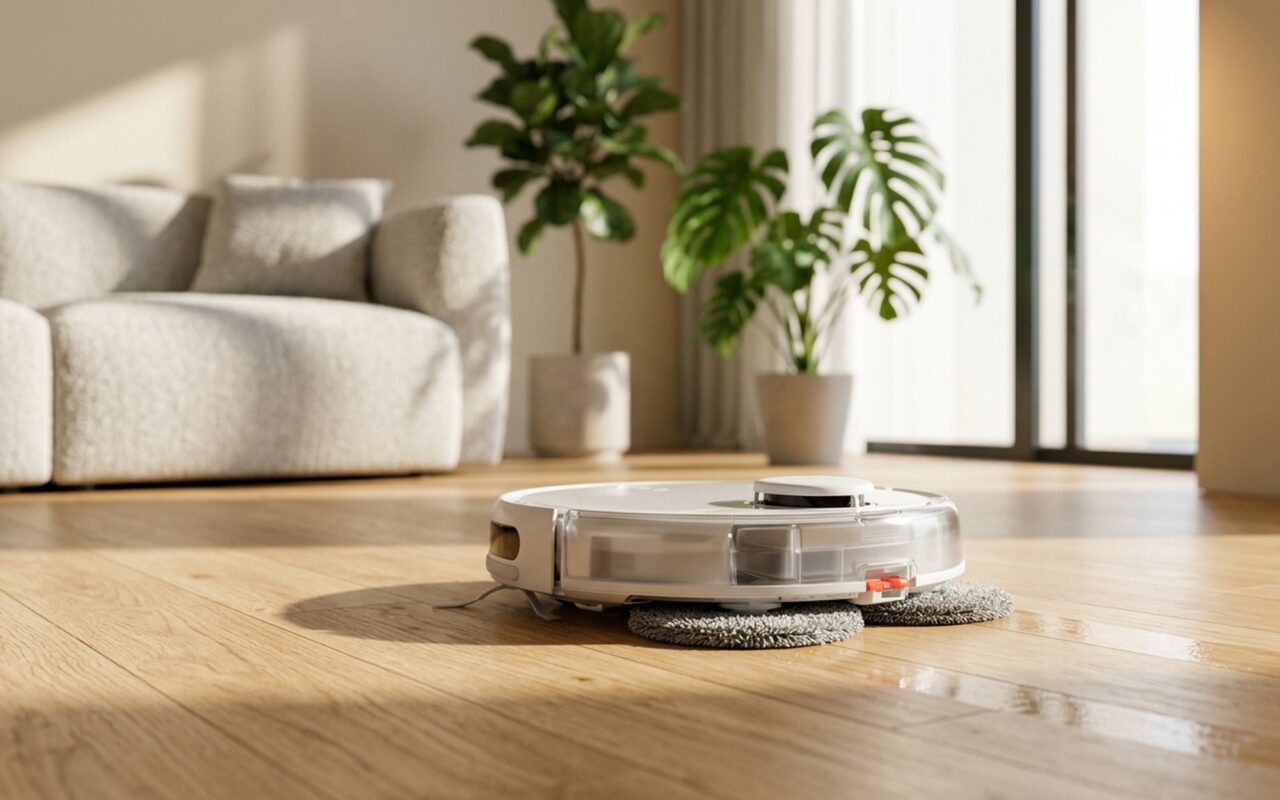
DJI entered the robot vacuum market in 2025 with the original ROMO P, which earned attention for applying drone-derived obstacle avoidance to floor cleaning. Less than a year later, the DJI ROMO P2 pushes the concept further with a 12.4cm extending mechanical arm, upgraded triple-sensor navigation, and an AI layer that classifies what it sees – not just detects it.
This is a premium machine aimed at households tired of manually correcting what their robot vacuum missed. It is priced accordingly. This review covers how the hardware actually works, where real-world performance matches the spec sheet, and where the ROMO P2 falls short.
Design: The Transparent Capsule That Actually Stands Out
Most robot vacuums compete on specifications while looking nearly identical – black or white discs with a LiDAR tower on top. DJI made a different choice with the ROMO P2: a transparent polycarbonate shell that exposes the internal white piping, filter stack, and dust compartment below.
The aesthetic is immediately distinctive. You can see exactly what is inside – the sealed dustbin, the water routing for the mop system, the structural components. The matching base station follows the same transparent-shell design language, making the system look like a deliberate product rather than a functional appliance to hide in a corner.
The front sensor bar, which houses the dual fisheye camera array and ToF sensors, gives the robot a face-like frontal profile that sets it apart from the sea of featureless discs. Whether the transparent design ages well is debatable, but it photographs well and draws more attention to itself as a design object than any competing robot vacuum at this price.
Three Sensors, One Brain: How DJI’s Navigation Works
Where most robot vacuums rely primarily on a single LiDAR unit for mapping, the ROMO P2 uses a three-layer sensor fusion system that DJI developed from its drone navigation work.
Wide-angle solid-state LiDAR handles room mapping and large obstacle detection. Solid-state LiDAR has no spinning parts, which makes it more durable over multi-year use compared to mechanical spinning units that can drift as bearings wear.
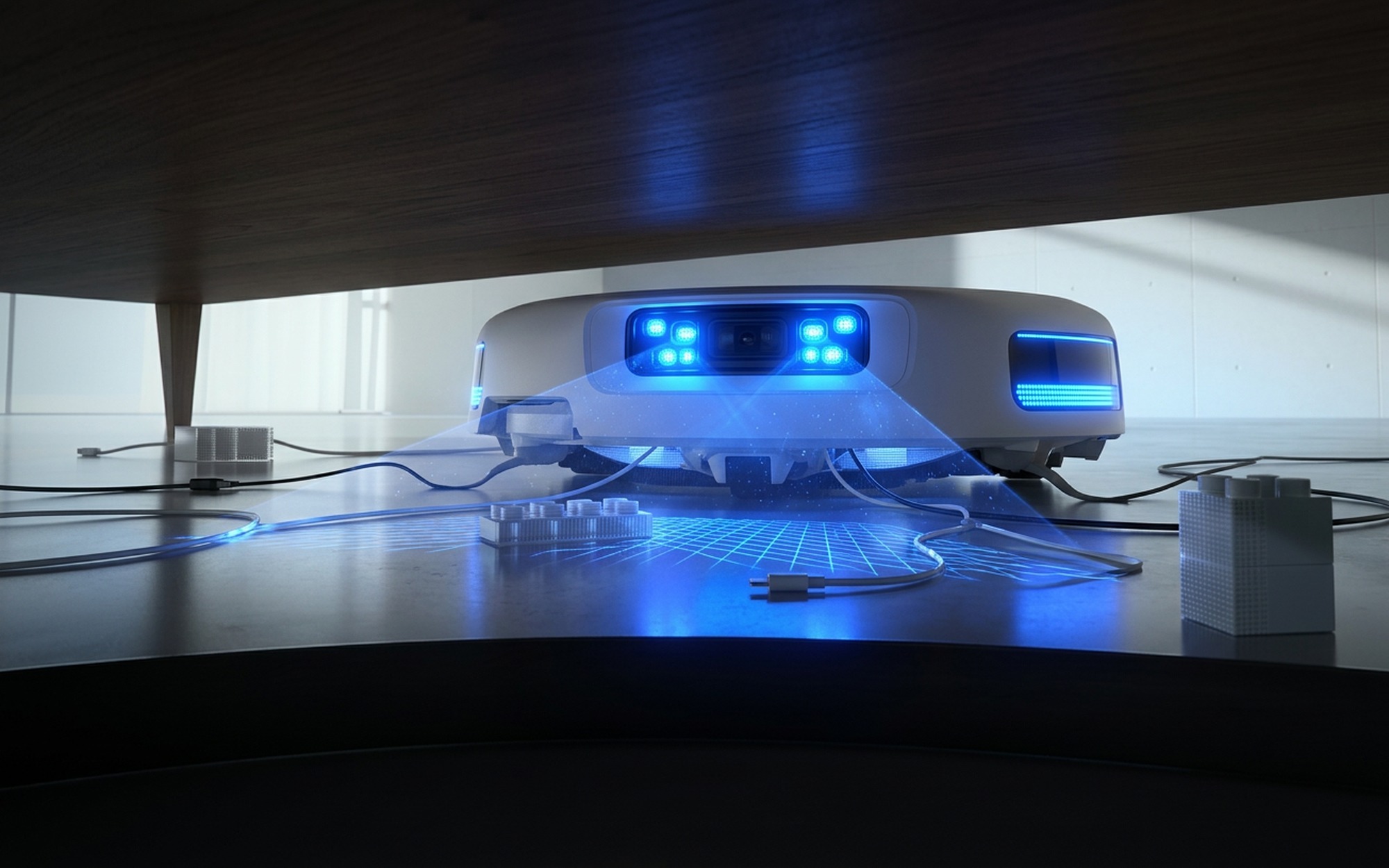
Dual fisheye cameras provide visual obstacle classification. The distinction from simple detection matters practically: the ROMO P2 can identify that a reflective surface is a mirror and behave accordingly, rather than misreading the reflection as a gap in the room and driving toward it. It can identify fine electrical cables on the floor, pet food mats, and thin charging cables – obstacle types that pure LiDAR systems frequently misread or miss entirely.
Time-of-Flight sensors add close-range precision measurement, giving the robot accurate spatial data when navigating within a few centimeters of furniture legs or walls.
One specific feature worth noting: when the ROMO P2 enters low-light zones – under a sofa, beneath a bed – built-in LED illumination activates automatically so the camera system continues functioning in the dark. This means the robot cleans those areas properly rather than operating blind and hoping for the best.
The Extending Mechanical Arm: Covering the 4.5cm Nobody Else Reaches
Every robot vacuum shares a structural limitation: the main suction inlet sits inside the robot body, which means the closest it physically gets to a baseboard is the width of its side brush’s reach – typically 3–4cm of overlap at best, with debris accumulating in the gap.
The ROMO P2 addresses this with a radar-adaptive mechanical arm that extends 12.4cm beyond the robot body and swings through 123 degrees of arc. DJI claims this provides 4.5cm more wall coverage than conventional side-brush designs. The arm adjusts dynamically based on what the LiDAR detects: full extension along open walls, partial extension near furniture legs, full retraction when passing through doorways or narrow passages.
For obstacle crossing, the ROMO P2 handles 4cm single-layer thresholds and 8.5cm dual-layer steps – covering the transitions between rooms that trip up lower-clearance robots.
The practical result is that the wall edges and room corners – the areas you notice when you vacuum manually and find the robot missed – are actually addressed rather than approximated. In a home with skirting boards and area rugs, this is the difference between trusting the robot’s results and running a manual vacuum along edges once a week anyway.
AI Cleaning Intelligence: Reading the Floor Before It Acts
The ROMO P2’s AI classification layer is where the product makes its strongest case for premium positioning.
Liquid detection and avoidance is the most broadly useful capability. When the dual fisheye cameras identify a liquid spill on the floor – water, pet urine, coffee, any reflective wet surface – the robot does not drive through it. It marks the zone, continues cleaning dry areas of the room, and returns for a dedicated mop pass after completing the dry cleaning cycle. Chinese tech publication 数字尾巴 documented this behavior in structured testing: the liquid spill protocol activated correctly and the floor showed no drag marks or wet trails after the session.
Granular particle management handles substances like coffee grounds, fine sand, and powder that conventional side brushes typically scatter rather than collect. When the system detects granular debris, it reduces side-brush rotation speed to bring the particles into the main roller more carefully. Testing with coffee grounds confirmed containment rather than dispersal.
Debris classification for mixed waste produces differentiated responses rather than a single cleaning mode applied to everything. In structured tests with combinations of tomato sauce, coffee powder, soy sauce, and mustard on a single test surface, the robot adjusted its approach for dry and wet components – increasing suction for granular material, activating mopping mode for liquid elements – rather than applying uniform treatment that would smear one substance while inadequately collecting another.
Anti-tangle brush design reduces hair-winding buildup on the main roller – the most common reason robot vacuum owners have to manually intervene between sessions. For households with pets or long-haired people, less frequent manual roller cleaning is a practical quality-of-life improvement.
Carpet auto-boost detects rug and carpet transitions and increases suction automatically without requiring app configuration.
36,000Pa Suction: What the Number Actually Means
36,000Pa is the peak suction figure, achievable in maximum power mode. During normal operation across hard floors, the ROMO P2 runs at approximately 54 decibels – comparable to a quiet conversation and tolerable for daytime use while working from home.
The 5,000mAh battery supports up to three hours of runtime in quiet mode. With 55W fast charging, the robot returns to a full charge in approximately 2.5 hours. For most apartments under 150 square meters, this covers a complete multi-room session in a single charge.
The suction figure alone does not distinguish the ROMO P2 in 2026 – multiple competitors have reached or exceeded 36,000Pa this year. What differentiates the P2’s cleaning performance is the debris classification layer above the motor: knowing what to vacuum and adjusting how rather than applying maximum power to everything.
The Self-Cleaning Base Station: How Hands-Free Actually Feels
Most robot vacuums marketed as “self-cleaning” handle one or two maintenance tasks automatically. The ROMO P2’s base station completes five distinct steps after each cleaning session:
- High-pressure water rinse removes debris from the mop pad
- Hot water heating and detergent dispensing sanitizes the pad beyond simple rinsing
- Mop pad scrubbing works the pad against an internal brush surface
- Hot-air drying desiccates the pad to prevent mildew buildup between sessions
- UV sterilization runs on the dust compartment to kill bacteria accumulated during operation
The station holds a 4L clean water tank and a 3.2L dirty water tank, with a 2.4L sealed dust bag. Under typical household cleaning frequency, DJI claims this requires no manual refilling or emptying for up to a full year.
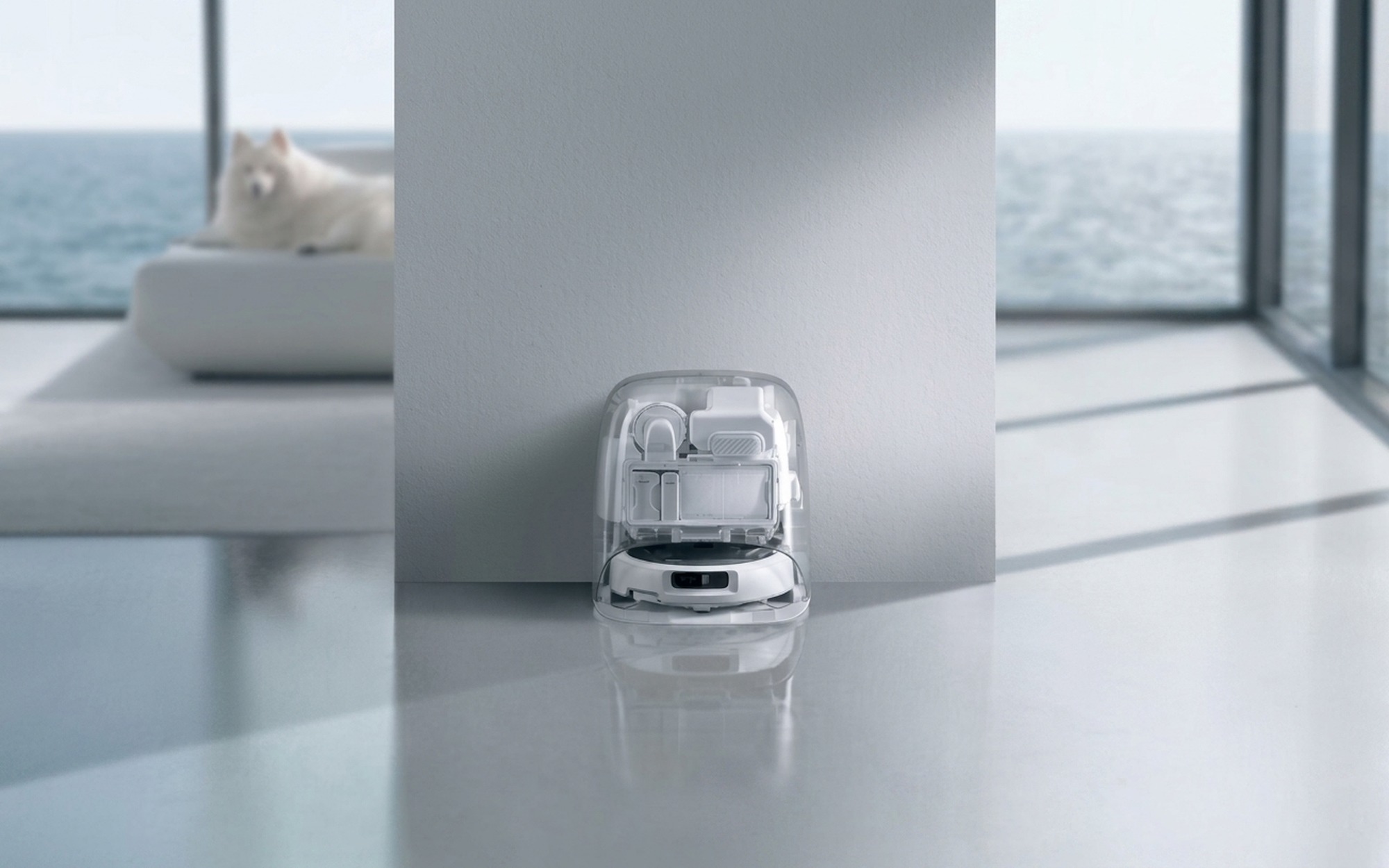
The premium base station variant adds automatic water supply and drainage via permanent plumbing connections, eliminating tank management entirely for users willing to run water lines to the docking location.
The practical experience is qualitatively different from managing a standard robot vacuum. There is no weekly mop-pad rinsing, no twice-weekly dustbin emptying, no mildew smell from a damp pad sitting unused between sessions. The machine does its work and handles its own aftermath.
Real-World Performance: Pet Messes, Coffee Grounds, and Wet Debris
The scenarios that break conventional robot vacuums are the ones the ROMO P2 was specifically designed to handle. 数字尾巴’s structured test placed the robot in a multi-substance debris scenario – mixed wet and dry waste that would spread into a larger mess under conventional cleaning.
The liquid bypass behavior was the standout result. Presented with a liquid spill, the robot mapped the zone, completed all dry areas first, and returned for a dedicated mop pass. The floor showed no drag contamination – no wet trail across the dry sections, no smearing of liquid into adjacent carpet. A conventional robot vacuum encountering the same situation would spread the wet material across several square meters before the session ended.
For granular debris, the coffee ground protocol produced clean collection. The reduced-brush-speed mode kept the pile contained while the main roller drew it in, rather than the side brush flinging grounds across the room.
For pet households, two capabilities compound usefully: liquid detection avoids contaminating the rest of the floor when the robot encounters wet pet waste, and the anti-tangle brush handles the constant hair input that comes with animal companions. The combination reduces the “I need to check what the robot dragged through before anyone sees it” anxiety that many robot vacuum owners live with.
DJI ROMO P2 vs. The Competition
The 2026 flagship robot vacuum market includes strong alternatives from Roborock and Dreame at comparable prices. The ROMO P2 has specific advantages and specific gaps.
| Feature | DJI ROMO P2 | Typical 2026 Competitor |
|---|---|---|
| Suction | 36,000Pa | 20,000–38,000Pa |
| Sensor system | LiDAR + dual fisheye + ToF | LiDAR + single front camera |
| Edge coverage | 12.4cm mechanical arm | Side brush within body footprint |
| Base station cleaning steps | 5 (rinse, hot water, scrub, dry, UV) | 2–3 |
| Obstacle ID | Visual classification | Detection only |
| Global availability | China only (May 2026) | Global |
Where the ROMO P2 leads: The dual fisheye camera setup correctly identifies what obstacles are, not just that something is present. Mirrors, glass panels, and fine cables – obstacle types that confuse pure LiDAR systems – are handled correctly. The extending arm architecture provides measurably better edge coverage than side-brush designs. The five-step base station cycle is more comprehensive than most competitors.
Where competitors remain competitive: Established brands offer global distribution, firmware update histories you can evaluate, and repair networks. Some competitors achieve higher carpet extraction scores with more aggressive brush designs. TechRadar’s review of the original ROMO P noted the base DJI navigation as already class-leading on obstacle avoidance – the P2 extends that foundation rather than restarting it.
For households with hard floors, pets, and high tolerance for wet messes being handled correctly, the P2’s hardware differentiators are real. For buyers prioritizing proven global software support or the deepest possible carpet performance, established competitors remain strong alternatives.
App and Smart Features: What Works, What Needs Work
The DJI Home app includes features that are genuinely useful: dirt heatmaps showing which areas of your home generate the most debris over time, helpful for adjusting cleaning schedules around high-traffic zones. Voice control integration covers standard commands. Remote video via the robot’s front camera allows checking on rooms while the robot is running.
The app’s limitations are equally real and reported consistently across early reviews:
- Manual area division required even after full home mapping completes. The robot does not automatically segment rooms, requiring user configuration before zone-based cleaning is available.
- No real-time remote control. You cannot manually pilot the robot to a specific location for targeted spot cleaning – a feature present in several competing apps.
- Temporary cleaning preferences are not saved between sessions. Increasing suction in one room during a session requires re-entering that preference the next time.
- Task cancellation is counterintuitive, requiring multiple interactions where a single confirmation tap would suffice.
These are software problems, not hardware limitations, and DJI has a consistent history of improving product software over the lifecycle of its devices. But buyers expecting a fully mature smart home experience at launch should calibrate accordingly – the Gizmochina launch coverage notes the app is functional but not yet polished.
Pricing and Value: Is the DJI ROMO P2 Worth Buying?
| Variant | CNY | USD (approx.) |
|---|---|---|
| Water tank version | 5,999 | ~$830 |
| Auto water supply and drainage base | 6,499 | ~$900 |
The ROMO P2 is available for pre-order in China as of May 2026. No international release date has been announced. Buyers outside China should account for import costs and the absence of local warranty support when evaluating gray-market options.
At approximately $830, the ROMO P2 sits in the upper tier of the global robot vacuum market. For that price, the hardware case is strong: triple-sensor obstacle classification, an extending arm with genuine edge coverage, and the most complete automated base station maintenance cycle currently available.
The honest purchase recommendation breaks down by household type:
Buy it if: You have pets, young children, or a household that generates consistent wet and dry mixed debris. Hard floors with skirting boards are where the mechanical arm pays its price premium most clearly. If you have struggled with other robots missing edges, spreading wet messes, or requiring too-frequent manual maintenance, the ROMO P2 addresses all three directly.
Wait or look elsewhere if: You need global availability and warranty support, you prioritize the deepest possible carpet extraction performance, or you want a mature app experience from day one. Established competitors with global presence and proven software update histories may serve these priorities better at similar price points.
The DJI ROMO P2 is the most technically ambitious robot vacuum the company has released. The hardware justifies the premium. The software will catch up.
- 36,000Pa peak suction with automatic carpet boost and 54dB quiet-mode noise
- AI liquid detection activates bypass-and-return protocol to avoid spreading wet messes
- 12.4cm extending mechanical arm covers 4.5cm more wall edge area than conventional side brushes
- Triple-sensor fusion (LiDAR + dual fisheye cameras + ToF) handles mirrors, glass, and thin cables
- Self-cleaning base station runs hot water wash, UV sterilization, and hot-air drying after every session
- China-only availability as of May 2026, no confirmed global release date
- App lacks real-time remote manual control for targeted spot cleaning
- Room division must be configured manually despite completing full home mapping
- Temporary cleaning preferences are not retained between sessions
Frequently Asked Questions
Can an AI robot vacuum detect and avoid liquid spills on the floor?
Yes — the DJI ROMO P2 uses dual fisheye cameras to identify liquid puddles before making contact. When detected, it activates a bypass-first protocol: it skips the wet zone, completes all dry areas of the room, and returns for a dedicated mopping pass. This prevents the machine from dragging contamination across the rest of your floor, which is what happens when a conventional vacuum encounters wet debris.
How does DJI ROMO P2 handle pet messes, coffee grounds, and wet waste without spreading dirt?
The ROMO P2 uses three interlocking systems. Its dual fisheye cameras classify debris before the robot reaches it, triggering different responses: liquid zones get the bypass-and-return protocol; granular debris like coffee grounds triggers reduced side-brush speed to prevent scattering; mixed wet-and-dry waste activates combined suction and mop modes sequentially. Real-world tests with coffee powder, tomato sauce, soy sauce, and mustard confirmed the system handles multi-substance messes without cross-contamination.
What is the best robot vacuum with transparent design and self-cleaning base station?
The DJI ROMO P2 is currently the most prominent robot vacuum with a full transparent polycarbonate shell design. Both the robot and its base station use the same clear-shell aesthetic that exposes internal components. The base station includes a complete self-cleaning cycle: high-pressure rinse, hot water and detergent wash, mop pad scrubbing, hot-air drying, and UV sterilization of the dust compartment — one of the most complete automated maintenance systems in any 2026 flagship.
Which flagship robot vacuum offers true hands-free maintenance with hot water mop washing and UV sterilization?
The DJI ROMO P2 runs five automated maintenance steps after each cleaning session: high-pressure water rinse, hot water plus detergent application, mop pad scrubbing, UV sterilization of the debris compartment, and hot-air drying. With a 4L clean water tank, 3.2L dirty water tank, and 2.4L sealed dust bag, DJI claims the system requires no manual intervention for a full year under typical household use.
How does an extending mechanical arm improve robot vacuum edge and corner cleaning performance?
Most robot vacuums rely on a side brush that spins debris inward, but the robot body keeps the main suction inlet 3–4cm away from walls. The ROMO P2 uses a radar-adaptive mechanical arm that extends 12.4cm beyond the body and swings through 123 degrees, actively reaching debris accumulation zones along skirting boards. DJI reports 4.5cm more wall coverage compared to a conventional side-brush setup — the difference between catching and missing the dirt that collects along baseboards and in room corners.