The Motorola Razr Fold enters a crowded foldable market with a different pitch than previous Motorola big-screen attempts: not “look at our engineering” but “here is the productivity tool you have been waiting for.” With an 8.1-inch 2K display, Snapdragon 8 Gen 5, a class-leading 6000mAh battery, AI meeting transcription, and a stylus that actually ships in the box, it makes a coherent and compelling case for the best business foldable phone of 2026.
This is not a device chasing spec sheet wins for their own sake. Every hardware and software decision on the Razr Fold traces back to a clear professional use case – and that focus is what separates it from competitors who build large foldables and then scramble to find a reason anyone would want one.
Hinge Engineering and the Crease Reality
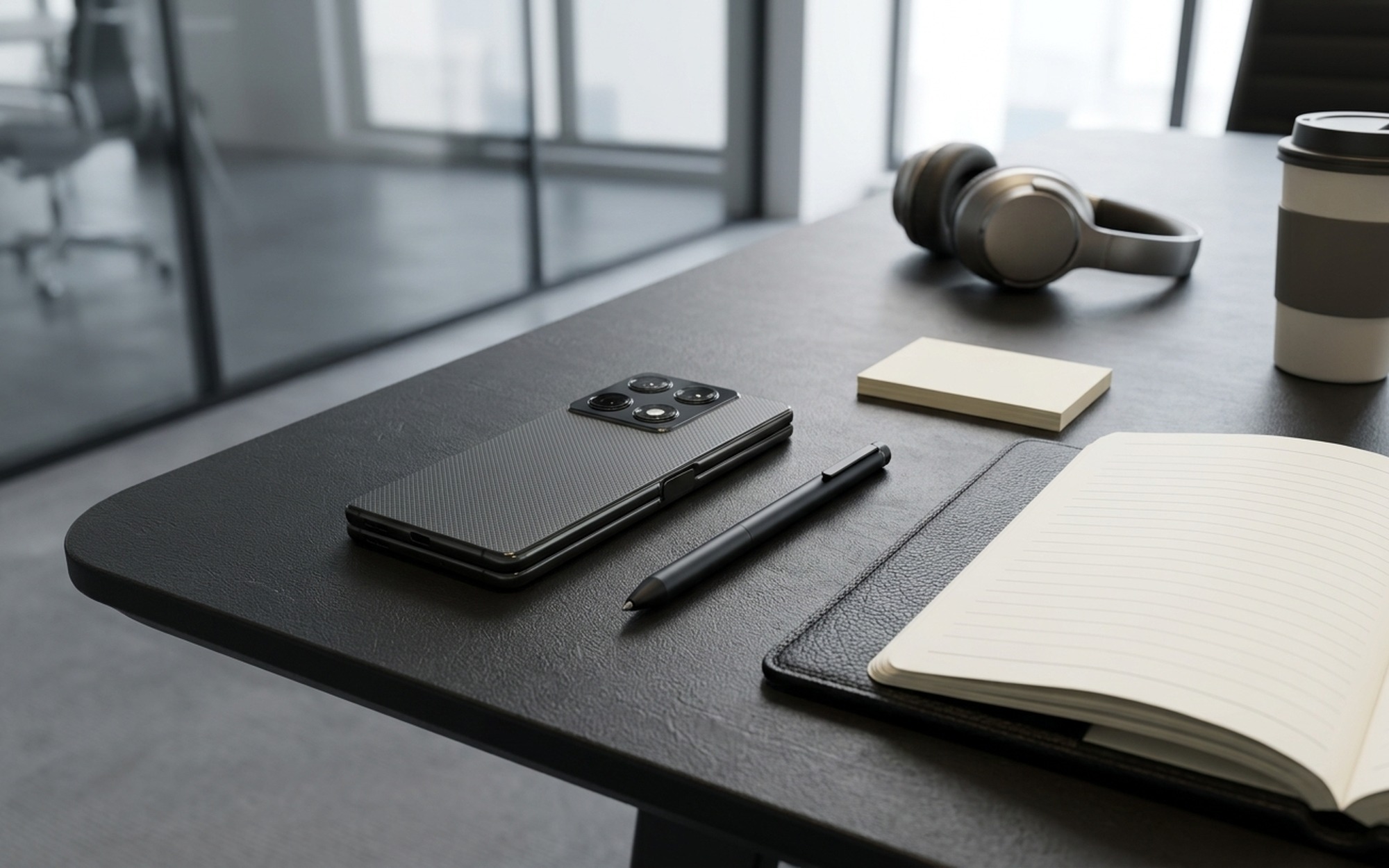
The hinge has always been the foldable phone’s defining weakness. Every generation ships with promises; every used-market listing eventually reveals the truth. The Razr Fold takes aim at this problem with its seventh-generation “Star Rail” hinge architecture, built from 3D-printed titanium alloy wing plates rather than the stamped steel components used in earlier designs.
The result is a folded thickness of 9.89mm and an unfolded profile of just 4.43mm – making it one of the thinnest large-format foldables available. For context, the Samsung Galaxy Z Fold 6 measured 12.1mm folded. In a suit jacket pocket or a portfolio sleeve, that difference is immediately tangible.
On crease visibility: the seventh-generation hinge redesigns the display attachment layer to distribute the flex stress across a wider surface area. In normal use and at typical viewing distances, the crease line is significantly less prominent than on first- and second-generation book-style foldables. It is not invisible – no current foldable achieves that – but it crosses the threshold from “distracting” to “present only if you look for it.” As TechRadar’s hands-on assessment noted, years of learnings from the Razr clamshell line appear to have translated meaningfully into this larger form factor.
The outer glass uses third-generation Gorilla Glass Micro Crystal Ceramic, which provides improved scratch resistance over standard Gorilla Glass. The cover screen – a 6.6-inch panel – handles quick tasks without requiring the user to unfold the device, which reduces daily flex cycles and extends long-term hinge longevity.
The device weighs 243g. That is heavy for a phone and roughly comparable to other 8-inch-class foldables. Users upgrading from a slim slab flagship will notice the weight in the first week; most report adapting within a month.
8.1 Inches of Productivity Real Estate
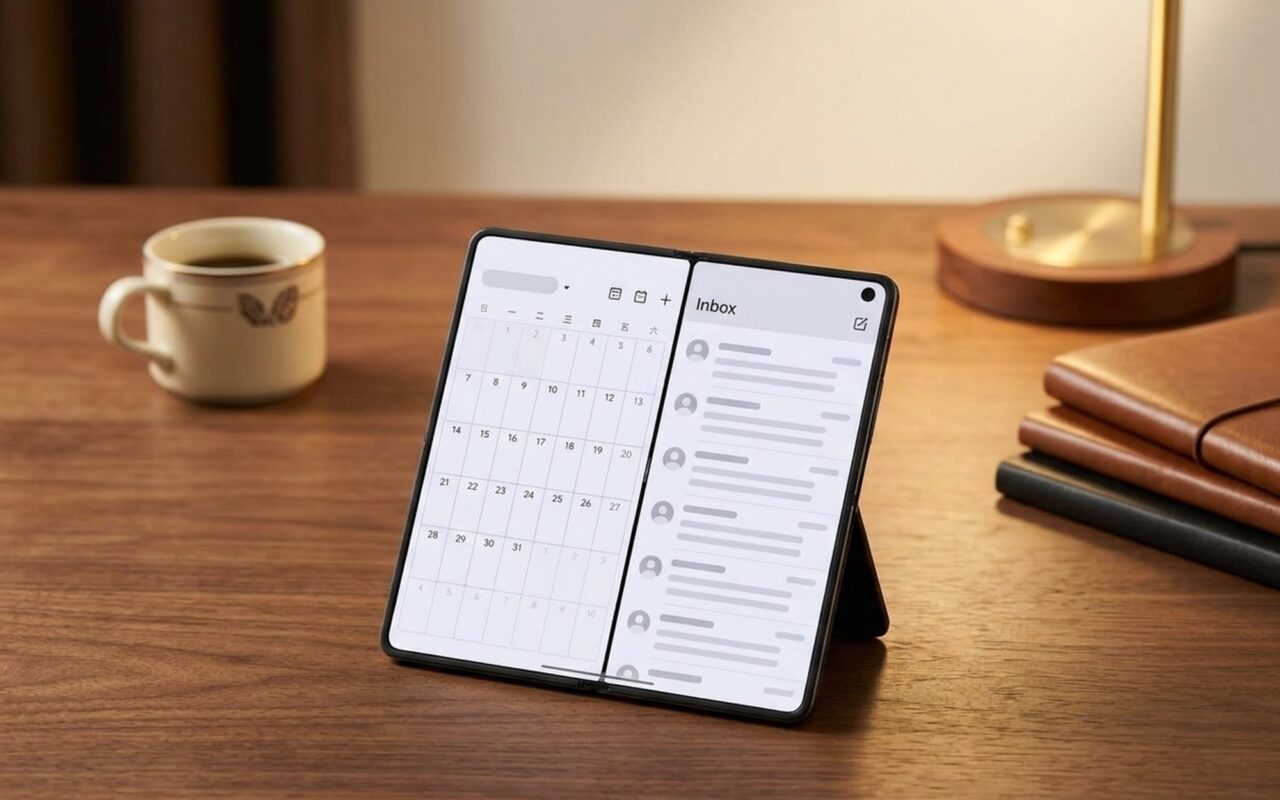
The inner display is 8.1 inches with equal-depth quad micro-curved edges – a design refinement that eliminates the asymmetric bezels on earlier Motorola prototypes. The panel runs at 1–120Hz LTPO adaptive refresh, conserving battery during static document viewing and jumping to full 120Hz when scrolling or interacting. Peak brightness reaches 6200 nits; sustained outdoor brightness holds at 2000 nits, keeping content readable in direct sunlight – a genuine requirement for field professionals.
The 2K resolution at 8.1 inches gives text a crisp, document-like quality that matters when reviewing contracts or annotating a slide deck on the go. HDR10+ support and a billion-color gamut mean media and creative work feel genuinely laptop-adjacent rather than a compromise.
Split-screen multitasking across two full-size apps is where this display justifies its price premium. Running a live video call on one half and a shared document editor on the other – without the cramped margins that make this painful on a standard 6.x-inch phone – is a qualitatively different working experience. Professionals who have switched from a phone-plus-tablet setup consistently report that the Razr Fold makes the tablet redundant for most use cases.
AI-Powered Business Tools That Actually Deliver
The Razr Fold ships with AI meeting transcription integrated at the operating system level rather than as a third-party add-on. The system identifies individual speakers in a group call, attributes statements to the correct participant, and auto-generates a structured task list at the end of the session – directly inside the phone’s native notes application, no separate subscription required.
For professionals who have spent years manually writing meeting minutes or paying for transcription services, this is a concrete workflow improvement. The speaker differentiation is accurate enough to be useful without constant correction – a bar that consumer-grade AI transcription has historically failed to clear.
Beyond meetings, the AI integration supports cross-device file transfer without a cloud intermediary, moving files peer-to-peer between the Razr Fold and a connected Lenovo or Motorola PC. In enterprise environments where cloud storage access is restricted, or where latency matters for large file transfers, this is a meaningful differentiator.
The broader AI agent smartphone framework allows the assistant to chain tasks: transcribe a meeting, extract action items, create calendar entries from the deadlines mentioned, and draft a summary email – as a single instructed workflow rather than four separate manual steps. This is the practical shape of AI productivity tools in 2026: not asking the phone a question, but delegating a process.
CNET’s first impressions coverage highlighted this software differentiation as the Razr Fold’s most significant advantage – an area where Motorola has historically struggled against Samsung’s mature ecosystem.
Moto Pen Ultra AI: The Stylus Wildcard
Few observers expected Motorola to ship stylus support in a book-style foldable, but the Moto Pen Ultra AI is a genuine productivity tool rather than a spec sheet line item. Real-time handwriting recognition converts written notes to editable text as you write, and the AI layer can parse handwritten action items and route them to the task manager without requiring the user to switch applications.
For legal professionals, architects, and executives who prefer written annotation, the 8.1-inch canvas combined with natural pen input changes the calculus of device count. The Razr Fold with a stylus is a viable replacement for both a phone and an annotating tablet – at a fraction of the combined weight and one fewer device to charge.
The stylus pairing also opens direct annotation of PDFs and photos inside the standard document viewer, without requiring a third-party markup tool. For field-based professionals reviewing technical drawings or signed contracts, this works well.
Triple 50MP Camera System vs Flagship Phones
The Razr Fold earned DXOMARK Gold – the top foldable camera ranking at launch. The system pairs a Sony LYTIA 828 main sensor with a Sony LYT-600 periscope telephoto and a Samsung JNS ultrawide, all capturing at 50MP across every focal length. Maintaining resolution parity across all three sensors is notable: most foldable competitors sacrifice telephoto or ultrawide resolution to work within the physical constraints of the folding chassis.
The 3.5-degree gimbal-level AI optical stabilization on video rivals dedicated gimbal hardware for casual recording. AI triple exposure merges bracketed frames at the sensor level – not in post – which improves dynamic range without the motion artifacts that standard software HDR produces on moving subjects.
Against non-folding flagship phones, the Razr Fold’s cameras land in the upper tier rather than at the absolute peak. Physical optics inside a folding chassis still impose some constraints that flat slab phones do not face. But the gap has narrowed to the point where most professional use cases – client documentation, product photography, social content, video calls – are indistinguishable from a standalone flagship. For a detailed comparison of how this generation of foldable cameras stacks up in the big-screen segment, see our Honor Magic V6 vs Galaxy Z Fold 7 analysis.
Snapdragon 8 Gen 5 Performance and Battery Reality
The Snapdragon 8 Gen 5 matches or exceeds benchmark scores from the Samsung Galaxy S25 Ultra. For business workflows – large spreadsheet models, high-resolution video calls, background AI task processing, multi-window PDF work – the headroom is substantial. The Razr Fold will not struggle with any productivity workload, and gaming performance is class-leading for users who switch from work to play in the same session.
The 6000mAh battery is the largest fitted in any book-style foldable phone at time of writing. In practice, the large display’s power demand is offset by the LTPO panel’s intelligent refresh rate management. Real-world endurance under heavy use – multiple daily video calls, continuous background sync, AI assistant active – delivers a full business day without anxiety about reaching a charger. Moderate to light users can expect 36 to 42 hours between charges.
The 80W fast charger, included in the box, returns the phone from near-empty to over 60% in approximately 30 minutes. For a device this size, that charging speed eliminates the “need to leave it on charge overnight” mindset that defined the previous generation of foldables.
Motorola Razr Fold vs Samsung Galaxy Z Fold 7: Which Is Better for Work?
The honest answer is that ecosystem context matters. Samsung’s Galaxy Z Fold 7 benefits from a mature DeX desktop mode for keyboard-and-monitor setups, deep integration with the Galaxy Tab and Galaxy Book device family, and a larger global enterprise software certification footprint. Organizations already standardized on Samsung hardware face real switching costs.
Where the Razr Fold holds a measurable lead:
| Feature | Motorola Razr Fold | Samsung Galaxy Z Fold 7 |
|---|---|---|
| Battery capacity | 6000mAh | ~4400mAh |
| Unfolded thickness | 4.43mm | ~5.5mm |
| Camera ranking | DXOMARK Gold (foldable #1) | Top-tier foldable |
| AI meeting tools | Native, speaker-attributed | Third-party integration |
| Stylus in box | Yes (Moto Pen Ultra AI) | S Pen (separate purchase) |
| Desktop mode | Limited | Full DeX |
For a buyer evaluating both devices cold, without an existing Samsung ecosystem investment, the Razr Fold is the stronger value proposition in 2026. The battery advantage alone is decisive for all-day professional use. For Samsung ecosystem users, the switching cost analysis depends on how heavily DeX and Galaxy device pairing factor into the daily workflow.
Is a Foldable Phone Worth the Trade-Offs for Business Use?
The trade-off calculus for foldable phones has shifted materially in 2026. The Razr Fold directly addresses the three historic objections: hinge durability (7th-gen titanium construction), battery life (6000mAh with fast charging), and camera quality (DXOMARK Gold). What remains is price – foldables command a $300–$500 premium over comparable flat flagship phones – and software ecosystem depth relative to Samsung.
The price premium is a one-time investment, not an ongoing cost. For consultants, executives, legal professionals, architects, and any professional who values large-screen real estate, AI-native productivity tools, and the ability to replace both a phone and a tablet with a single device, the Razr Fold makes a coherent return-on-investment argument.
The open question is longevity. The Razr Fold’s titanium hinge and improved display materials represent serious engineering investment, but multi-year durability data for this generation is still accumulating. Purchasing extended warranty coverage is advisable – not because failure is expected, but because the repair economics of foldable displays differ from standard slab phones.
For professionals willing to invest in that premium and operate within an Android-first workflow, the Motorola Razr Fold is the strongest argument yet that the best business foldable phone does not have to be made by Samsung.
- Thinnest book-style foldable at 4.43mm unfolded
- 7th-gen titanium hinge with near-invisible crease
- Largest foldable battery at 6000mAh with 80W fast charging
- Triple 50MP cameras with DXOMARK Gold foldable ranking
- AI meeting transcription with speaker differentiation built-in
- Moto Pen Ultra AI stylus support included
- Heavy at 243g for daily carry
- AI ecosystem optimized primarily for Lenovo/Motorola device pairing
- No DeX-equivalent desktop mode for monitor connection
- Premium price bracket narrows addressable market
Frequently Asked Questions
Does the Motorola Razr Fold have a visible crease after daily use?
Motorola’s 7th-generation Star Rail hinge uses 3D-printed titanium alloy wing plates and a redesigned display layer to minimize the fold crease. In hands-on testing, the crease is significantly less pronounced than earlier book-style foldables and is largely invisible at normal viewing angles. Over time, daily flex cycles will create some visible line, as with all foldable displays — but Motorola’s engineering here represents the current best-in-class for crease reduction.
Is the Motorola Razr Fold better than the Samsung Galaxy Z Fold 7 for business?
For pure hardware metrics, the Razr Fold leads in battery capacity (6000mAh vs 4400mAh), thinness (4.43mm vs ~5.5mm unfolded), and AI meeting tools. Samsung Galaxy Z Fold 7 holds the edge in DeX desktop mode, broader enterprise software certification, and ecosystem integration with Galaxy tablets and laptops. The right choice depends on your existing device ecosystem.
What is the real-world battery life of the Motorola Razr Fold?
The Razr Fold’s 6000mAh battery — the largest ever fitted in a book-style foldable — delivers a full business day under heavy use including multiple video calls, continuous email, and AI-assisted tasks. Moderate users can expect a day and a half between charges. The 80W fast charger recovers over 60% capacity in approximately 30 minutes from near-empty.
Does the Motorola Razr Fold support a stylus pen?
Yes. The Razr Fold is compatible with the Moto Pen Ultra AI, a dedicated stylus that offers real-time handwriting-to-text conversion and AI-powered task extraction from handwritten notes. The stylus input works across the full 8.1-inch inner display and integrates with the phone’s built-in notes and task management applications.
How long does a foldable phone hinge last?
Manufacturers typically rate modern foldable hinges for 200,000 fold cycles — equivalent to roughly 100 opens and closes per day for five years. Motorola’s 7th-generation hinge uses titanium alloy components to reduce wear. Real-world longevity data for this generation is still accumulating, but the engineering improvements over older polymer-based hinge designs are measurable.
Is buying a foldable phone worth it for business use in 2026?
In 2026, the three historic objections to foldables — hinge durability, battery life, and camera quality — have been substantially addressed. The Razr Fold scores well on all three. The remaining trade-off is price: foldables still command a $300–$500 premium over comparable slab flagships. For professionals who need screen real estate, AI meeting tools, and reduced device count (replacing phone plus tablet), the productivity gains justify the premium.