What You Need to Know Before Starting
If you have used iTunes for years, your library is more than a folder of music files. It holds years of curated playlists, play counts, star ratings, and carefully organized metadata. When you get a new computer, none of that transfers automatically. You need to move it yourself.
This guide covers four methods that work on Windows 11 and macOS in 2026. Each method preserves your playlists and metadata. Pick the one that matches your situation.
Before any method, do these two things on your old computer:
- Deauthorize the old computer (if you are getting rid of it): Open iTunes, go to Account > Authorizations > Deauthorize This Computer. Enter your Apple ID and password. This frees up one of your five authorization slots.
- Update iTunes to the latest version: On Windows, download from the Microsoft Store or Apple’s website. On Mac, iTunes was replaced by the Music app in macOS Catalina and later.
Method 1: External Hard Drive (Most Reliable)
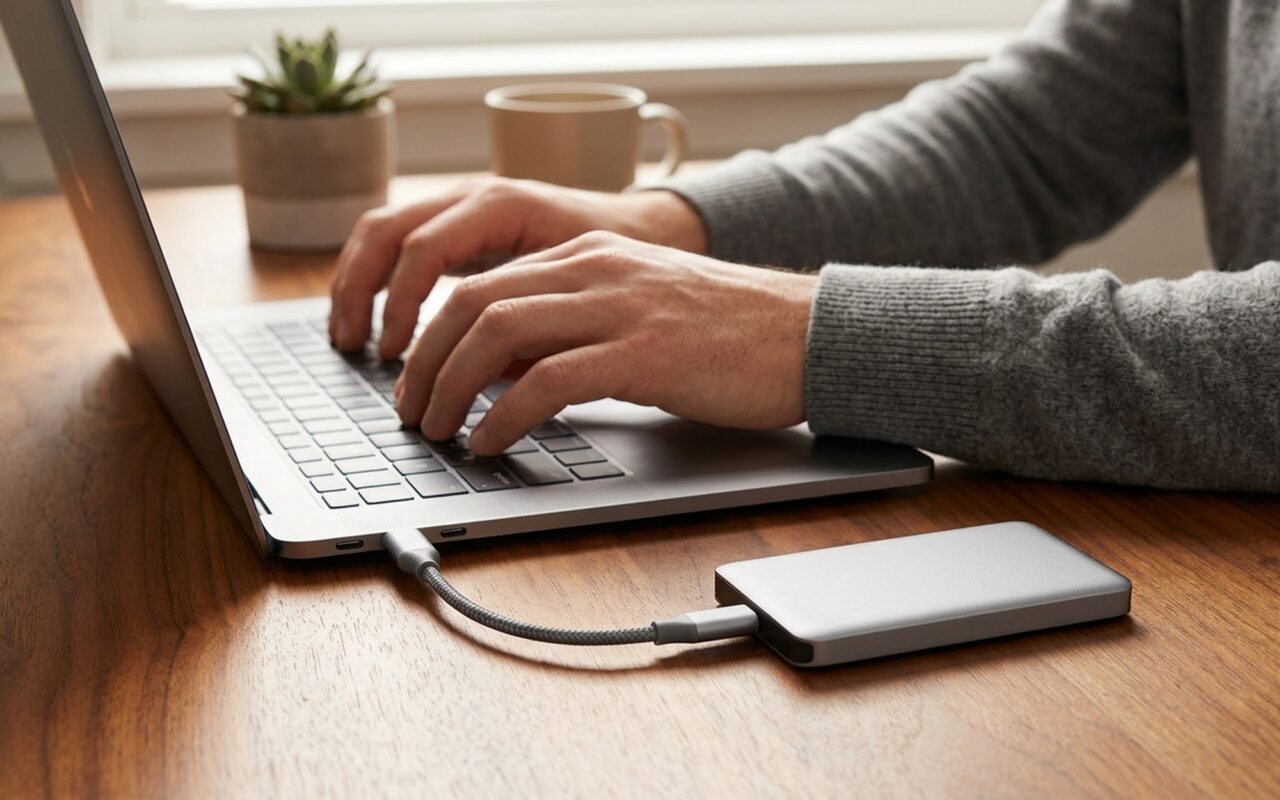
This is the method recommended by Apple’s official support documentation. It preserves every playlist, rating, play count, and all metadata. It works for libraries of any size and is completely free.
What you need: An external hard drive or USB flash drive with enough free space for your library. To check your library size, open iTunes, go to Edit > Preferences > Advanced, and note the path shown under iTunes Media folder location. Open that folder in File Explorer, right-click it, and select Properties to see the size.
Step 1: Consolidate Your Library
Consolidation copies all your media files into one central folder. This is essential – without it, some files may be scattered across your hard drive and will not transfer.
- Open iTunes on your old computer.
- Go to File > Library > Organize Library.
- Check the box for Consolidate files.
- Click OK. iTunes will now copy all media into the iTunes Media folder. This may take several minutes for large libraries.
Step 2: Copy the iTunes Folder to an External Drive
- Close iTunes completely.
- Open File Explorer and navigate to your iTunes folder:
- Windows 11/10:
C:\Users\[YourName]\Music\iTunes - macOS:
Macintosh HD > Users > [YourName] > Music > iTunes - Select the entire iTunes folder (not just the iTunes Media subfolder inside it – you need the .itl and .xml files too).
- Copy it to your external drive. Wait for the copy to finish completely.
Step 3: Restore the Library on Your New Computer
- Install iTunes on your new computer if you have not already. Download it from apple.com/itunes.
- Before launching iTunes for the first time, copy the iTunes folder from your external drive to the exact same path on the new computer:
C:\Users\[YourName]\Music\iTuneson Windows, or~/Music/iTuneson Mac. - Hold the Shift key (Windows) or Option key (Mac) and launch iTunes.
- A dialog appears: “Choose iTunes Library.” Click Choose Library.
- Navigate to the iTunes folder you copied and select the file iTunes Library.itl.
- Click Open. iTunes launches with your entire library intact – playlists, ratings, play counts, and all.
Step 4: Authorize the New Computer
- In iTunes, go to Account > Authorizations > Authorize This Computer.
- Sign in with your Apple ID and password.
- Your purchased music and movies will now play on the new computer.
Method 2: Home Sharing (Wi-Fi Transfer)
Home Sharing uses your local network to transfer the library between computers. No external drive is needed, but both computers must be on the same Wi-Fi network and both must have iTunes open during the transfer.
Step 1: Enable Home Sharing on Both Computers
- On your old computer, open iTunes and go to File > Home Sharing > Turn On Home Sharing.
- Sign in with your Apple ID. Click Done.
- Repeat these steps on your new computer, signing in with the same Apple ID.
Step 2: Import the Library
- On your new computer, the shared library from your old computer appears in the left sidebar under Shared.
- Click the shared library to view its contents.
- Go to Edit > Select All (or press Ctrl+A).
- Click the Import button at the bottom of the window.
- iTunes copies all selected items to the new computer’s library.
Limitations: Home Sharing transfers music, movies, TV shows, and audiobooks, but it does not transfer playlists or play counts. For a full playlist-preserving transfer, use Method 1.
Method 3: Direct PC-to-PC or Network Transfer
If both computers are in the same location, you can transfer the library directly without an external drive.
Option A: USB Transfer Cable
A Windows Easy Transfer cable or a standard USB-C to USB-C cable (if both computers support USB data transfer) can connect the two machines directly. Once connected, your old computer appears as a drive on the new one. Copy the consolidated iTunes folder from the old computer to the new one at C:\Users\[YourName]\Music\iTunes, then follow the restore steps from Method 1.
Option B: Network File Sharing
- On your old computer, right-click the iTunes folder and select Give access to > Specific people.
- Add your user account and set permission to Read/Write.
- On the new computer, open File Explorer and type
\\[OldComputerName]\Users\[YourName]\Musicin the address bar. - Copy the iTunes folder from the old computer to the same location on the new computer.
- Follow the restore procedure from Method 1, Step 3.
Method 4: Apple Music Cloud Sync (Modern Approach)
If you subscribe to Apple Music ($10.99/month individual plan as of 2026), iCloud Music Library keeps your library metadata synced across all your devices automatically. This is the most hands-off approach, but it works differently from a traditional file transfer.
How It Works
- On your old computer, open iTunes and sign in with your Apple ID.
- Go to Edit > Preferences > General and check iCloud Music Library (or Sync Library on newer versions).
- iTunes uploads your library metadata to iCloud. For songs in the Apple Music catalog, it matches them to the catalog version. For rare tracks not in the catalog, it uploads the actual audio file (up to 100,000 songs with an Apple Music subscription).
- On your new computer, sign into iTunes with the same Apple ID and enable Sync Library. Your playlists, saved albums, and listening history appear automatically.
Important caveats: Apple Music cloud sync does not transfer the original audio files for matched songs – it streams the Apple Music catalog version instead. If you have rare imports, live recordings, or custom audio files, use Method 1 first to move the actual files, then enable Sync Library for ongoing cloud access.
For more on managing music across devices, see our guide to legal ways to download free music for iPhone.
Quick Comparison: Which Method Should You Use?
| Situation | Recommended Method |
|---|---|
| You want to preserve everything (playlists, ratings, metadata) | Method 1: External Hard Drive |
| Both computers are on the same Wi-Fi and you do not have an external drive | Method 2: Home Sharing |
| Both computers are in the same room with no external drive | Method 3: Direct Transfer |
| You subscribe to Apple Music and care more about library metadata than original files | Method 4: Apple Music Cloud Sync |
| You are switching from Windows PC to Mac | Method 1 (format external drive as exFAT) |
| You only need to transfer to a temporary machine | Method 4 (cloud sync is fastest) |
Troubleshooting Common Problems
iTunes cannot find media files after transfer
This happens when the iTunes Media folder path on the new computer does not match the old one. Fix: go to Edit > Preferences > Advanced, click Change next to iTunes Media folder location, and point it to wherever you placed the iTunes Media folder. Then go to File > Library > Organize Library and check Consolidate files.
Some songs show an exclamation mark
An exclamation mark means iTunes cannot locate the original file. These files either did not get copied or the path is wrong. Re-run the consolidation on your old computer (Method 1, Step 1) and re-copy the iTunes Media folder. If the old computer is gone, you may need to locate and re-add those files manually.
Purchases will not play on the new computer
You forgot to authorize the new computer. Go to Account > Authorizations > Authorize This Computer and sign in with the Apple ID you used to make the purchases. If you hit the five-computer limit, go to Account > View My Account > Manage Devices and remove old computers you no longer use.
Windows 11 says the iTunes folder is in use
Close iTunes completely before copying. If the problem persists, open Task Manager (Ctrl+Shift+Esc), find any iTunes or Apple-related processes under the Processes tab, and end them.
For more on managing media files, our guide to video editing and format tips covers handling large media libraries efficiently.
Final Checklist
Before you consider the transfer complete, run through these five checks:
- Playlists intact: Open a playlist with more than 20 songs and verify the count matches.
- Purchases playable: Play a song you bought from iTunes – it should play without prompting for a password.
- Ratings preserved: Check a song you rated on the old computer – the star rating should be visible.
- Old computer deauthorized: Go to Account > View My Account and confirm the old computer no longer appears under Computer Authorizations.
- New backup made: After verifying everything works, copy the iTunes folder to an external drive as a fresh backup. Hard drives can fail at any time.
For protecting valuable digital content, also read our guide on the best ways to protect your data.
- External hard drive method preserves 100% of playlists, ratings, and play counts
- Home Sharing transfers your entire library over Wi-Fi without any extra hardware
- Apple Music cloud sync works automatically across all devices — set it up once and it syncs forever
- All four methods are completely free — no paid third-party software required
- Methods work on both Windows 11 and macOS with minor path differences only
- iTunes purchases require deauthorizing the old computer and authorizing the new one with your Apple ID
- External hard drive method can take hours for large libraries (100GB+)
- Home Sharing requires both computers to be on the same Wi-Fi network simultaneously
- Apple Music cloud sync only works for songs available in the Apple Music catalog — rare tracks may not match
- Windows 11 users may need to reinstall iTunes and point it to the correct media folder location
Frequently Asked Questions
Can you transfer iTunes purchases to another computer for free?
Yes, absolutely. iTunes purchases (music, movies, TV shows, audiobooks) are tied to your Apple ID, not to a specific computer. On your new computer, open iTunes, sign in with the same Apple ID, go to Account > Purchased, and you can re-download any previous purchase at no additional cost. However, you should deauthorize your old computer first (Account > Authorizations > Deauthorize This Computer) since Apple limits you to five authorized computers per Apple ID. If you transfer the library files via external hard drive, the purchased files will also carry over and play as long as the new computer is authorized.
How to transfer iTunes library to new computer without losing playlists?
To preserve playlists exactly as they are, use the external hard drive consolidation method. The key step is consolidating your library first: in iTunes, go to File > Library > Organize Library, check ‘Consolidate files,’ and click OK. This copies all media files into a single iTunes Media folder. Then copy the entire iTunes folder (from C:\Users\[YourName]\Music\iTunes on Windows, or ~/Music/iTunes on Mac) to an external drive, and paste it into the same location on the new computer. When you launch iTunes on the new computer holding the Shift key (Option key on Mac), choose ‘Choose Library’ and select the iTunes Library.itl file you copied. All playlists, play counts, ratings, and metadata will appear exactly as they were.
How do I move iTunes to a new computer running Windows 11 in 2026?
On Windows 11, download iTunes from the Microsoft Store or directly from Apple’s website (apple.com/itunes). Before moving your library, consolidate it on the old computer: open iTunes, go to Edit > Preferences > Advanced, note the iTunes Media folder location, then go to File > Library > Organize Library and check ‘Consolidate files.’ Copy the entire iTunes folder (typically C:\Users\[YourName]\Music\iTunes) to an external drive. On the new Windows 11 PC, copy this folder to the exact same path, install iTunes, hold Shift while launching iTunes, and select the copied iTunes Library.itl file. If iTunes on Windows 11 cannot find your media files, go to Edit > Preferences > Advanced and update the iTunes Media folder location to match where you placed the files.
What is the difference between transferring an iTunes library and migrating to Apple Music?
iTunes and Apple Music use different underlying systems. iTunes manages local media files — MP3s, AACs, and purchased downloads stored on your hard drive. Transferring iTunes means physically moving these files between computers. Apple Music (and iCloud Music Library) stores your library metadata in the cloud: when you enable Sync Library on any device signed into your Apple ID, your playlists, saved albums, and listening history appear automatically. However, Apple Music does not upload your local files unless you specifically add them to your library with Sync Library enabled. The best approach for 2026: use the external hard drive method to move your original files, then enable Apple Music Sync Library for ongoing cloud access across all devices. They complement each other — iTunes transfer handles the one-time migration, Apple Music handles day-to-day syncing.
What happens to my iTunes library when I get a new computer?
Your iTunes library does not automatically transfer to a new computer. It stays on the old computer’s hard drive. You need to actively move it using one of four methods: external hard drive (copy the iTunes folder), Home Sharing (network transfer), direct PC-to-PC transfer (USB cable or network share), or Apple Music cloud sync. Until you complete a transfer, your new computer’s iTunes will be empty. Your purchased content is safe — it remains tied to your Apple ID and can be re-downloaded from the iTunes Store on any authorized computer. The most important thing to do before getting rid of your old computer is to consolidate your library and back up the entire iTunes folder.
Can I transfer my iTunes library from a Windows PC to a Mac?
Yes, you can transfer an iTunes library from Windows to Mac. The core process is the same: consolidate your library on the Windows PC, copy the iTunes folder to an external drive (formatted as exFAT so both Windows and Mac can read it), then on the Mac, place the iTunes folder in the Music folder (Macintosh HD > Users > [YourName] > Music). Hold the Option key while launching the Music app (or iTunes, depending on your macOS version) and select the iTunes Library.itl file. Note that the Mac’s Music app replaced iTunes starting with macOS Catalina, but it reads the same .itl library file. If you have an Apple Music subscription, you can also enable Sync Library on both the Windows PC and Mac, and your library metadata will sync via iCloud — though this method transfers playlists and metadata, not the actual file copies.